The biggest bottleneck in AI isn’t chips anymore. It’s construction. Nvidia has a plan to fix that.
For the past two years, the race to build AI infrastructure has produced a paradox: chip suppliers can barely keep pace with demand, yet hundreds of thousands of GPUs are sitting idle in warehouses because the data centers meant to house them won’t be ready for months. Traditional data center construction is a years-long undertaking — site selection, environmental permitting, concrete pours, electrical switchgear, cooling loops, fiber trenching, rack installation, cabling. The bottleneck isn’t silicon. It’s steel and time.
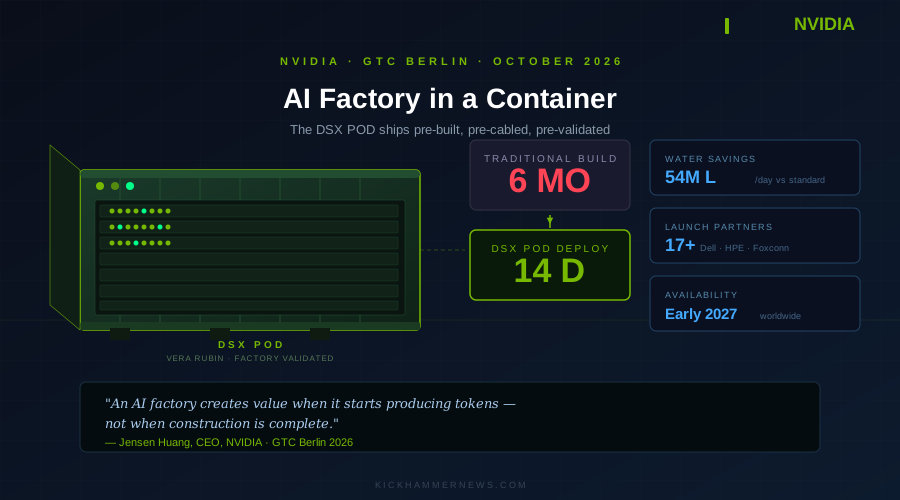
On October 21 at GTC Berlin, Jensen Huang put Nvidia’s answer on stage: the DSX POD, a reference design that fits a complete Vera Rubin AI factory inside a modular container and cuts onsite deployment from six months to as little as 14 days.
“An AI factory creates value when it starts producing tokens — not when construction is complete,” Huang said. The line was part product pitch, part rebuke of the industry’s habit of measuring progress in megawatts permitted rather than workloads running.
What the DSX POD Actually Is
The DSX POD is not a product Nvidia sells directly. It is a reference architecture — a blueprint specifying how computing, networking, power distribution, and liquid cooling should be integrated into prefabricated modular units built around Nvidia’s Vera Rubin platform (the successor to Blackwell). Nvidia hands the specification to its manufacturing partners, who build, cable, and validate the units in their factories before they leave the floor.
That last part is the engineering breakthrough. Under conventional construction, a data hall is built first, and racks are installed, cabled, and tested inside it — a sequential process that collapses under the slightest delay at any stage. The DSX POD inverts that sequence: the hard integration work happens in a controlled factory environment, in parallel with whatever site preparation is occurring at the destination. When the container arrives, local crews connect it to pre-staged power, cooling, and fiber. Commissioning begins almost immediately.
Nvidia describes the electrical interface as a standardized 800-volt direct-current input — a high-voltage DC architecture that reduces conversion losses and simplifies the power distribution path inside the unit. Liquid cooling is built in, with the design supporting dry-cooler configurations that Nvidia claims can save up to 54 million liters of water per day compared with evaporative cooling in a conventional data center. For hyperscale operators under water-use scrutiny from regulators and local governments — Google’s Finnish forest-clearing controversy is still fresh — that number carries weight.
The Partner Network
Nvidia is not building DSX POD units itself. The commercial ecosystem spans more than a dozen companies: Dell Technologies (developing a full Modular Data Center product with integration, testing, and lifecycle support), HPE (drawing on its existing AI Mod Pod systems), Foxconn’s Ingrasys, GIGABYTE, Lenovo, Quanta Cloud Technology, Wistron, Pegatron, Schneider Electric, Vertiv, Eaton, and Delta on the hardware and power side — plus Anduril, Armada, Crusoe, and DayOne as early deployment customers representing defense-tech, distributed compute, and purpose-built cloud markets.
The breadth of the list is deliberate. Nvidia wants multiple competing supply chains producing DSX POD units simultaneously, preventing any single integrator from becoming a bottleneck. Worldwide availability is targeted for early 2027.
Who Needs a Data Center in 14 Days?
The obvious customers are hyperscalers and frontier AI labs that have chips ready to deploy but no facility to put them in. But the more interesting demand signal comes from the names further down Nvidia’s partner list — Anduril and Armada, both defense-technology companies.
Anduril’s AI systems run on tactical edge compute; Armada makes deployable communications and compute infrastructure for military and disaster-response applications. For those customers, the constraint isn’t that they can’t afford a six-month build — it’s that a six-month build is tactically useless. A DSX POD that can be helicoptered to a forward operating base, connected to a generator and a satellite uplink, and start running inference models within two weeks represents a genuinely new category of AI capability for defense customers.
The same logic applies to sovereign AI buildouts. Countries that want domestic AI compute — and there are now more than thirty national AI infrastructure programs funded as of late 2026 — often need to move faster than conventional construction allows to meet political timelines. A DSX POD deployment can go live while a permanent facility is still under environmental review.
The Constraints Nvidia Doesn’t Lead With
The 14-day figure comes with important caveats. The clock starts at a prepared site — one with electrical capacity already in place, cooling infrastructure connected, and fiber provisioned. Those prerequisites are often the longest part of the conventional timeline. Building an 800-volt DC substation in a rural area where grid capacity doesn’t exist takes the same eighteen months it always has.
Nvidia is candid about this: DSX POD doesn’t solve the power problem, it solves the assembly problem. The power problem — the fact that AI’s electricity demand is growing faster than generation and transmission capacity in most markets — remains unsolved by any technology announcement. Google’s own experience in Finland, where it cleared 300 hectares of forest before an environmental review was complete and is now facing regulatory action, illustrates what happens when infrastructure ambition outruns permitting reality.
There is also a supply-chain concentration risk. Vera Rubin-based systems require Nvidia’s own silicon, which means DSX POD adoption accelerates Nvidia’s already-dominant position in AI compute. For customers or governments seeking hardware diversity — whether for geopolitical reasons or to hedge against Nvidia’s pricing power — the DSX POD’s convenience is inseparable from its lock-in.
The Bigger Shift
What the DSX POD signals is a structural change in how AI infrastructure is thought about and procured. For the past decade, “building a data center” meant construction. Nvidia is repositioning it as manufacturing — moving the activity from a job site to a factory floor, where quality control is tighter, timelines are more predictable, and the workforce is skilled at electronics integration rather than civil construction.
Jensen Huang’s framing — that value is created when tokens are produced, not when concrete is poured — is an implicit critique of how the industry has been measuring its own progress. Announcements of data center investments are typically measured in megawatts committed or dollars pledged, long before any GPU turns on. The DSX POD compresses the distance between commitment and capability.
Whether the 14-day figure holds at scale, across geographies, and under real-world logistics pressure is a question that won’t be answered until units start shipping in early 2027. But the concept is sound, the partner ecosystem is credible, and the problem it addresses — idle GPUs waiting on construction — is real and costly. For an industry that has spent two years talking about the chip shortage, the DSX POD reframes the conversation: the new constraint is time, and Nvidia just filed a patent on speed.
Nvidia’s DSX POD was announced at GTC Berlin on October 21, 2026. Worldwide commercial availability from hardware partners is planned for early 2027.


