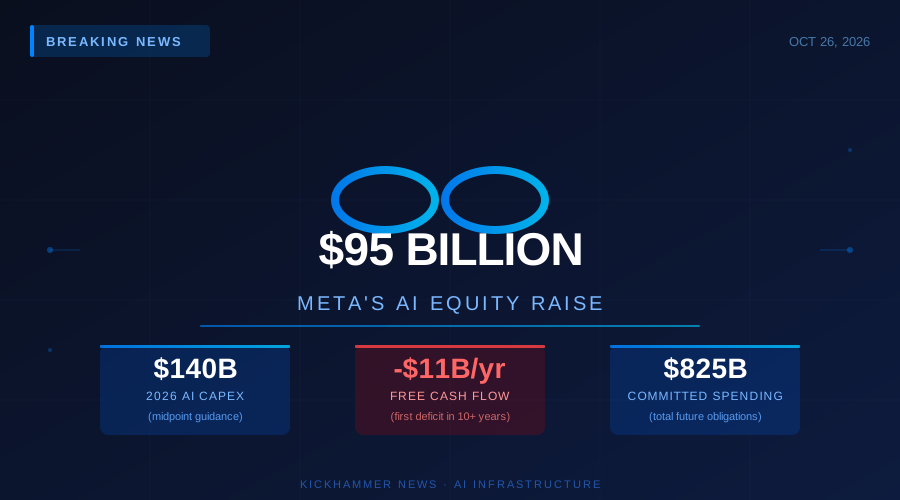
I’ve been watching Meta’s finances for over a decade, and what happened today is genuinely unprecedented. Meta — the company that generated so much cash it spent more than $100 billion buying back its own shares — announced it will dilute those same shareholders by raising up to $95 billion in new equity. Not debt. Equity. The company that printed money is now asking investors for money. That distinction matters enormously, and almost every headline I’ve seen has gotten it backwards.
The story being told is that Meta is investing boldly in AI. The story that’s actually unfolding is that Meta’s free cash flow machine has broken down under the weight of AI infrastructure spending, and the company is doing something structurally new to keep up. Whether that’s brilliant strategy or a distress signal disguised as ambition is the most important question in tech investing right now.
What Meta Actually Announced
Meta disclosed today that it plans to raise up to $95 billion in new equity capital, structured in two tranches:
Tranche 1 — $35 billion, now: Approximately $22.5 billion in Class A common stock plus $12.5 billion in mandatory convertible preferred shares, sold through concurrent public offerings. Settlement of the common-stock portion runs through forward-sale agreements with Morgan Stanley and Goldman Sachs, meaning Meta won’t receive all of that cash immediately. Three semiconductor companies — Nvidia, Advanced Micro Devices, and Broadcom — have indicated interest in buying a combined $5 billion of this initial offering.
Tranche 2 — $60 billion, starting Q1 2027: An at-the-market program for new non-voting Class C shares that Meta has yet to establish. The timing, price, and pace of issuance are undetermined.
The stated purpose: fund AI infrastructure. Meta now expects 2026 capital expenditures of $135 billion to $145 billion, up from its prior guidance of $130 billion to $145 billion. The company has four AI superclusters under construction or operation, each exceeding 1 gigawatt of capacity, across data centers in 23 U.S. states. It expects to nearly double its total infrastructure capacity in 2026 versus 2025.
The Math That Explains Why Meta Is Doing This
Let me run the numbers that you won’t see in the press release, because they’re the reason this raise is happening.
The cash-flow gap: – Meta’s operating cash flow for the first three quarters of 2026: $97 billion, or roughly $32 billion per quarter – Annualized operating cash flow run rate: approximately $129 billion per year – 2026 capital expenditure guidance (midpoint): $140 billion – Annual free cash flow at current pace: approximately negative $11 billion
That $11 billion annual gap is why Meta reported its first negative free cash flow in more than ten years in Q3 — a cash burn of $2.12 billion in a single quarter, compared to positive free cash flow of $10.63 billion in the same quarter a year earlier. The swing was $12.75 billion. In a single year. This is not a rounding error; it is a structural change in the business.
The commitment overhang: Meta disclosed approximately $825 billion in committed future spending. Against a cash balance of $82 billion and long-term debt of $80.9 billion — those two figures are essentially a wash — the company needs to fund roughly $743 billion from a combination of future operating cash flows, additional debt, and new equity. At $129 billion per year in operating cash flow, that math works over six years if the business holds — but there’s no room for error, and no cushion left.
The dilution: Meta has roughly 2.57 billion shares outstanding. At a stock price around $590–$610 (where META has traded recently), the $95 billion raise represents: – $35 billion immediate: approximately 58 million new shares, or about 2.3% dilution on the common stock – $60 billion Class C (if fully exercised at similar prices): approximately 98 million new shares, or roughly 3.8% additional dilution – Total potential dilution: approximately 6% of current shares outstanding
That’s not catastrophic, but it is the first meaningful dilutive equity issuance in Meta’s history as a public company. For a business that spent $50+ billion per year on buybacks as recently as 2023, it marks a complete inversion of capital allocation philosophy.
The chipmaker loop: Here is a detail that deserves more attention than it’s getting: Nvidia, AMD, and Broadcom are investing up to $5 billion to buy Meta stock in an equity raise that will fund Meta’s purchases of chips from Nvidia, AMD, and Broadcom. This is circular capital. The chip suppliers are effectively lending Meta the money to buy their own products. That’s not inherently nefarious, but it creates an alignment of interest that should make independent shareholders ask whether this raise is priced in their interest or in the chipmakers’ interest.
A Decision Framework for Meta Investors
How should you think about what this means for your position? Here are three paths with specific thresholds.
Hold or add if your investment thesis is that Meta’s AI infrastructure becomes a competitive moat generating durable revenue — and you are willing to tolerate 5–7 years of suppressed free cash flow and ~6% dilution in exchange for that future optionality. The threshold for this view: Meta’s AI products (Llama integration, Meta AI assistant, AI advertising optimization) must generate at least $30–40 billion in incremental annual revenue by 2029 to justify the capital outlay. Watch the Q3 and Q4 earnings calls for any disclosure of AI-attributable revenue.
Trim on dilution if you bought Meta as a cash-generation machine and your thesis was predicated on buybacks continuing to drive per-share value. That thesis is dead for at least three to four years. The threshold: if Class C ATM issuances begin materially in Q1 2027 and Meta still cannot return to positive free cash flow by Q2 2027, the buyback machine is not coming back on the original timeline.
Sell if you believe the $825 billion in committed spending will not produce proportional revenue growth and that Meta will be forced to issue additional equity beyond this $95 billion. The signal to watch: if Meta’s Q4 2026 or Q1 2027 earnings show capex guidance being raised again with no proportional revenue guidance increase, the spending is running ahead of returns.
The Contrarian Take No One Is Writing
Most coverage of this raise has framed it as Meta being aggressive and visionary — Zuckerberg betting the farm on AI. That framing obscures something important.
Meta did not choose to issue equity because it has excess returns to deploy. It issued equity because its operating business can no longer fund its ambitions. Every other year of the last decade, Meta would have funded infrastructure with cash from operations and let the buyback program absorb any slack. This year, operations aren’t keeping pace. The company raised $95 billion because the alternative — cutting capex — would mean ceding ground in an infrastructure arms race where first-mover advantages appear to be real.
That’s not a vote of confidence. That’s a company caught between two bad options and choosing the one that preserves strategic position at the cost of financial flexibility. The “aggressive investor” framing conflates intent with necessity.
There’s a second overlooked angle: the Class C shares. By creating a new non-voting share class to fund the ATM program, Meta is diluting economic ownership while concentrating voting power. Mark Zuckerberg retains control regardless of how much equity Meta issues. That structure means shareholders bear the financial risk of a massive infrastructure bet while having no mechanism to vote against it if the thesis fails. That asymmetry is baked into the offering documents, and institutional investors considering the $60 billion ATM tranche should price it accordingly.
Dated Action Checklist
If you own Meta stock or are considering a position, here are specific actions tied to specific dates:
By October 28, 2026 (Alphabet and Microsoft earnings): Watch for any commentary on AI-related capex returns. If Alphabet reports that Google Cloud AI revenue is growing faster than Google’s own infrastructure spend, that is a validation signal for the Meta thesis. If Microsoft’s Azure AI revenue disappoints, treat that as a warning sign.
By October 29, 2026 (Amazon earnings): Andy Jassy has already said AWS is largely sold out through 2027. Watch for any revision to that claim or any signal that enterprise AI workload demand is softening.
By November 30, 2026: The $35 billion common stock offering will have settled under most forward-sale timelines. Watch Meta’s share count in the Q4 10-Q filing (due approximately February 2027) to verify dilution landed at the ~2.3% level disclosed.
By January 31, 2027: Meta will announce whether the Class C ATM program is going ahead and when. If it announces a delay or reduction in the $60 billion program, that is a positive signal — it means operating cash flow improved enough to reduce the need. If it launches the full program immediately, expect continued dilution pressure through the year.
By Q2 2027 earnings (expected July 2027): This is the most important checkpoint. Meta’s forward-sale settlements run through November 2027. By Q2 earnings, you will have roughly two full quarters of capex under the new guidance, and you’ll be able to see whether free cash flow is recovering. If it isn’t — if capex remains above $130 billion annually and operating cash flow hasn’t grown materially — Meta is in a multi-year dilution cycle, not a one-time raise.
What This Means for the Rest of Tech
Meta’s equity raise is not an isolated event. It is a data point about the economics of the current AI infrastructure cycle. When the most profitable social media business in history cannot internally fund its AI ambitions, it tells you something about the magnitude of what the industry is trying to build.
The figures from just this week make the scale concrete: Amazon has committed $220 billion in 2026 capex and says AWS is sold out through most of 2027. Microsoft reports earnings October 28. Meta has $825 billion in committed future spending. These are not incremental technology upgrades. These are permanent structural changes to how the largest companies in the world allocate capital.
The AI infrastructure cycle has entered a phase where even the best-capitalized companies in history are returning to equity markets to keep up. That either means the returns being projected are extraordinary, or the competitive pressure is so severe that capital discipline has been temporarily suspended. The answer to that question — which will start becoming clear in earnings reports over the next two weeks — is the most consequential investment question of the decade.
I’d rather know the answer before the market does. The October 28 and 29 earnings calls are where it starts.


