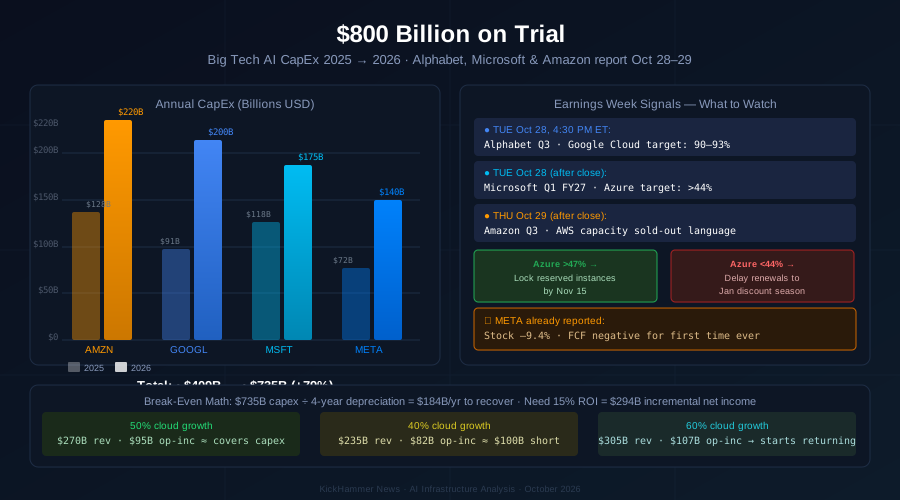
I’ve been watching the AI infrastructure arms race since early 2024, and I’ve never seen a week as consequential as this one. On Tuesday evening, Alphabet and Microsoft report Q3 earnings. On Thursday, Amazon follows. Together, these three companies are spending more on AI infrastructure this year than the United States spent on the entire Apollo program, adjusted for inflation — and this week’s results will tell us whether the market thinks that money is being wisely deployed or recklessly burned.
Meta already reported, and the answer wasn’t reassuring: the stock fell 9.4% even as the company posted record AI revenue. That divergence — strong revenue, declining stock — is a signal worth dissecting carefully before Tuesday’s calls. Wall Street isn’t rejecting AI. It’s pricing in a specific and troubling scenario: that AI infrastructure costs will permanently outpace AI monetization for longer than the balance sheet can absorb.
Here’s what I think the numbers actually mean — and what enterprise teams should do about it before the week is out.
The Real Scale of What’s on Trial
The headline figure of “$800 billion” understates the precision with which you can analyze this. Here’s the actual picture for the big four hyperscalers in 2026:
| Company | 2025 CapEx | 2026 CapEx Guidance | YoY Increase |
|---|---|---|---|
| Amazon | ~$128B | ~$220B | +72% |
| Alphabet | ~$91B | ~$195–205B | +120% |
| Microsoft | ~$118B | ~$175B | +48% |
| Meta | ~$72B | ~$135–145B | +94% |
| **Total** | **~$409B** | **~$735–745B** | **+79%** |
Alphabet is the most striking: it has doubled its capital spending in a single year. That $200 billion is not being spent on cafeterias and campuses — it’s overwhelmingly data center compute, primarily Nvidia H200s and the company’s own TPU v7 arrays.
Now consider what return these companies need to justify this spending. A standard corporate investment analysis uses a 10–12% hurdle rate. On $735 billion in annual capex, the combined hyperscalers need to generate approximately $73–88 billion in incremental net income per year just to break even in present-value terms — and that’s before accounting for the fact that AI infrastructure depreciates in 3–5 years rather than the 15–20 years for traditional physical assets.
Put it differently: every 1% of additional cloud growth that fails to materialize represents approximately $7–8 billion in unrecovered capex. Microsoft has guided Azure growth at 44–45% for the quarter. Analyst consensus requires 47% to justify the current stock price. That 2–3 point miss, if it materializes, isn’t a rounding error — it represents $5–7 billion in annualized revenue shortfall against a model that assumed it would be there.
What Meta’s 9.4% Drop Is Actually Telling You
Most coverage has framed Meta’s stock decline as a “spending concern” or “investor nervousness.” I think that framing misses the point.
Meta’s AI revenue isn’t weak — its AI-powered ad targeting drove record engagement and significant CPM increases in Q3. The problem is the ratio. For the first time in Meta’s history as a public company, its free cash flow went negative in the same quarter that its capex eclipsed $130 billion annualized. That means Meta is now spending capital faster than its own business generates it — which requires either debt, equity issuance, or a drawdown of reserves.
Wall Street is doing the math: at current capex run rates, Meta will have spent its entire cash position by mid-2027 unless AI monetization accelerates dramatically. The market isn’t saying AI is a bad bet. It’s saying: the timing is going to hurt.
Alphabet faces the same dynamic. The company’s free cash flow turned negative for the first time in Q2 — negative $5.9 billion — even while Google Cloud grew 82%. It has paused share buybacks. These are not the behaviors of a company with a comfortable financial cushion; they are the behaviors of a company that has decided to bet the balance sheet.
A Decision Framework for Enterprise Cloud Buyers
This week’s earnings calls will directly affect cloud pricing and availability for enterprise customers. Here is how to read the signals:
If Azure reports >47% growth: Microsoft is supply-constrained. Reserved instance prices will increase in Q1 2027, and availability windows for H100/H200 GPUs will lengthen. Action: lock in 1-year Azure reserved instances before November 15.
If Azure reports 44–46% growth: Roughly on-plan. Microsoft will not move aggressively on pricing. Action: no immediate action needed; monitor Q4 guidance.
If Azure reports <44% growth: Pricing pressure incoming. Microsoft will likely offer deeper discounts on committed-use contracts in Q1 to stimulate demand. Action: delay major Azure contract renewals until after January pricing announcements.
Apply the same logic to Google Cloud: analyst consensus expects 90–93% growth after 82% in Q2. If Cloud growth beats 95%, expect GCP capacity constraints and potential price increases by February. If it misses 85%, expect Google to compete aggressively on committed-use discounts.
For teams splitting workloads across AWS, Azure, and GCP: watch Amazon’s earnings most carefully for capacity signals. CEO Andy Jassy said last week that 2026 AWS capacity is “sold out,” 2027 is “largely sold out,” and parts of 2028 are already committed. If that language holds on Thursday’s call, spot GPU availability will remain constrained through at least mid-2027.
The Contrarian Case: The Market Is Getting the Timing Wrong
Here’s the view you won’t find in most earnings preview coverage: the hyperscalers are probably making the right bet, but the market is pricing them as though the capex payoff is 10 years away when it’s more likely 18–24 months.
Consider GitHub Copilot’s trajectory: from 4.7 million paid subscribers at $19/month (annualized: $1.07 billion ARR) to 50 million total users with usage-based billing now in effect. That’s not a slow ramp — it’s exponential. If even 15% of those 50 million users convert to paid at $19/month over the next 12 months, that’s $1.7 billion in new annual revenue from a single product.
Scale that math across Microsoft’s enterprise customer base of 400+ million commercial Microsoft 365 seats, where AI add-ons are now pricing at $30–$60/user/month. Full adoption at even 20% penetration generates $29–$58 billion in annual AI add-on revenue on top of the base M365 contract. Microsoft’s entire 2026 capex could be recovered in under three years from AI upsell alone, without a single new enterprise customer.
The bear case requires believing that enterprises will not adopt these tools at scale — that the 50 million Copilot users are overwhelmingly individual developers and won’t translate to enterprise seat expansions. That’s possible. But every IT leader I’ve spoken with in the last six months tells a different story: the friction isn’t willingness, it’s procurement, compliance, and change management. Those are solvable problems. The capex is already committed; the revenue is the variable.
The market is pricing in peak pessimism on the revenue side at precisely the moment that procurement pipelines are beginning to clear.
Worked Numbers: What Growth Rate Justifies What Capex
To make this concrete, here’s how to run the math for your own planning assumptions:
At $735 billion in combined capex, depreciated over four years:
Annual depreciation charge: ~$184 billion/year
To generate a 15% return on this invested capital: need $294 billion in AI-attributable net income.
Combined FY2025 net income of the big four: ~$198 billion.
The gap: $96 billion in incremental AI-attributable earnings still needed to be unlocked.
Break-even cloud growth rates (illustrative, using current Azure and GCP run rates):
At 50% cloud growth across Azure + GCP: new cloud revenue ~$270 billion in 2027, with ~35% operating margins = ~$95 billion in cloud operating income. Roughly covers the capex depreciation charge.
At 40% cloud growth: ~$235 billion revenue, ~$82 billion operating income. ~$100 billion short.
At 60% cloud growth: ~$305 billion revenue, ~$107 billion operating income. Starts returning capital.
The key insight: the hyperscalers are in a narrow corridor. They need 50%+ sustained cloud growth to generate returns proportional to their infrastructure spend. Any quarter that comes in at 40–44% is not a disaster — but it extends the payback period meaningfully and puts more pressure on the next quarter.
Your October 28–29 Earnings Checklist
Copy these into your calendar now:
Tuesday, October 28, 4:30 PM ET — Alphabet Q3 call. Listen for: Google Cloud growth rate (threshold: 90% = on plan, 95%+ = supply-constrained), 2027 capex guidance, any change in buyback suspension.
Tuesday, October 28 (after close) — Microsoft Q1 FY2027 call. Listen for: Azure growth guidance (threshold: <44% = pricing softness ahead, >47% = capacity constraint), Copilot paid subscriber update, commercial RPO trajectory.
Thursday, October 29 (after close) — Amazon Q3 call. Listen for: AWS growth rate, whether Jassy reaffirms sold-out capacity language, any change to $220 billion 2026 capex plan.
By November 1 — Review any Q1 2027 cloud contract renewals you have in procurement. If Azure guides above 47% Tuesday, the window to lock in current-generation pricing closes fast.
By November 15 — If all three beat on cloud growth: begin reserved-instance purchasing for 2027 GPU workloads. Spot pricing will increase in Q1. If all three miss: wait for January negotiation season.
The Bottom Line
I believe the market’s current skepticism is both rational and temporary. Rational, because the cash flow math is genuinely difficult right now — these companies are spending more than they’re generating, and that gap is real. Temporary, because enterprise AI adoption is behind a procurement bottleneck that will clear in the next two to four quarters, not permanently.
This week’s earnings calls are the single most important data point of Q4 for anyone building or budgeting AI infrastructure. Watch the cloud growth rates, not the headline earnings — and watch what the companies say about 2027 capex even more closely. The companies that maintain their capex guidance despite a miss are the ones that see something in their sales pipelines that the quarterly income statement doesn’t yet reflect.
KickHammer News covers AI infrastructure, enterprise technology, and the financial dynamics shaping the AI industry.


