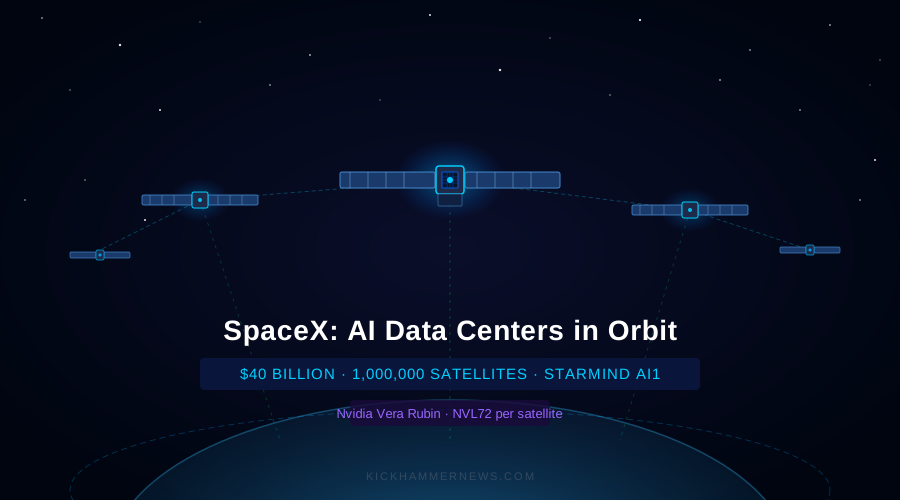
When news broke this week that SpaceX had secured approximately $40 billion in GPU financing — led by Apollo Global Management, with bond fund PIMCO among the initial investors — most of the coverage framed it as another chapter in the AI arms race: Elon’s companies against the rest of the frontier AI world. SpaceX merged with xAI in February. Of course they need more chips.
I think that framing misses almost everything interesting about this deal.
The $40 billion isn’t primarily for a ChatGPT competitor. It’s for putting data centers in orbit. That’s not a metaphor.
What the Money Is Actually For
SpaceX has been remarkably specific about its plans. On August 4, Musk announced that SpaceX would use Nvidia chips — and exclusively Nvidia chips — for all of its AI infrastructure, from the Colossus 2 ground facility to its Starmind AI1 program. Starmind AI1 is the satellite. Each one will carry Nvidia Rubin GPUs and Vera CPUs, functioning in Musk’s words as an “optimized Vera Rubin NVL72” — the same rack configuration running some of the most powerful AI workloads on Earth today.
The satellite specs are not vague. Each Starmind satellite will have a 70 to 75 meter wingspan, a 20 meter deployed height, approximately 110 square meters of liquid-cooled radiator panels, and peak power consumption of around 250 kilowatts drawn from in-house solar arrays built in Bastrop County, Texas. Nvidia says its space-optimized module delivers up to 25 times the AI performance of an H100 in a comparable power envelope. Two AI1 prototypes are scheduled for launch in early 2027, with mass production of the full constellation beginning in late 2027.
SpaceX has filed with the FCC for permission to launch up to one million of these satellites at altitudes between 500 and 2,000 kilometers. The FCC has accepted the application and opened public comment. The $40 billion in Apollo-led financing — roughly $10 billion in bank loans and $30 billion in investment-grade debt — is what bridges SpaceX from “here is our FCC filing” to “we can actually afford to begin.”
The Numbers Nobody Is Running
Let me do the math that I have not seen in any coverage of this story.
One NVL72 rack at current retail pricing costs approximately $2.2 million. A serious AI training cluster — the kind Google, Amazon, and Microsoft operate — holds 50,000 to 100,000 H100 equivalents, or roughly 700 to 1,400 NVL72 racks. These are the facilities making headlines for their billion-dollar price tags.
SpaceX’s FCC filing contemplates one million satellites, each equivalent to one NVL72 rack. At bulk discount rates of 40% off retail (consistent with hyperscaler-scale orders), one million NVL72 racks in orbit would cost approximately $1.3 trillion in hardware alone — not counting launch, satellite chassis, ground stations, or operations. The $40 billion financing covers perhaps 3% of that total. It is a down payment on a down payment.
More useful: here is how SpaceX’s terrestrial commitment compares to existing hyperscaler capacity. SpaceX announced 10 GW of AI compute planned by 2027. Current industry estimates place the total AI compute capacity of major cloud providers at:
- Google: approximately 2.5–3.0 GW
- Microsoft Azure: approximately 1.5–2.0 GW
- AWS: approximately 2.0–2.5 GW
- Meta: approximately 1.5 GW
SpaceX’s 10 GW terrestrial target, if achieved, would exceed Google, Microsoft, and Amazon’s current combined AI infrastructure. No single private company has built at that scale, that fast.
For a practical deployment scenario: assume SpaceX’s first operational Starmind cluster is 1,000 satellites (post-prototype, pre-mass production — approximately 2028). That’s 1,000 NVL72 equivalents, or roughly 72,000 Rubin GPUs in orbit. At Nvidia’s stated 25x H100 performance multiplier, this orbiting cluster would be equivalent to approximately 1.8 million H100s running simultaneously — more than OpenAI’s estimated peak training capacity for GPT-6.
A Decision Framework for Enterprises
Starmind compute won’t be something most enterprise IT departments evaluate in 2027. But if you’re in a sector where AI workloads originate outside a data center, here is how I’d frame the decision:
Use SpaceX orbital compute when (estimated availability 2028–2029):
- More than 20% of your AI inference jobs involve data generated in locations outside terrestrial cloud coverage: maritime operations, aviation, remote monitoring, field operations in locations without reliable fiber connectivity, or military forward operating bases.
- Your use case involves real-time satellite imagery analysis, synthetic aperture radar processing, or weather pattern modeling at the sensor. Running inference at the data source — in orbit — before downlinking results cuts bandwidth costs and latency dramatically.
- Your sovereignty requirements prohibit routing sensitive AI workloads through any single nation’s ground-based infrastructure.
Stay with hyperscaler cloud AI if:
- Your round-trip latency requirements are under 10 milliseconds. Low Earth orbit adds 2–5ms per hop; multi-step AI workflows compound that.
- Your workloads require symmetric high-bandwidth data transfer. Starmind is architected for inference output downlink, not bulk data uplink.
- You need guaranteed SLA-backed compute reservations. Early orbital compute will operate on best-effort availability.
The threshold that matters: If fewer than 5% of your AI workloads involve remote or mobile data collection, Starmind is irrelevant to your infrastructure planning through 2029. Between 5% and 20%, add it to your 2028 evaluation list. Above 20% — defense contractors, maritime logistics, remote mining, aviation analytics — begin building vendor relationships with SpaceX now, because early allocation windows for novel infrastructure typically go to customers already in the pipeline.
What Everyone Is Getting Wrong
Most coverage of this story frames SpaceX’s GPU financing as Elon trying to beat Dario Amodei at inference, or build the next GPT. I think that framing is structurally wrong.
SpaceX’s primary business is not software. It is launch vehicles, satellite manufacturing, and — increasingly — defense contracting. Musk’s February merger of SpaceX and xAI gave SpaceX a foundation model. But the more strategically valuable thing it gave them was a rationale for owning frontier AI infrastructure that can be sold to the U.S. government as a strategic service.
The Department of Defense has spent years articulating a need for AI inference capabilities that do not route through commercial cloud providers vulnerable to supply chain disruption or cyberattack. A Starlink-connected orbital compute network — operated by a domestic defense contractor, riding on a laser-mesh backbone already in service — is precisely what the DoD has been describing in its AI modernization frameworks. Anduril is already a launch customer for Nvidia’s DSX POD program. SpaceX has active DARPA contracts. The $40 billion financing, structured as investment-grade debt with Apollo and PIMCO, is priced like infrastructure debt, not venture capital.
This is not another ChatGPT competitor. It is SpaceX positioning to become the United States government’s AI compute backbone for the next decade of near-peer conflict. The commercial inference revenue — enterprises buying API access to orbital compute for maritime and aviation use cases — is the secondary stream.
The companies that should be most worried about Starmind are not OpenAI or Anthropic. They are the defense integrators who currently own that government compute relationship: Palantir, Leidos, Booz Allen Hamilton, and L3Harris. Those firms’ AI platforms run on cloud compute they do not control. SpaceX is building the cloud they will eventually depend on — and SpaceX will set the terms.
Your Dated Action Checklist
These are not “stay informed” suggestions. These are specific calendar items for anyone whose work intersects with AI infrastructure, defense technology, or satellite communications.
- November–December 2026: Monitor the FCC public comment period on SpaceX’s Starmind satellite application. Comments from Amazon Kuiper and Telesat LEO will telegraph regulatory friction. A contested proceeding adds 6–18 months to any commercial launch timeline.
- February 2027: Starmind AI1 prototype launches. Look for independent orbital performance benchmarks, not SpaceX press releases. The Nvidia “25x H100” figure is for the space module in lab conditions. Actual in-orbit inference throughput, accounting for thermal cycling and power budgets, will differ.
- Q2 2027: Apollo financing close. The pricing on the $30 billion bond tranche will reveal what institutional investors believe about SpaceX’s government contract pipeline. A coupon above 6% signals skepticism; below 4.5% signals defense-contract confidence.
- Q3 2027: Bastrop manufacturing begins. Watch for unit economics: cost per NVL72-equivalent at volume will determine whether Starmind is cost-competitive with terrestrial inference by 2030.
- Q1 2028: If SpaceX has not announced commercial orbital compute pricing by this date, the operational schedule has slipped materially. Adjust your enterprise planning assumptions accordingly.
What This Actually Means
I have been watching AI infrastructure announcements long enough to calibrate hype carefully. Amazon’s AWS sold-out 2027 announcement last week is real. Meta’s $95 billion equity raise for AI capex this month is real. Anthropic’s $518 billion in cloud compute commitments in its S-1 is real.
SpaceX’s $40 billion orbital compute plan is also real — in the sense that the financing is real, the FCC filing is real, the Nvidia partnership is real, and the prototype launch schedule is real. What is not yet real is the revenue model, the regulatory approval, the per-unit economics, and the operational performance of a liquid-cooled Rubin GPU cluster cycling through 16 sunrises per day in low Earth orbit.
The risk-adjusted version of this story is: SpaceX has secured the capital to attempt something no one has ever done, in service of a customer base — the U.S. defense establishment — that has both the budget and the need for exactly what SpaceX is building. The first two years will be prototypes and uncertainty. The following decade will be an infrastructure platform that everyone currently planning their 2030 AI strategy has not yet included in their models.
That gap between what is in current AI planning and what SpaceX is building is, I think, the most important asymmetry in AI infrastructure today. And it has nothing to do with which chatbot answers your questions.
Sources: Rio Rundown (Oct. 27, 2026), Futurum Group, CNBC, Bloomberg, Interesting Engineering, Digital Citizen, The Rundown AI, Fortune