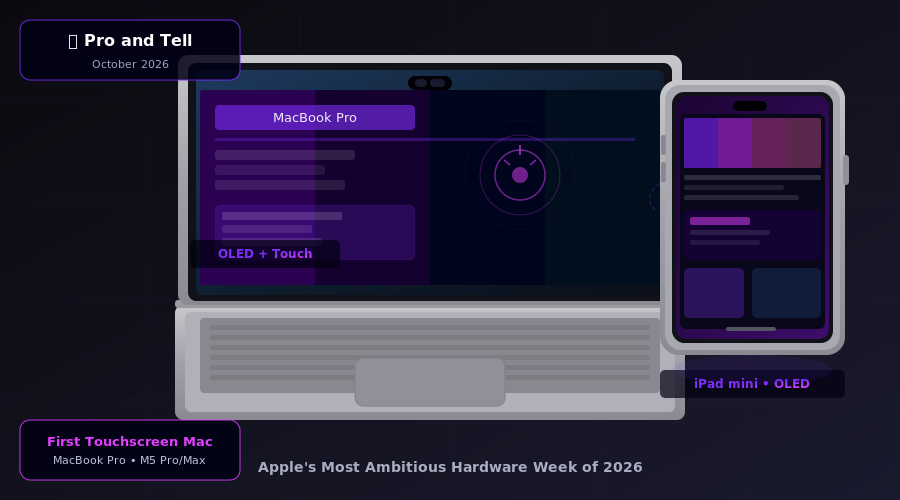
Apple is having its biggest hardware week of 2026. On October 26, the company kicked things off by unveiling the all-new iPad mini 8th generation — its first compact tablet with an OLED display and the most significant redesign the mini has seen in years. One day later, Apple is set to take the stage in Los Angeles for its “Pro and Tell” event, where it is expected to unveil what could be one of the most consequential Mac updates in the company’s history: a touchscreen MacBook Pro.
For Apple fans who have waited years for a smaller, sharper, lighter iPad mini, and for Mac professionals who have fantasized about reaching out and touching their screens, this week is shaping up to be the payoff they have been waiting for.
iPad mini 8th Generation: Small Tablet, Big Upgrade
The iPad mini has always occupied a curious niche in Apple’s lineup — beloved by readers, note-takers, and one-handed browsing enthusiasts, but frequently overlooked in Apple’s hardware calendar. The 8th generation changes that. With the leap to OLED and the inclusion of Apple’s A20 Pro chip, the iPad mini is no longer playing second fiddle.
At 8.5 inches, the display is slightly larger than its predecessor’s 8.3-inch LCD panel, but the real story is the technology behind it. OLED brings true blacks, pixel-level contrast, and vibrant color reproduction to a form factor that previously had to make do with IPS LCD. The result is a screen that looks stunning for a device this size — whether you’re watching a film on a plane or annotating documents at a desk.
The A20 Pro chip inside is no slouch. Depending on storage configuration, buyers get either a 5-core CPU with a single 16-core Neural Engine (on the 128GB and 256GB models) or a full 6-core CPU with dual Neural Engines on the 512GB tier. With 12GB of RAM across all variants, the mini can comfortably run Apple Intelligence features and handle multitasking that would have been unthinkable on previous generations.
At 5.4mm thin and weighing just 255 grams, the new iPad mini is also noticeably slimmer and lighter than its 6.3mm, 293-gram predecessor. That might sound like a minor refinement on paper, but in a device you hold for hours at a stretch, the difference is immediately perceptible. Apple’s Acoustic Display technology — which turns the screen itself into part of the speaker system — delivers improved audio for a tablet of this size.
The FaceTime camera has moved to the landscape edge, a change that makes far more sense for how most people actually use an iPad in video calls. Water and dust resistance has been certified at IP67. And if you need a screen that handles glare in difficult lighting, the optional nano-texture glass — available on 256GB and 512GB models for $100 extra — provides a matte finish that rivals dedicated anti-glare accessories.
Pricing starts at $699 for the Wi-Fi model, up $100 from the outgoing generation. Cellular connectivity adds $150. It is a premium price for a compact device, but OLED and the A20 Pro justify the step up.
The MacBook Pro Gets Its First Touchscreen
If the iPad mini announcement was the opening act, tomorrow’s “Pro and Tell” event could be the headline. According to Bloomberg’s Mark Gurman — who has been accurate on Apple hardware for more than a decade — Apple is preparing to unveil touchscreen MacBook Pro models in both 14-inch and 16-inch sizes. They are expected to be the first Macs in history with a touchscreen.
The implications are significant. Apple spent years resisting touch on the Mac, famously arguing that reaching up to touch a vertical display leads to ergonomic fatigue — what many called the “gorilla arm” problem. The company’s position was that touch belonged on tablets, not laptops. The upcoming MacBook Pro suggests Apple has changed its mind, or at least found a way to implement touch that it believes solves the problems it previously identified.
What makes this launch particularly notable is the accompanying switch to OLED panels. Combined with touch input, OLED gives the new MacBook Pros the same vibrant, high-contrast display technology the iPad Pro and now the iPad mini have enjoyed — applied to a full laptop form factor. Reports suggest both the 14-inch and 16-inch models will also replace the notch with a Dynamic Island — the interactive notification and status area Apple introduced on the iPhone 14 Pro.
On the silicon side, the touchscreen MacBook Pros are expected to carry forward M5 Pro and M5 Max chips rather than jumping to the next generation. This is reportedly because M6 Pro and M6 Max chips are being held for a later cycle. The entry-level 14-inch MacBook Pro, however, will reportedly use the M6 chip, receiving a performance bump without the touchscreen or OLED treatment.
Pricing for the touchscreen models is expected to command a significant premium — estimates have put the 14-inch starting around $2,800 to $3,000 and the 16-inch at $3,300 to $3,500. Those figures reflect the engineering investment Apple has made in a display technology it has never shipped on a Mac before.
iMac with M6: A Workhorse Refreshed
Rounding out the event, Apple is also expected to update the 24-inch iMac with the M6 chip. The design is likely to remain the same, with the same iconic slim silhouette and color options, though new color choices may be introduced. Wi-Fi 7 and Bluetooth 6 are rumored additions that would keep the iMac current for home and office networking. An OLED iMac, while technically feasible, is reportedly years away — the engineering challenges of building a large-format OLED desktop display at Apple’s cost and quality bar remain substantial.
For most iMac buyers, M6 represents a meaningful generational upgrade over M4-equipped machines currently in the lineup. The M6 architecture brings improvements in CPU performance, neural processing throughput, and energy efficiency. For creative professionals and everyday users who rely on the iMac as their primary workstation, the upgrade path is clear.
What This Week Means for Apple’s Hardware Strategy
Taken together, this week’s announcements represent a coherent strategic statement from Apple. The iPad mini OLED upgrade signals the company’s willingness to bring premium display technology down to its most compact products. The touchscreen MacBook Pro represents a historic shift — however cautious — toward convergence of touch interaction and the Mac. And the M6 iMac and entry MacBook Pro refresh ensures the prosumer tier stays competitive.
The move to touch on the Mac is the one that will generate the most debate. Skeptics will question whether users will reach for the screen often enough to justify the price premium, the added weight that touch sensors introduce, and the engineering complexity. Proponents will point to creative workflows — digital artists, architects, video editors — who have longed for touch precision directly on their Mac display.
Apple’s answer, shaped by the industrial design team and years of developer research, will arrive tomorrow when the curtain rises in Los Angeles. But the iPad mini 8th generation, already in buyers’ hands, is a reminder of something Apple does exceptionally well: taking a product category its critics had written off and making it feel indispensable again.
Sources: Macworld, 9to5Mac, Digital Trends, MacRumors, Business Standard