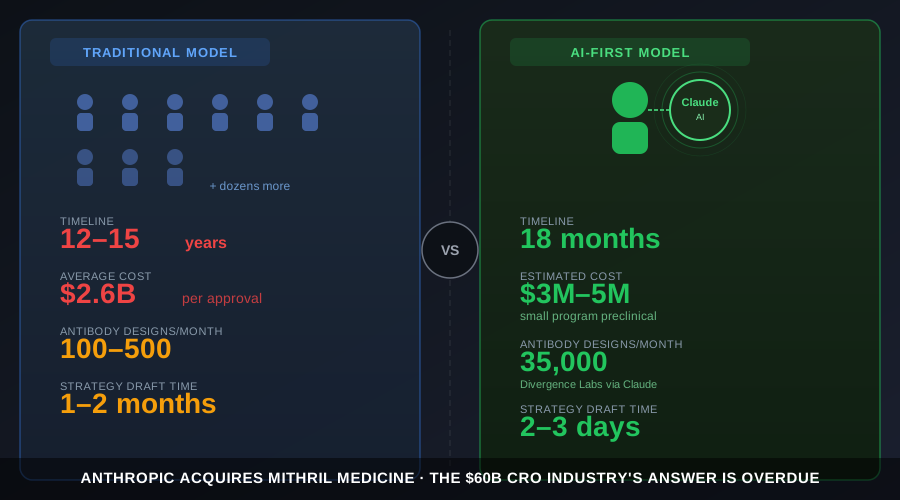
Cody Tranbarger is not a typical drug developer. He has no research team. He has no lab. He coordinates experiments at eleven external contract facilities using Claude to manage the paperwork, strategy, and logistics that would normally occupy a team of a dozen scientists. In eighteen months, his one-person company, Mithril Medicine, produced more than 100 experimental antibodies and advanced a candidate to mouse testing for LAMA2-related congenital muscular dystrophy — a rare disease with no approved treatment and no obvious path through a conventional R&D process that averages twelve years and $2.6 billion.
Anthropic bought Mithril Medicine in July 2026. It disclosed the acquisition on October 27, alongside six active pharmaceutical partnerships including Bristol Myers Squibb, BigHat Biosciences, Generate Biomedicines, Divergence Labs, Enveda, and The Column Group. The financial terms were not disclosed.
The coverage has largely treated this as a human-interest story about a lone scientist and a promising mouse-study result. That framing misses what’s actually happening. Anthropic just demonstrated — with a real drug candidate, real animal data, and a real acquisition — that a single person with access to a frontier language model can now compete with programs that cost fifty times more and take ten times longer. The $60 billion global contract research organization industry runs on exactly the kind of work Tranbarger was doing solo.
The Math of Traditional Drug Development
The standard Tufts Center for the Study of Drug Development estimate puts the average cost of getting one new drug approved at $2.6 billion. That figure includes the cost of failures: for every drug that reaches FDA approval, roughly 5,000 compounds were screened and 250 entered preclinical development. Historically, about 14% of drugs entering clinical trials reach approval.
A typical Phase I program — the first-in-human safety study — costs between $10 million and $50 million and takes 1.5 to 3 years. Before that, preclinical development, including animal studies, formulation work, and manufacturing optimization, runs $1 million to $15 million depending on the modality. Contract research organizations capture a large fraction of this spending: IQVIA, Covance, PRA Health Sciences, Syneos Health, and a hundred smaller firms collectively earn roughly $60 billion per year managing the logistics, execution, and documentation of clinical and preclinical research.
The work they do is not mysterious. It is protocol writing, data management, regulatory documentation, site coordination, and vendor contracting. It requires precision and credentialing, but not necessarily large teams. It requires the integration of vast amounts of prior scientific literature to make coherent decisions about which molecules to advance. It requires a level of project management sophistication that scales poorly with human attention.
That is precisely what Claude is good at.
What the Numbers Actually Show
Anthropic’s research report, published alongside the acquisition announcement, includes specific figures from its pharmaceutical partners that deserve scrutiny.
Divergence Labs generated approximately 35,000 antibody designs in a single month using Claude. A conventional antibody design campaign using existing computational tools might produce 100 to 500 candidates per month. Thirty-five thousand is roughly two orders of magnitude higher — not incremental progress, but a categorical difference in throughput.
Enveda reported an 89% reduction in human review time for manufacturing documentation. The chemistry, manufacturing, and controls section of an FDA drug filing routinely runs to thousands of pages, and review cycles between CROs and sponsors consume months. An 89% reduction does not mean the work disappears; it means the bottleneck shifts from human review hours to machine-generated drafts that humans verify.
Tranbarger himself reported that drafting an initial research strategy — the document that anchors an entire preclinical program — dropped from one to two months to two to three days. Generate Biomedicines used Claude to help redesign a portion of an experimental CAR-T cell therapy, a task that involves protein engineering, cell biology, and immunology converging at the intersection of three complex disciplines. Bristol Myers Squibb is applying Claude to clinical trial planning across roughly 200 active global studies.
The CRO Disruption Calculation
Apply the Divergence throughput figure to a typical antibody drug discovery program. A conventional 18-month preclinical campaign might screen 5,000 to 15,000 antibody candidates at a total cost of $5 million to $20 million, using a medium-sized CRO or internal team. At 35,000 designs per month, a 3-month generation phase could replace a year of conventional screening work.
Here is what the three-tier cost comparison looks like:
Small program (biotech, 2 targets, 18-month preclinical): Traditional model with full CRO engagement costs $12M-$18M. AI-augmented model — one to three internal scientists, external assay labs, Claude for documentation and strategy — runs an estimated $3M-$5M. Savings: $7M-$13M per program.
Medium program (mid-cap pharma, 5 targets, 24-month preclinical): Traditional: $35M-$60M. AI-augmented: $10M-$18M. Savings: $20M-$42M.
Large program (large pharma, pipeline acceleration across 20 programs): Traditional: $200M-$400M. AI-augmented: $60M-$120M. Savings: $140M-$280M annually.
These are illustrative estimates based on published industry benchmarks, not independently verified figures from Anthropic’s partnerships. But if the partner data holds even partially at scale, the addressable disruption is substantial. A 40-60% reduction in preclinical and early clinical CRO spend would remove $24B-$36B from the $60B CRO market annually.
A Decision Framework for AI-First Drug Discovery
Not all drug development is equally amenable to AI augmentation. Here are specific thresholds:
Go AI-first if: Your target has an existing crystal structure or homologous structure in the Protein Data Bank, your disease has validated biomarkers that make Go/No-Go decisions binary, and your indication is rare — orphan disease pathways are more flexible and trial sizes are small enough to fit a compressed model.
Augment but don’t replace if: You’re in a first-in-class mechanism with no structural precedent, you’re developing a biologic where manufacturing process development is tightly coupled to the molecule itself, or you need real-world evidence from large populations where Phase III scale requires institutional infrastructure.
Keep traditional CRO engagement if: You’re in Phase II or later. FDA inspection readiness, GCP compliance monitoring, and data integrity for late-stage trials require institutional systems. AI has not replaced the regulatory-ready trial execution apparatus, and a PDUFA date miss costs $100M or more.
The threshold number: programs under $30M in total expected preclinical spend should evaluate the AI-first model aggressively. Above that, AI augmentation of specific functions — documentation, candidate generation, literature synthesis — is justified, but wholesale CRO replacement is premature.
The Contrarian Read That Most Coverage Is Missing
Most coverage of the Mithril acquisition frames this as a story about AI accelerating drug discovery. The more accurate interpretation is that Anthropic just proved that the primary scarce resource in preclinical pharmaceutical R&D has never been expertise — it has been attention. Attention scales poorly with team size. Claude’s attention is essentially free.
The CRO industry was built on a structural assumption: that managing the complexity of pharmaceutical research required large teams, extensive institutional infrastructure, and years of established vendor relationships. Mithril Medicine had none of those things. It had one person, external assay labs, and Claude. It still produced a drug candidate in eighteen months.
There is also a tension worth naming explicitly. Anthropic’s IPO prospectus, filed last week, includes language warning that the AI it is building could pose existential risks. Anthropic is simultaneously deploying that same AI to run drug development programs that will eventually reach human clinical trials. The regulatory framework for AI-generated drug candidates does not yet exist. FDA guidance on AI/ML-based Software as a Medical Device covers software that makes medical decisions, not AI systems that generate the molecules those decisions concern. There is a meaningful gap here, and no agency appears to be moving quickly to close it.
One more uncomfortable angle: Anthropic’s six pharma partnerships are currently structured as tool-supply agreements — Anthropic provides Claude, partners apply it. The Mithril acquisition changes that structure. Anthropic now holds drug candidates it owns. If those candidates advance to IND applications, Anthropic becomes a drug developer competing with its pharmaceutical customers for the same regulatory bandwidth. The company has not addressed how it plans to manage that conflict.
Dated Action Checklist
By November 15, 2026: Check FDA’s docket for the comment period closing on AI in drug development guidance (21 CFR 312 has not been updated to address AI-assisted INDs). This directly affects how Mithril’s candidates will be reviewed.
By December 1, 2026: Audit your CRO master service agreements for AI-assisted work provisions. Most standard CRO MSAs were written before 2024 and say nothing about AI-generated documentation, AI-designed molecules, or liability allocation for AI-assisted regulatory submissions.
Q1 2027: Anthropic has said it will select formal drug candidates for LAMA2 and alpha-dystroglycanopathy from the Mithril pipeline. Watch for IND filings — they will be the first signal of how FDA handles AI-native drug programs at the application stage.
Q2 2027: Expect 5-10 “pipeline-in-a-person” startups to be announced, following the publicity from this disclosure. The model is now proven at the preclinical level; the question is whether it scales through IND filing and into Phase I trials.
Late 2028: If Anthropic’s projected timeline holds, potential LAMA2 human trials would begin. That will be the first clinical test of whether AI-designed experimental antibodies behave in humans the way they did in mice. The gap between mouse and human has killed thousands of drug programs; AI did not invent that gap, and it has not solved it.
January 31, 2027: If you are a CRO with revenue below $500M, you need a strategic response to this model in writing. The large CROs — IQVIA ($16B revenue), Covance/Labcorp ($14B), Syneos ($5B) — have balance sheets to acquire AI companies and reposition. The mid-tier does not have that luxury, and the clock has started.
The acquisition price for Mithril Medicine is undisclosed. Whatever Anthropic paid, it bought proof that the most expensive input in drug development — time, measured in patient-years, scientist-hours, and regulatory cycles — is now compressible in ways the FDA, CRO boardrooms, and academic institutions have not yet built a response to. The mouse data from Mithril’s LAMA2 program may not hold in humans. But the economic model will.