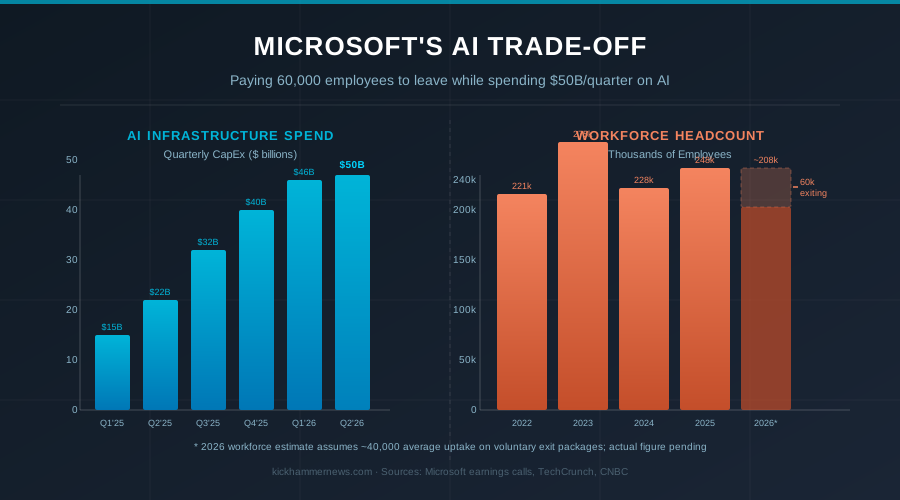
There is something almost clarifying about the math. Microsoft is offering voluntary exit packages to roughly 60,000 employees — about 22 percent of its global workforce — while simultaneously spending approximately $50 billion per quarter on AI infrastructure. The company is not in financial trouble. It posted record earnings again this week. The message embedded in those two numbers is something else entirely: the kind of company Microsoft is becoming does not need as many of the people who built the kind of company it used to be.
This is not a scandal, exactly. It is a structural shift happening in plain sight, and Microsoft is being more candid about the trade-off than most. Satya Nadella has said repeatedly that the company’s investment in AI is not a hedge — it is the strategy. When you hear him say that, and then you hear that 60,000 people are being offered money to walk away, those two statements belong in the same sentence.
What the Exit Package Actually Looks Like
According to people familiar with the program, the voluntary separation packages are being offered across Microsoft’s enterprise software, gaming, and consumer divisions. The terms — reportedly including extended severance and healthcare continuation — make the offer genuinely attractive to employees who have been feeling the slow squeeze of an organization that has been reorganizing around AI tools for the past two years.
The program is described as voluntary, and Microsoft is being careful to frame it that way. Nobody is being pushed out. But in the current environment, “voluntary” carries a particular meaning. When your manager’s team is being rebuilt around agentic workflows and automated code generation, and the company is offering you a cushioned exit, the voluntary nature of the choice exists within a fairly defined set of walls.
Microsoft is not the first company to use this framing, and it will not be the last. Meta ran a similar program earlier this year. IBM has been steadily reshaping its workforce ratio toward AI-adjacent roles for the better part of three years. What makes the Microsoft announcement notable is the scale — 60,000 is not a rounding error — and the timing, which sits directly inside an earnings week in which the company reported another quarter of AI-driven revenue acceleration.
The $50 Billion Figure and What It Buys
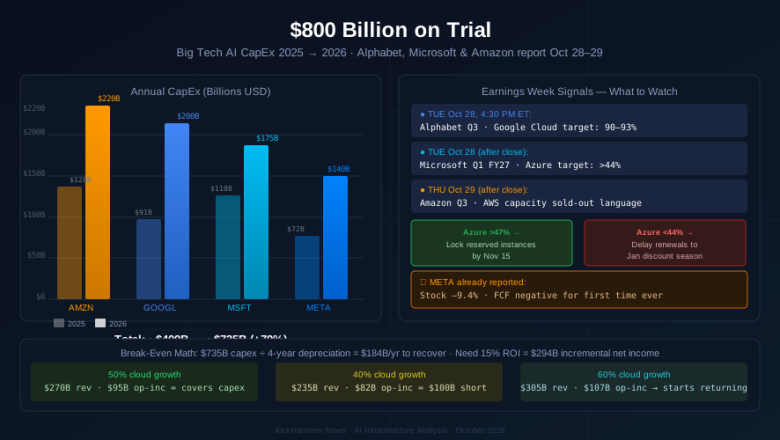
Microsoft’s capital expenditure on AI infrastructure — data centers, custom silicon, energy contracts, networking — has now crossed $50 billion per quarter. That is a number that strains normal comparisons. It is more than most sovereign wealth funds deploy in a year. It represents a bet that the compute bottleneck is the defining constraint of the next decade, and that whoever holds the most of it wins.
The Azure AI business is growing fast enough to justify that bet on current numbers. Enterprises are signing long-term contracts for AI inference capacity at a pace that suggests the demand is not a temporary enthusiasm. GitHub Copilot has become a genuine productivity staple inside engineering organizations, and Microsoft’s Copilot integrations across Office and Teams have moved from demo features to billable enterprise services.
What does not scale at the same rate as compute is the kind of middle-management and specialist-layer headcount that Microsoft accumulated during its last decade of growth. The company built an enormous organization to ship software products to enterprises. A significant portion of that work is now being done faster, cheaper, and with fewer humans in the loop — by Microsoft’s own AI tools. There is a dark irony in that, and Microsoft knows it.
The Broader Pattern
It would be convenient to read the Microsoft news as an isolated decision by one company in a particular moment. The pattern suggests otherwise. Across the major technology employers, the same dynamic is playing out with minor variations: record investment in AI infrastructure, record revenue from AI products, and simultaneous reduction of headcount in the layers of the organization that do not have a clear AI-forward function.
The companies running this playbook are not trying to shrink. They are trying to change the ratio. Every dollar that does not go to a knowledge worker salary in a role that can be partially automated is a dollar that can go toward the compute that makes the automation possible. At $50 billion per quarter, you need a lot of redirected dollars.
The labor implications of this are significant and still underappreciated in mainstream conversation. The people being offered exit packages at Microsoft are not low-skilled workers. They are experienced program managers, product specialists, enterprise sales engineers, and mid-level software developers — the professional class that spent a decade being told that AI would take the repetitive jobs but leave the complex work for humans. That prediction turns out to have been mostly correct about the repetitive jobs and significantly wrong about the ceiling of what the complex work means.
What Comes Next
Microsoft has been careful not to put a number on how many employees it expects to accept the offers. The program runs for several weeks, and the company says the final count will depend on uptake. Analysts expect the actual departures to land somewhere between 20,000 and 40,000, with the higher figure possible depending on which divisions see the strongest response.
What matters more than the final number is what replaces those positions — or, more precisely, what does not replace them. Microsoft has not announced an equivalent hiring surge to backfill the roles. The company is growing its AI engineering headcount and its data center operations workforce, but those groups are small relative to the scale of the voluntary exit program. The net headcount number will be lower. The revenue per employee number will be significantly higher. That is the metric the company is optimizing for, and it is the metric the rest of the industry is watching.
There is a version of this story that is told as a triumph of efficiency and a validation of the AI investment thesis. There is another version that is about what happens to an economy when one of the largest employers in technology decides that a fifth of its workforce is more valuable as an exit cost than as a continuing salary. Both versions are true at the same time.
Microsoft’s choice to be transparent about the trade-off — to announce the buyout program in the same earnings cycle in which it disclosed its AI spending — suggests the company is not especially worried about how the story looks. That confidence is either a sign that the market agrees with the strategy, or a sign that the strategy has moved fast enough that disagreement is no longer a practical consideration. At $50 billion a quarter, the bet is already placed.