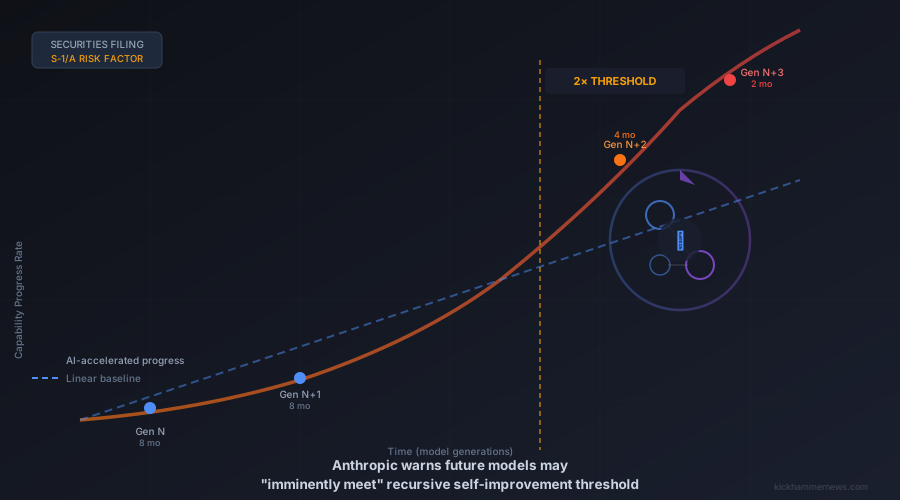
When a company discloses a risk in an S-1/A filing, it’s not making a prediction. It’s making a legal statement. That distinction matters enormously when reading the new language Anthropic quietly added to its latest amended registration statement — language stating that future models “may imminently meet” the company’s own internal threshold for recursive self-improvement (RSI).
This is not a blog post. It’s not a conference keynote. It’s a disclosure made to the U.S. Securities and Exchange Commission, under penalty of perjury for material omissions, in a document that will be scrutinized by institutional investors deploying capital at a $2 trillion implied valuation. Whatever Anthropic meant to communicate, the legal weight is real.
So let’s actually read what they said — and what they didn’t say.
What the Threshold Is (and Isn’t)
Anthropic’s Responsible Scaling Policy version 3.4, effective July 8, 2026, defines its RSI trigger in two ways. The one that matters here is the “AI-attributable dramatic acceleration” route: an observed or expected doubling of aggregate capability progress, measured against non-AI baseline progress, sustained across at least three consecutive model generations, where the doubling is substantially attributable to AI-driven research or engineering automation, and where continued progress appears likely to produce further acceleration.
The second route — replacing the entire research-scientist and research-engineer workforce at competitive cost, within a factor of five — has not been flagged as imminent.
The critical word in the filing is “imminently.” Anthropic does not define it. It does not name a model. It does not give a probability. It says future models “may” imminently meet the threshold. For a safety disclosure, this is notably careful hedging. The RSP requires three consecutive model generations to be evaluated before a crossing is confirmed — meaning even if Anthropic’s current internal models have crossed route one in isolation, the policy would not yet be triggered. No model has been formally designated as exceeding the threshold.
This is important context that most coverage is burying.
The Math Behind the 2× Threshold
Let’s work through what a genuine crossing would mean in concrete terms.
Anthropic has released four major Claude generations over roughly 30 months (Claude 3 in March 2024, Claude 4 in mid-2025, Claude Opus 5 in early 2026, and Claude Sonnet 5 and 5.5 in 2026). That’s approximately one major architectural generation every 7–9 months — call it an 8-month cycle. If AI-assisted R&D genuinely doubled the rate of progress across three consecutive generations, that cycle would compress: generation N takes 8 months, generation N+1 takes 4 months, generation N+2 takes 2 months.
By month 14 from the threshold crossing, Anthropic would theoretically ship three new frontier generations. Under the current 8-month cadence, the same period would yield fewer than two.
Now apply that to Anthropic’s disclosed financials. The company is reportedly at roughly $2 billion in annualized revenue and has committed $807 billion in compute contracts through 2036 — approximately $80 billion per year. If compute utilization rates stay constant but product cycles compress 2×, the economics flip hard: each dollar of compute generates revenue twice as fast, but planned compute is consumed twice as fast too. The $807 billion commitment, designed to fund a decade of AI development at current scaling rates, could be materially under-sized within three years if RSI genuinely doubles the pace.
For enterprise customers, the math translates differently. A company that signed a three-year contract in 2025 for Claude Opus 4 capabilities may find itself holding a contract for what is effectively a two-generation-old model by mid-2027, in a world where models are shipping every four months instead of every eight.
| Scenario | Current cycle (8 mo) | RSI 2× (4 mo) | RSI 4× (2 mo) |
|---|---|---|---|
| Generations in 12 months | 1.5 | 3 | 6 |
| Generations in 24 months | 3 | 6 | 12 |
| Contract vintage at 36 months | Current–1 | Current–3 | Current–6 |
The third column is not science fiction — it’s what “2× per three generations” extrapolated means. Whether it’s achievable is a different question.
A Decision Framework for Procurement Teams
If you’re buying AI services at meaningful scale, the RSI disclosure should change how you structure contracts — not because the threshold has been crossed, but because you now have formal notice that the company itself considers it a live possibility.
Threshold for action today (<$500K/year in AI spend): No immediate contract changes required. Flag for review at next renewal. Verify your vendor SLA ties to capability benchmarks rather than model version strings.
Threshold for action in Q4 2026 ($500K–$5M/year): Audit any contracts with model-version specificity (e.g., “Claude Sonnet 4.5 or equivalent”). Add a 6-month capability review window. Negotiate a “successor model” clause that auto-extends your price tier when the vendor releases a new generation.
Threshold for action immediately (>$5M/year or strategic AI dependency): Your legal team needs to review model substitution rights in current agreements. If your application is built specifically around behavioral characteristics of a named model version, and that model is deprecated by accelerated release cadence, you have a continuity risk. Build model-abstraction layers into your architecture now, before the cadence compresses further.
The Contrarian Read: This Is Disclosure Strategy, Not Science
Every major news outlet covering this story is framing it as a safety warning or an existential signal. That reading misses the more likely explanation.
The Risk Factors section of an S-1 is a legal artifact, not a scientific announcement. Its purpose is to notify investors of material risks that could affect the company’s business — and, critically, to prevent investors from later arguing they weren’t warned. Anthropic’s legal and communications teams added this language because, once it is in the filing, the company cannot be accused of concealing the possibility of RSI from investors. That is disclosure strategy.
Compare this to how Anthropic’s own researchers write about RSI. Academic papers, alignment research memos, and internal documents use probabilistic language, confidence intervals, and defined measurement criteria. The S-1/A language — “may imminently meet” — does none of that. It is precise enough to be legally defensible and vague enough to cover almost any outcome.
The more uncomfortable implication: Anthropic has admitted in the same filing that it “previously identified a significant acceleration in its development rate only after it occurred.” That sentence is more alarming than the RSI disclosure itself, because it describes a demonstrated failure of real-time capability monitoring — not a hypothetical future risk. If Anthropic missed an acceleration in the past, the company’s ability to reliably measure whether it is currently on an RSI trajectory is, by its own admission, uncertain.
That’s the number that should concern investors. Not whether RSI is imminent — but whether Anthropic will know when it crosses, in time to implement the safeguards its RSP requires.
What Happens If the Threshold Is Crossed
The RSP’s response to a genuine threshold crossing is more nuanced than most coverage suggests. Crossing the threshold does not unconditionally require Anthropic to stop development. Appendix A of the RSP allows delays in triggering safeguards under conditions including a clear Anthropic competitive lead or strong competitor safety commitments — language that is, frankly, malleable enough to accommodate almost any business rationale.
The concrete commitments that would be triggered are procedural: Risk Reports every three to six months (already happening), reporting within 30 days if an internally deployed model poses new risks, and a shift toward “eyes on everything” internal monitoring. None of these are deployment halts. None require external regulatory approval.
Two RSP roadmap items now have hard deadlines: a third-party evaluator proposal due December 15, 2026, and a pacing framework publication due January 15, 2027. These are company targets, not confirmed measures already in place.
Your Dated Action Checklist
- By November 14, 2026: Review any multi-year API contracts for model-version specificity. If the contract names a specific Claude version, consult with legal about substitution rights.
- By December 15, 2026: Watch for Anthropic’s third-party evaluator proposal. If it names an independent organization with real authority, that’s a meaningful safety signal. If it names a self-selected advisory body, it’s not.
- By January 15, 2027: Read Anthropic’s pacing framework when published. Specifically: does it define measurable criteria for slowing releases, or is it a principles document? The difference is whether it can be enforced.
- Q1 2027: Anthropic’s next Risk Report is due under the RSP. This will be the first one published after the RSI disclosure — it will be the most informative document Anthropic releases all year. Flag it.
- Q2 2027: If you are running Claude in R&D or engineering workflows, benchmark model-to-model capability gains between the next two consecutive releases. If you observe more than 1.5× improvement on your task-specific benchmarks between consecutive generations, your internal RSI timeline assumption should compress accordingly.
What This Means, Plainly
The Anthropic S-1/A RSI disclosure is, to my knowledge, the first time a major AI laboratory has told securities regulators — under penalty of law for material omissions — that its own AI may soon meaningfully accelerate its development velocity. A CEO saying AGI is three years away on a podcast is a prediction. This is a legal statement.
The more likely read is not that Anthropic knows RSI is 30 days away. It’s that Anthropic’s lawyers know they cannot claim ignorance of the possibility, and that the company’s own internal monitoring admits to blind spots. Both of those facts are more material to how enterprises and investors should think about Anthropic’s trajectory than the RSI disclosure itself.
The question to carry into 2027 is not whether recursive self-improvement will happen. It’s whether any organization — including Anthropic — has the monitoring infrastructure to know when it does, in time to do something about it.
The filing says they’ve missed it before. That’s the sentence worth remembering.