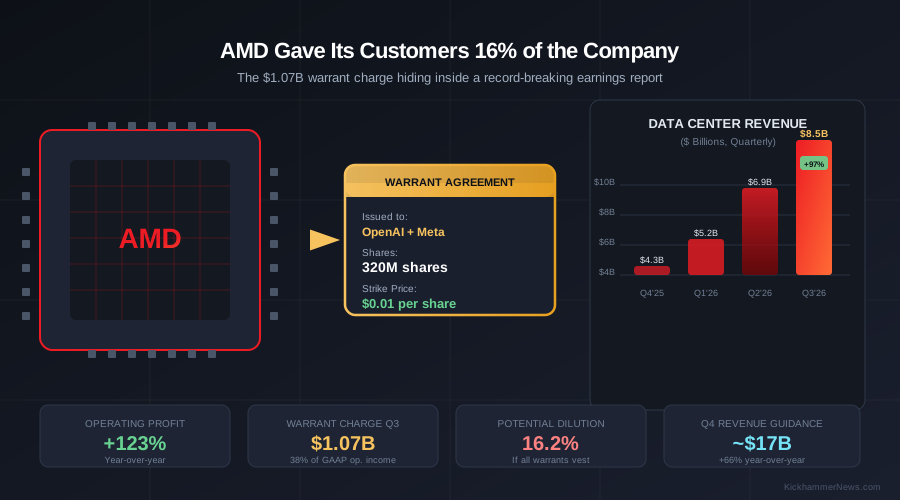
The number that matters most in AMD’s blockbuster Q3 earnings report isn’t the headline revenue figure. It isn’t the data center segment that nearly doubled year-over-year, or the Q4 guidance that shocked analysts into revising their models upward. The number that tells you something genuinely new about how the AI supply chain works is a relatively obscure line item: a $1.07 billion non-cash charge tied to warrants AMD issued to two of its largest customers.
For the first time in semiconductor history, a chipmaker has handed equity options to the hyperscalers buying its chips — not as an incidental financing arrangement, but as the stated price of multi-year supply commitments. AMD gave OpenAI warrants for up to 160 million shares at a strike price of one cent, vesting in tranches as OpenAI deploys AMD Instinct GPUs from one gigawatt up to six gigawatts of capacity. Meta received a similar warrant, also for up to 160 million shares, tied to its own multi-gigawatt supply agreement. Combined, the two deals cover up to 320 million AMD shares. If fully vested, they would represent approximately 16% of the company.
That Q3 charge — $1.07 billion, equal to about 38% of AMD’s $2.83 billion GAAP operating income for the quarter — is the accounting entry for a simple fact: AMD bought its way into the AI hyperscaler supply chain partly with equity, not purely with technology.
The Numbers Behind AMD’s Record Quarter
AMD’s headline results were genuinely impressive. Total revenue reached $13.4 billion in Q3, up 45% year-over-year. The data center segment hit $8.5 billion — up 97% from the same quarter a year ago. GAAP operating income rose 123% to $2.83 billion. The company guided Q4 revenue to roughly $17 billion, implying about 66% year-over-year growth and sequential acceleration from an already-elevated base.
For context: AMD’s data center business was doing about $4.3 billion quarterly a year ago. It is now doing $8.5 billion. In four quarters, the segment has essentially doubled in absolute dollar terms, not just in percentage growth. At the Q4 midpoint, AMD annualizes at roughly $53 billion in total revenue. If data center holds its current 63% revenue share and grows at even half its trailing pace, AMD will generate $30 billion or more in data center revenue on an annual basis by mid-2027.
Anthropic, Meta, Microsoft, OpenAI, and Oracle Cloud Infrastructure are all named as running workloads on AMD’s new Helios rack-scale systems. That is effectively the entire first tier of AI infrastructure spending in one sentence.
The Warrant Math: What 16% of AMD Actually Means
Here is the calculation that most earnings coverage is passing over.
AMD has approximately 1.66 billion diluted shares outstanding — derived from $2.43 billion GAAP net income at $1.46 diluted EPS. If all 320 million warrant shares vest (160 million for OpenAI, 160 million for Meta), the new diluted share count would be approximately 1.98 billion.
The warrants would then represent 320M / 1,980M = 16.2% of AMD on a fully diluted basis.
The vesting schedule is milestone-driven: OpenAI’s tranche unlocks in tranches as it deploys AMD GPUs, beginning at 1 gigawatt and scaling to 6 gigawatts. For reference, a single gigawatt of AI compute at current GPU density represents roughly 25,000 to 50,000 high-end GPUs. Six gigawatts is approximately the full compute capacity of a mid-sized hyperscale cloud region.
The Q3 warrant charge of $1.07 billion represents the quarterly remeasurement of these warrants’ fair value. AMD’s rising stock price — and updated probability estimates that the vesting milestones will be hit — drove the charge. As of AMD’s Q2 10-Q, no shares had yet vested under either warrant. That means the remaining warrant liability on AMD’s books is still substantial, and future quarterly charges will follow as milestones approach.
What does the full warrant value represent? Using AMD’s pre-earnings trading range as a rough reference, 320 million shares at any price between $180 and $220 represents between $57 billion and $70 billion in value given away to OpenAI and Meta. That is larger than most semiconductor companies’ entire market capitalizations. OpenAI’s tranche alone — 160 million shares — would be worth $29 to $35 billion if fully vested today. Meta’s $60 billion, five-year AMD supply agreement provides a parallel data point: even at that enormous purchase commitment, Meta negotiated equity participation on top of it.
A Decision Framework: Who Has Leverage in the AI Supply Chain
The warrant structure creates a clear three-tier dynamic that any organization deploying AI infrastructure at scale should understand.
Tier 1 — Hyperscalers (annual AI chip spend above $5 billion): You have sufficient purchasing power to demand equity participation in return for multi-year volume commitments. The OpenAI and Meta deals demonstrate that AMD will grant this. If you are in this tier and have not explored warrant arrangements with chip suppliers, you are leaving substantial optionality unrealized. The ask should accompany any supplier commitment exceeding $10 billion over five years.
Tier 2 — Large enterprises (annual AI chip spend $100 million to $5 billion): Warrant leverage is not available, but hard contract leverage is. Push for supply guarantees with specific delivery timelines, price protection clauses, and exit provisions if delivery slips. The warrant recipients’ gigawatt-scale deployments will consume AMD supply first; Tier 2 customers absorb scheduling risk unless they have contractual protections in place before capacity crunches materialize.
Tier 3 — Mid-market (annual AI chip spend below $100 million): Market rate is your rate. Focus on vendor diversification across AMD, Nvidia, and cloud-based inference rather than supply concentration with any single vendor. The hyperscaler equity-linked volume deals create potential supply compression for smaller buyers at peak demand periods.
The Counterintuitive Read Most Coverage Is Missing
Most coverage of AMD’s Q3 results frames the warrant charge as a minor accounting footnote — a “non-cash item” that analysts strip from non-GAAP earnings and move on. The more important read runs in the opposite direction: AMD needed those deals more than OpenAI and Meta needed AMD.
Consider the structural reality. Nvidia controls approximately 70 to 80 percent of the AI training GPU market. AMD is an alternative, not a default. For OpenAI and Meta to commit to multi-gigawatt AMD deployments — when Nvidia’s H100s, B200s, and GB300s are the proven industry standard — AMD had to offer something beyond benchmark comparisons. The warrants were the offer.
That is a supply-chain power story wearing an earnings-beat costume. When a chip company gives customers warrants for 16% of itself in exchange for purchase commitments, the customer is signaling that it wants AMD to survive as a viable second source — not that it prefers AMD on the merits. The warrants are AMD’s insurance policy against being perpetually locked out of the top-tier hyperscaler supply chain, paid for in future dilution to existing shareholders.
The implication for the broader industry is worth sitting with: AMD’s warrants may not be the last of their kind. Any second-tier supplier — in networking ASICs, liquid cooling systems, power delivery — that wants guaranteed hyperscaler volume may eventually face an identical implicit negotiation: equity for access. The AI supply chain is beginning to look less like a commodity market and more like a series of vertically integrated equity partnerships, with the hyperscalers at the center.
What This Means for AMD’s Own Business Risk
The gaming segment’s continuing decline — down 40% year-over-year to $773 million — illustrates the transformation AMD is in the middle of. Gaming once represented a meaningful share of AMD’s revenue. Today it is about 6%. AMD is no longer a balanced consumer-and-data-center company. It is effectively an AI infrastructure supplier with a consumer electronics legacy.
That transition is not risk-free. The five customers running the first Helios rack-scale systems — Anthropic, Meta, Microsoft, OpenAI, and Oracle — represent an unusually narrow concentration for a company of AMD’s scale. If Meta’s potential $60 billion, five-year supply agreement holds, that single relationship represents $12 billion in annual revenue. Against AMD’s current data center quarterly run rate of $8.5 billion ($34 billion annualized), Meta alone could represent roughly 35% of the entire data center segment. Any disruption to that relationship — a technology shift, a competing chip design, an internal cost restructuring at Meta — is a meaningful earnings event.
The Helios rack-scale system also represents AMD’s attempt to move up the value chain from discrete GPUs toward full-system infrastructure sales, mirroring Nvidia’s DGX strategy. The question is whether AMD can replicate not just the hardware but the software ecosystem, ROCm tooling, and operational support that makes Nvidia’s customers reluctant to switch even when AMD’s performance benchmarks are competitive.
The Dated Action Checklist
For enterprise technology leaders watching the AI chip supply chain:
By November 14: AMD’s Q3 10-Q will be filed with the SEC. The document will likely contain additional warrant disclosure, potentially including further detail on vesting milestones and the split between OpenAI and Meta. Review it before finalizing any multi-year AMD supply contract.
By December 1: Monitor AMD Helios customer expansion announcements. If a sixth major customer deploys Helios, it signals AMD’s rack-scale strategy is working and the warrant model may extend to new entrants. If no expansion is announced, the five-customer concentration risk remains unresolved.
By December 15: OpenAI’s custom chip Jalapeño — built with Broadcom, hosted on AMD EPYC Turin CPUs — is in deployment. Jalapeño milestones may interact with OpenAI’s warrant vesting schedule. Watch AMD’s next quarterly warrant fair-value disclosure for a step-change in the charge.
By Q1 2027: AMD Venice, the next-generation EPYC processor, begins broad deployment with over 240 committed hardware platforms — roughly 20% more than Turin had at launch. If Venice ships on schedule and those platform commitments convert to deployments, it signals AMD has closed a portion of the ecosystem gap with Nvidia in CPU-side AI infrastructure.
By Q2 2027: The first formal assessment window for whether OpenAI’s initial warrant tranches have begun vesting. Any AMD 8-K or 10-Q disclosing warrant share issuance would be a material event: it means OpenAI’s gigawatt-scale AMD deployment is confirmed, on schedule, and the equity transfer to a customer has begun.
By Q3 2027: A meaningful test of the warrant thesis. If AMD’s data center revenue has reached a $45 billion annual run rate by this point, the warrant recipients’ purchasing commitments are tracking to plan, and AMD’s dilution trade was worth making. If data center growth has stalled below $40 billion annualized, the equity given away in exchange for volume commitments will look like it purchased market share that did not materialize at scale.
The AMD Q3 earnings report is being read mostly as a good-beat, solid-guidance quarter. The more lasting story is what the warrant charge reveals about the structural terms on which AMD secured its position in the AI supply chain. That 16% equity option held by two customers is not a financing curiosity. It is the price of admission to the AI infrastructure tier — and the first clear evidence that chipmakers below Nvidia’s market position may have to pay it.