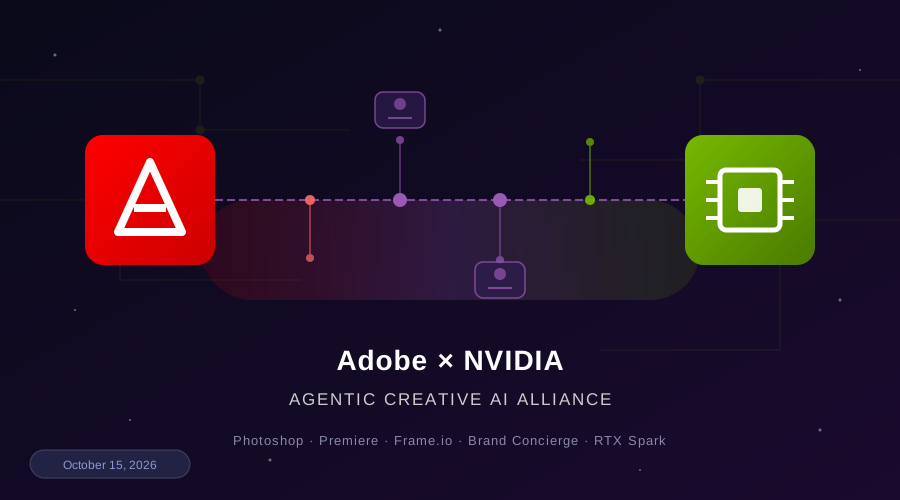
In a move that signals a fundamental shift in how AI is being woven into professional creative tooling, Adobe and NVIDIA announced on October 15, 2026 an expanded collaboration designed to accelerate AI-powered creation, production, and personalization across Adobe’s flagship product portfolio. Building on a strategic partnership formed earlier in March 2026, the new agreement reaches into Photoshop, Premiere Pro, Substance 3D, Frame.io, and Adobe’s enterprise customer experience platform — and it arrives at a pivotal moment for both companies.
Speed as the New Currency of Creativity
The heart of the expanded deal is raw performance. Adobe has optimized Photoshop, Premiere Pro, and Substance 3D Painter for NVIDIA’s new RTX Spark superchip, claiming speedups of up to 2x for AI processing, editing, color grading, and effects. For working professionals, those numbers translate to measurable time savings across daily tasks.
In Photoshop, the headline improvement is a rebuilt GPU-accelerated compositing pipeline that benefits tools like Remove Tool and on-canvas generative effects. Premiere Pro users gain faster playback and rendering, with quicker turnaround on AI features like Enhance Speech and Object Mask — capabilities that have become staples for video professionals doing everything from podcast cleanup to broadcast post-production. Substance 3D Painter, the industry standard for asset texturing, sees reduced processing time across texturing workflows that can balloon in complexity for game and film pipelines.
Perhaps the most striking numbers come from Frame.io, Adobe’s cloud-based video collaboration and review platform. Early testing on selected workloads shows approximately 5x faster embedding generation, a 4-to-5x improvement in P95 processing latency, and an 80% reduction in the size of search proxies. Those efficiency gains matter enormously as creative teams work with growing media libraries — content uploaded to Frame.io can now be indexed and made searchable far sooner, and storage costs for intelligent search infrastructure drop substantially.
Agentic AI Moves to the Center
Performance improvements are only part of the story. The expanded collaboration is equally focused on what both companies describe as “agentic creation” — AI systems capable of coordinating multiple tools, enterprise data sources, and business processes to execute multistep workflows with minimal human intervention.
The most concrete example of this vision is Adobe Brand Concierge, a conversational customer-experience tool now being optimized with NVIDIA’s open Nemotron large language models. Brand Concierge is designed to give enterprise customers a scalable, context-aware system for handling personalized customer interactions at the top of their digital experience stack. NVIDIA has already deployed Brand Concierge on its own NVIDIA.com website as a reference implementation, offering enterprises a live proof of concept. The enterprise version of Brand Concierge powered by Nemotron is expected to become available to customers later in 2026.
Behind Brand Concierge is NVIDIA’s broader Agent Toolkit, which now counts Adobe, Salesforce, and SAP among its key partners. The parallel signal is telling: enterprise software’s biggest names are converging on NVIDIA’s AI infrastructure layer not just for model training, but for daily operational workloads.
Deepa Subramaniam, VP of Product Marketing for Creative Professionals at Adobe, emphasized the creative side of the partnership: “Creative workflows are more multimodal than ever.” The implication is that performance headroom — delivered by NVIDIA hardware and optimized software — keeps creative professionals in a flow state rather than waiting on progress bars.
Jason Paul, VP of Local AI at NVIDIA, framed the business case for the toolmaker: “AI agents are helping creators unlock deeper and richer workflows,” pointing to RTX Spark-powered tools delivering the promised 2x performance gains as proof that local AI acceleration is ready for professional production environments.
The Larger Context: Adobe at a Crossroads
The expanded NVIDIA partnership arrives at a complicated moment for Adobe. The company posted strong fiscal Q3 2026 results — revenue of $6.76 billion, up 13% year over year, with adjusted EPS of $6.13 and annualized recurring revenue of $27.50 billion — but its stock has shed roughly 26% year to date, a sharp underperformance against both the broader market and peers in enterprise software.
The pressure comes from multiple directions. One day before the NVIDIA announcement, HSBC downgraded Adobe, citing the risk that AI tools capable of generating creative assets at lower cost will commoditize the very workflows Adobe charges subscription premiums to support. The fear is straightforward: if AI makes it dramatically cheaper and faster to produce creative content, the economic case for paying full Creative Cloud rates weakens, and competitors offering AI-first tools at lower price points gain ground.
The partnership with NVIDIA is, in part, Adobe’s answer to that concern. Rather than watching AI erode its moat, Adobe is positioning itself as the platform that turns AI into measurable professional output — faster rendering, richer agentic workflows, and enterprise-grade customer experience tooling. The strategic logic holds up on paper, but execution will determine whether the narrative changes investor sentiment.
Adding another dimension to Adobe’s transition: new CEO Anil Chakravarthy takes the helm on December 1, 2026, replacing long-tenured Shantanu Narayen, who moves to executive chair. Chakravarthy currently leads Adobe’s Customer Experience Orchestration business and worldwide field operations — precisely the part of Adobe’s portfolio most relevant to the NVIDIA Brand Concierge collaboration. His ascension suggests Adobe sees the enterprise AI layer as its next growth engine, not just an enhancement to the creative suite that made the company famous.
Regulatory Tailwinds and Headwinds
No discussion of enterprise AI in late 2026 is complete without acknowledging regulation. The EU AI Act’s transparency requirements began applying in August 2026, meaning that customer-facing AI agents — including anything like Brand Concierge deployed in EU markets — must disclose the AI nature of interactions and mark certain outputs in machine-readable form. Responsibility for compliance is shared across model providers, application providers, and deploying organizations, creating a layered compliance burden that adds cost and complexity for enterprises adopting AI at scale.
For Adobe and NVIDIA, the regulatory environment creates both friction and opportunity. Friction because meeting EU AI Act requirements adds development and legal overhead to every enterprise deployment. Opportunity because the compliance burden favors well-resourced platform vendors — exactly what Adobe and NVIDIA represent — over smaller AI-first startups that may struggle to meet the documentation and transparency standards that large enterprises now demand from their software partners.
What to Watch Next
Adobe MAX, scheduled for November 10–12, 2026, will serve as the public showcase for the deepened NVIDIA collaboration, giving creative professionals their first hands-on look at the performance improvements in Photoshop, Premiere, and Substance 3D. Expect the event to be a proving ground: if real-world workflows match the benchmark numbers both companies have put forward, it will be a meaningful moment of validation for the partnership’s near-term promise.
Longer-term, the question is whether agentic AI genuinely extends Adobe’s enterprise revenue opportunity — converting AI adoption into higher subscription tiers, new platform fees for Brand Concierge deployments, and deeper integration with the marketing and analytics stack — or whether the efficiency gains accelerate commoditization faster than Adobe’s pricing power can adapt.
The Adobe-NVIDIA alliance is one of the more consequential partnerships in enterprise software right now, spanning GPU hardware, AI model infrastructure, and creative workflow software in a way that few vendor relationships can match. Whether the combination turns the stock’s year-to-date slide into a foundation for the next growth chapter depends on answers that will emerge in the quarters ahead.
Sources: Adobe Newsroom, ROIC.ai, GuruFocus, Simply Wall St