Adobe’s third quarter of fiscal 2026 will likely be remembered for two things: the moment the creative software giant crossed 1 billion monthly active users, and the passing of the torch from one of Silicon Valley’s longest-serving CEOs to a leader who will shepherd the company through its most ambitious AI transformation yet.
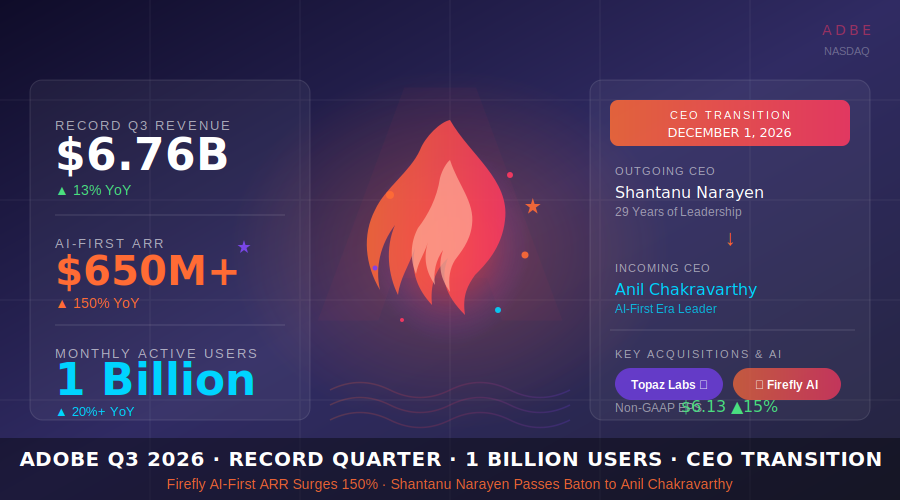
When Adobe reported its Q3 results on September 10, 2026, the headline numbers were undeniably impressive. Revenue hit a record $6.76 billion, growing 13% year-over-year in constant currency terms. Non-GAAP earnings per share climbed 15% to $6.13. The company raised its full-year revenue guidance, signaling confidence in the quarters ahead. By virtually every traditional metric, Adobe had delivered a blowout quarter.
But beneath those records lies a more nuanced story — one that captures exactly where enterprise software is headed as companies trade short-term monetization for long-term platform dominance in the age of AI.
A Billion Users: The Scale Adobe Bet On
Perhaps the most striking milestone in the quarter wasn’t a revenue figure at all. Adobe’s monthly active users crossed 1 billion — a figure that, just three years ago, would have seemed absurd for a company best known for expensive professional software subscriptions.
The number breaks down into two distinct cohorts. Creative freemium monthly active users surpassed 100 million, a staggering 70% jump year-over-year. Meanwhile, Acrobat and Adobe Express users exceeded 900 million monthly actives, up 25% year-over-year. These aren’t casual visitors clicking around a trial — they represent a massive base of users now embedded in Adobe’s ecosystem across mobile, web, and desktop.
CEO Shantanu Narayen captured the company’s philosophy bluntly on the earnings call: “We are incredibly impatient to drive a whole bunch of users,” even if it means accepting near-term metrics that give investors pause. That statement alone explains much of the quarter’s complexity.
The AI Bet: Firefly Takes Flight
At the center of Adobe’s strategy is Firefly, its generative AI platform woven throughout Creative Cloud applications. In Q3, Adobe’s AI-first ending annual recurring revenue (ARR) exceeded $650 million — a figure that grew more than 150% year-over-year. Firefly’s own ending ARR grew 40% sequentially, driven by accelerating adoption of video generation capabilities and AI credit consumption.
The numbers signal something important: enterprise customers and individual creators are not just experimenting with Adobe’s AI tools — they’re paying for them and consuming them at an accelerating rate. Firefly video generation, which allows creators to produce and extend video clips using text prompts, has been a particular standout, drawing in a category of content creators who previously had no viable AI-native workflow within the Adobe suite.
Adobe also announced the acquisition of Topaz Labs, an AI enhancement provider with over 1 million users and Emmy Award-winning technology for upscaling and noise reduction in video. Expected to close in Q4, the deal signals Adobe’s intent to be the professional standard not just for image creation, but for AI-enhanced post-production video workflows.
The company’s enterprise AI agent, CX Enterprise Coworker, attracted more than 1,700 customers since its June launch — a go-to-market velocity that rivals some of the best-performing AI product launches in the industry.
The Numbers Wall Street Debated
Not everything in the quarter was unambiguously rosy, and analysts were quick to flag two metrics worth watching.
Net new ARR declined 36–37% year-over-year. Adobe management was direct about the cause: the company is intentionally shifting toward freemium and deferring pricing initiatives to maximize user acquisition. In other words, Adobe is playing the long game — get users on the platform first, monetize deeply later. It’s the same logic that drove Slack, Spotify, and Zoom to enormous enterprise footprints, and it’s now Adobe’s playbook for the AI era.
Remaining performance obligations (RPO) growth also slowed to 8% year-over-year, the first time it’s dipped into single digits since early 2023. For a company of Adobe’s scale, RPO is a leading indicator of future revenue visibility, and slower growth here suggests that Adobe’s pipeline of committed future revenue isn’t compounding as quickly as it once was. Whether that’s a temporary effect of the freemium pivot or a structural concern remains the central debate among investors.
A CEO Passes the Baton After 29 Years
Buried in the earnings press release but dominating post-call discussions was a piece of news that few saw coming: Shantanu Narayen will step down as President and CEO on December 1, 2026, transitioning to the role of Executive Chairman after an extraordinary 29-year tenure — including more than 18 years as chief executive.
His successor, Anil Chakravarthy, currently serves as President of Customer Experience and has deep roots across all three of Adobe’s major business segments. Chakravarthy is known internally as an architect of Adobe’s experience platform strategy and has been closely involved in the company’s AI roadmap. He inherits a company with record revenue, 1 billion users, and an AI bet that is beginning to pay off — but also one that is deliberately suppressing certain financial metrics in favor of scale.
Narayen’s legacy is profound. He oversaw Adobe’s transformation from a packaged software company selling shrink-wrapped boxes at retail to one of the most powerful SaaS platforms in enterprise software history. He navigated the controversial Creative Suite-to-Creative Cloud migration, the $20 billion acquisition attempt of Figma (ultimately blocked by regulators), and now the early innings of an AI-native era. Under his leadership, Adobe’s market capitalization grew from roughly $7 billion when he became CEO to over $250 billion at its peak.
“He has been an extraordinary partner, colleague, and leader,” Chakravarthy said on the call. “This is a natural transition — one we have been planning together.”
What Comes Next for Adobe
The picture that emerges from Q3 is of a company in confident transition: leadership, business model, and product strategy all shifting simultaneously, but guided by a coherent vision. Adobe is betting that 1 billion monthly active users — trained on its tools, dependent on its AI, embedded in its document workflows — represents a monetization opportunity far larger than any short-term ARR metric can capture.
The Topaz Labs acquisition expands Adobe’s position in professional video, a segment where AI-powered enhancement and generation are converging rapidly. The freemium pivot into Acrobat and Express positions Adobe to own document intelligence workflows for billions of business users globally, not just the niche of creative professionals it has long served.
Chakravarthy will step into a role where the strategy is already set and the numbers are still strong. His challenge will be executing the monetization arc — demonstrating that the 1 billion users Adobe has gathered will convert, over time, into the kind of ARR growth that justifies the investment.
For now, Adobe has delivered one of the most significant quarters in its history: a record revenue milestone, a generational leadership handoff, and a billion people using its tools every month. The debate over what it all means for the next several quarters is, in many ways, exactly the right debate to have.
Sources: Adobe Q3 2026 Earnings Call, Adobe Investor Relations, The Motley Fool Transcript, BigGo Finance, Yahoo Finance