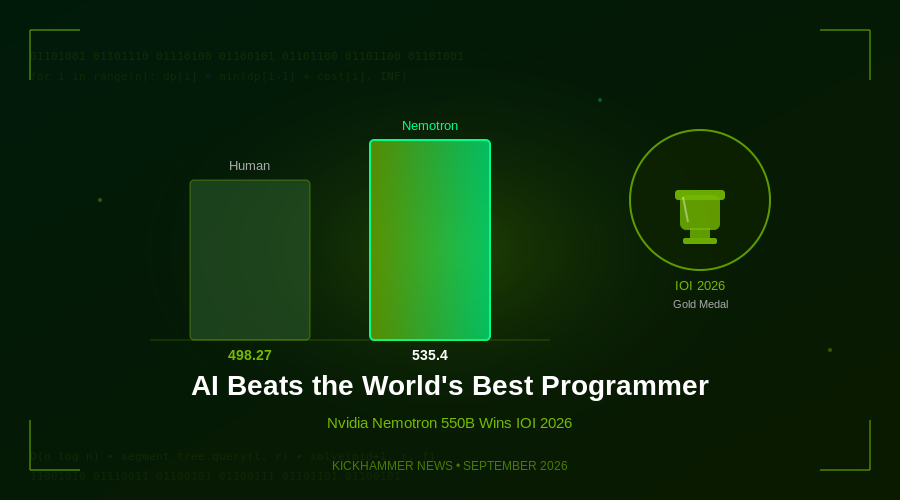
For the first time in the history of competitive programming, an artificial intelligence system has outscored every human contestant at the International Olympiad in Informatics. Nvidia’s Nemotron-3-Ultra-550B, the company’s flagship open-weight reasoning model, achieved a score of 535.4 out of 600 at IOI 2026 — surpassing the gold medal threshold of 361.12 and, more significantly, the top human score of 498.27. The result was published this week in a preprint paper and immediately triggered a wave of discussion about what AI dominance in elite competitive programming means for software engineering, education, and the future of human expertise.
The Competition and the Stakes
The International Olympiad in Informatics is not a hobbyist coding competition. It draws the most talented young programmers from across the globe, students who have spent years training on algorithmic problems that require deep mathematical intuition, creative problem decomposition, and precise implementation under time pressure. Winning a gold medal at IOI is the kind of achievement that opens doors at the world’s best technology companies and research labs. The problems are novel, crafted specifically for each year’s competition, and designed to resist rote memorization.
That novelty is what makes Nvidia’s result particularly significant. The evaluation was conducted prospectively — during the actual competition, under the same time limits, internet access rules, and submission constraints as the human contestants. The problems were new. Nemotron had not seen them before. This eliminates the most common objection to AI benchmark performance: that models simply regurgitate solutions they encountered in training data.
How Nemotron 3 Ultra Was Built
Nemotron-3-Ultra-550B was publicly released in June 2026 and is structured as a Mixture-of-Experts architecture, meaning that while it contains 550 billion parameters, each forward pass through the model only activates approximately 55 billion — giving it frontier-scale capability at a fraction of the computational cost of a dense model of equivalent size. The architecture makes it practical to deploy for long-running agentic tasks where inference costs can accumulate quickly.
For the IOI challenge specifically, Nvidia used a combination of large-scale problem curation, synthetic reasoning traces, supervised fine-tuning, and reinforcement learning. The key technical contribution is a technique called GenCorrect — a feedback-driven test-time compute strategy that iteratively generates candidate solutions, evaluates them against test cases, identifies failure modes, and refines the solution accordingly. Rather than producing a single answer and hoping it is correct, GenCorrect treats competitive programming as an iterative debugging problem, cycling through alternatives until a solution passes.
This approach mirrors what experienced human programmers actually do when they are stuck: generate a hypothesis, test it, observe where it breaks, and revise. The difference is that Nemotron can execute this loop far faster and across a much larger space of possible approaches than a human working under competition time constraints.
What the Score Actually Means
A score of 535.4 versus a top human score of 498.27 sounds like a comfortable margin, but competitive programmers who analyzed the results noted that the gap is less about raw intelligence and more about computational throughput. Nemotron can explore many more candidate solutions within a given time window than a human can mentally evaluate. The model does not get tired, does not panic under pressure, and does not make the kind of implementation errors — a misplaced index, a forgotten edge case — that frequently cost human contestants points.
Whether this constitutes “beating” human programmers in any meaningful sense is debated. The humans are working alone, in real time, under psychological pressure, with no ability to rapidly iterate through thousands of variants. The model is, in a sense, running a highly sophisticated brute-force search over solution space. Critics argue that this is a different skill than the genuine insight required to identify the correct algorithmic approach from scratch.
Proponents counter that the distinction does not matter for practical purposes. If an AI system can reliably produce correct solutions to problems that the world’s best human programmers struggle with, the implications for software development are the same regardless of the mechanism.
Implications for Software Engineering
The IOI result arrives in a context where AI coding tools are already transforming professional software development. Companies like Airbnb reported earlier this year that AI writes more than 60 percent of new code in some engineering teams. GitHub Copilot and its competitors have become standard tools across the industry. What the IOI result suggests is that the ceiling on AI coding capability is much higher than even optimistic projections assumed.
Elite competitive programming is, in some ways, the hardest form of software engineering — it demands algorithmic breadth, mathematical depth, and implementation precision simultaneously. If AI can dominate at this level, the question of which software engineering tasks remain firmly in human hands becomes considerably narrower.
The most likely near-term effect is not the elimination of software engineers but a shift in what they do. Writing implementation code — translating a known algorithm into working software — will increasingly be delegated to AI. The human contribution will concentrate in the upstream work: understanding requirements, designing systems, making architectural tradeoffs, and knowing which problem is worth solving in the first place. Those are skills that competitive programming, for all its rigor, does not really test.
Open Weights, Open Questions
One detail that distinguishes the Nemotron result from comparable achievements by OpenAI or Google: the model is open-weight. Nvidia has released the full model weights, meaning researchers, companies, and developers worldwide can download, fine-tune, and deploy Nemotron-3-Ultra-550B without API fees or usage restrictions. That has significant implications for who can access and build on top of frontier AI capability.
Open-weight frontier models have been a competitive pressure on proprietary labs all year, with Alibaba’s Qwen series accumulating three billion downloads and reshaping cost expectations across the industry. A 550-billion-parameter model that can outperform the world’s best human programmers at competitive tasks, available for free, is a different kind of disruption than a comparable proprietary API.
The IOI milestone will not be the last. AI progress in competitive programming has followed a consistent trajectory: each year’s frontier systems perform better than the last, and the gap between AI and top humans narrows. This year, it closed entirely. The question now is not whether AI can match elite human performance in narrow technical domains — it can — but what that means for the humans who built their identities and careers around being the best.


