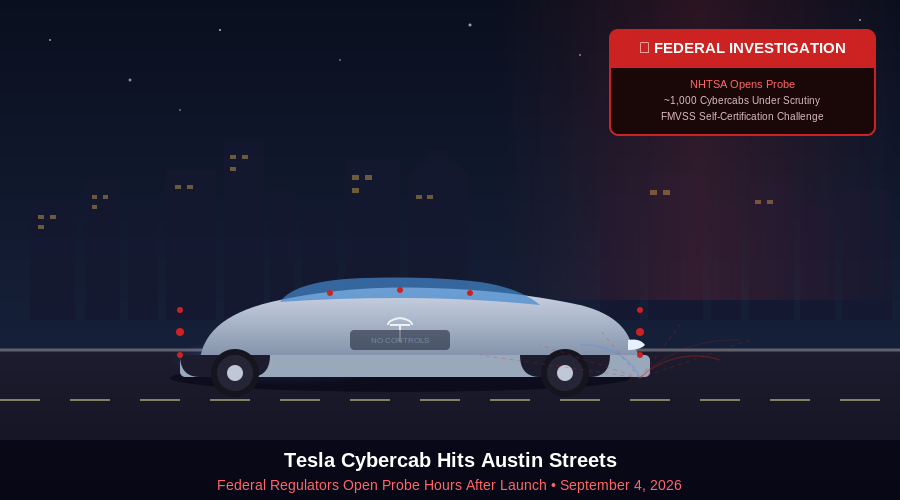
The moment was equal parts historic and chaotic. On the morning of September 3, 2026, Tesla put its first production Cybercabs on the streets of Austin, Texas — a milestone years in the making and arguably the most consequential day in the history of autonomous vehicle commercialization. By the following morning, the National Highway Traffic Safety Administration (NHTSA) had opened a formal investigation into those very cars. Welcome to the future of transportation.
The Car That Started a Regulatory Firestorm
The Tesla Cybercab is unlike any vehicle that has ever carried paying passengers on American public roads. There is no steering wheel. No brake pedal. No accelerator pedal. No mirrors in the traditional sense. What sits inside is a minimalist two-seat cabin powered by Tesla’s AI4 chip stack, guided entirely by nine cameras and a neural network that has been trained on billions of miles of real-world driving data.
The vehicle’s specs are genuinely impressive. Tesla claims an EPA-equivalent all-electric rating of 418 miles — 375 highway — though the company itself has said real-world drivers should expect closer to 300 miles per charge. The interior features ample legroom, individual climate control for each seat, and a spacious trunk. An Unreal Engine-powered interface greets riders. Unlike Waymo’s robotaxis, which use a combination of cameras, radar, and LiDAR to map the environment around them, the Cybercab relies exclusively on vision — the same philosophical bet Tesla has made across its entire self-driving program.
For years, critics argued this bet would never pay off. For a few hours on September 3, it looked like it might have. Then the lawyers got involved.
NHTSA Moves in Hours
The National Highway Traffic Safety Administration did not wait long. On Friday morning, September 4 — barely hours after the first paid Cybercab rides began rolling through Austin — the agency announced it had opened an investigation into nearly 1,000 Tesla Cybercabs.
The core issue is straightforward, even if the legal terrain is not: federal motor vehicle safety standards require that road-legal vehicles have manual controls, including a brake pedal. The Cybercab has none. Tesla argued in its self-certification filing that it had reviewed the relevant Federal Motor Vehicle Safety Standards (FMVSS) and determined the Cybercab was compliant — in part by characterizing certain requirements as simply inapplicable to a vehicle that was never designed to have human controls.
NHTSA said it opened the investigation to “examine the process and technical data on which Tesla relied when certifying the Cybercab and related issues.” Specifically, the agency said it would look at “the extent to which the company’s certification depended on determinations that certain federal motor standards are inapplicable to the Cybercab.”
In plain English: NHTSA wants to know whether Tesla’s reasoning for calling itself compliant actually holds up.
A Regulatory Gray Zone, By Design
The broader regulatory context matters here. In June 2026, the Trump administration’s Department of Transportation proposed removing the requirement for brake pedals and steering wheels in vehicles designed exclusively for autonomous operation — a policy change that would have explicitly legalized vehicles like the Cybercab. That proposal was still working its way through the regulatory comment period when Tesla decided it couldn’t wait any longer.
The company appears to have made a calculated bet: move first, argue compliance later. It is a strategy with precedent in Tesla’s history, and it has worked before. But it is also a strategy that carries significant risk, particularly with nearly 1,000 vehicles already on the road.
Competitors like Waymo, which has been running fully autonomous rides in San Francisco and Phoenix for years, sought regulatory approval through a more cautious path — one that involved extensive engagement with state and federal regulators long before putting passengers in its cars. Waymo has not had to face an investigation into its self-certification practices, in part because it worked to establish regulatory frameworks before it deployed.
Tesla’s approach is different. Elon Musk has long argued that excessive regulatory caution delays technologies that could save lives. The company’s FSD (Full Self-Driving) system has accumulated an extraordinary amount of real-world data, and Tesla has pointed to that data as evidence that its technology is ready. Whether NHTSA agrees — and whether the self-certification argument survives scrutiny — is now a question that will play out over months, not days.
What This Means for the Robotaxi Race
The Cybercab’s arrival in Austin marks a genuine inflection point regardless of how the investigation resolves. For the first time, a production vehicle with no manual controls is carrying paying passengers on American streets at scale. That alone changes the conversation around autonomous vehicles.
The economics of the Cybercab, if the regulatory questions can be resolved, are potentially transformative. Without a driver, operating costs drop dramatically. Tesla has not announced a formal per-mile fare for the Austin service, but early reports suggest the pricing is competitive with — and in some cases cheaper than — conventional rideshare options. If Tesla can replicate that across major cities, it has the potential to fundamentally reshape the urban transportation market.
The broader competitive landscape is also shifting rapidly. Waymo continues to expand its paid service footprint. Zoox, Amazon’s autonomous vehicle subsidiary, is accelerating its own deployment plans. Uber, which just announced layoffs of 3,300 people partly to fund its robotaxi transition, is betting its future on a world where self-driving vehicles handle the economics it can no longer sustain with human drivers. Tesla’s move has injected urgency into all of those timelines.
The Stakes Are High on Both Sides
If NHTSA determines that Tesla’s self-certification was improper, the agency could require the company to recall or ground the Cybercabs pending a formal rulemaking process — a potentially devastating blow to a commercial launch that has already begun building customer expectations. If, on the other hand, the investigation concludes that Tesla’s approach was defensible, it would set a significant precedent: autonomous vehicles can self-certify their way onto public roads without waiting for Congress or regulators to rewrite the rulebook.
The outcome will shape not just Tesla’s future, but the future of how autonomous vehicles are introduced in the United States. It will inform how companies like Waymo, Zoox, and dozens of startups approach the question of when and how to deploy.
For now, the Cybercabs are still rolling through Austin. The cameras are watching. The neural networks are deciding. And somewhere in Washington, D.C., federal investigators are just getting started.


