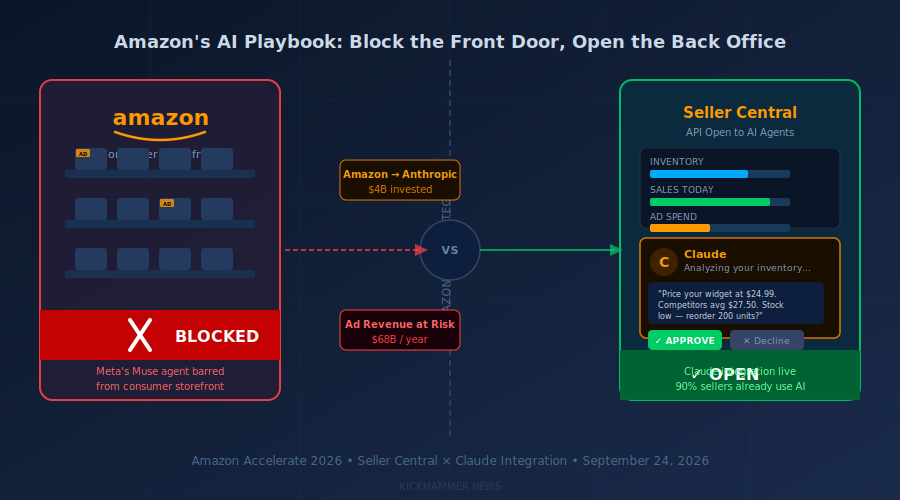
In a move that perfectly encapsulates Silicon Valley’s most fascinating contradiction, Amazon this week did two things that seem almost impossible to reconcile: it blocked Meta’s AI shopping agent from browsing its storefront, then turned around and threw open its seller tools to outside AI assistants — starting with Anthropic’s Claude.
Welcome to Amazon’s AI strategy. It’s not anti-AI. It’s just very, very particular about which AI gets to do what.
What Amazon Actually Announced
At Amazon Accelerate, the company’s annual conference for independent third-party sellers, Amazon unveiled a suite of new AI-powered capabilities that fundamentally change how the 2 million-plus merchants who run their businesses on Amazon can interact with the platform.
The headline feature: a plugin that lets sellers connect their Amazon Seller Central accounts to external AI agents in under 60 seconds, no coding required. The first integration? Anthropic’s Claude — the very company Amazon has invested $4 billion in over the past two years.
Once connected, Claude gains access to a seller’s listings, inventory levels, sales analytics, and performance metrics. Sellers retain granular control: they can choose which data categories the plugin can see and must approve each action before it’s executed. The platform is read-write, meaning Claude can recommend price changes and then make them — but only after the seller signs off.
It’s AI as a co-pilot, not an autopilot.
The Numbers That Made This Inevitable
Amazon didn’t build this because it suddenly fell in love with AI. It built this because 90 percent of its sellers were already using external AI to run parts of their operations — and they were doing it with cobbled-together screen scrapers, unofficial workarounds, and third-party tools that created security risks and compliance headaches for everyone involved.
The independent seller ecosystem that Amazon is now officially wiring for AI is not a sideshow. These merchants account for more than 60 percent of Amazon’s unit sales. In Q2 2026 alone, they paid Amazon $46.8 billion in fees. When that community tells you they’re living in AI-powered spreadsheets and asking ChatGPT to draft their product descriptions, you build the official on-ramp before someone builds a worse unofficial one.
Beyond the Claude Plugin
The Claude integration is the flagship, but Amazon also unveiled several supporting tools that reframe how the Seller Central platform works entirely.
Seller Assistant Canvas is a visual workspace that pulls live seller data into a structured view, making it easier to compare pricing strategies side by side or diagnose why an ad campaign is underperforming. It’s the kind of dashboard that used to require a third-party analytics subscription.
Background Automations takes the agentic concept further: the system monitors seller accounts continuously and can act on the seller’s behalf — again, with approval — when specific conditions are met. Think automated price matching during a flash sale window, or inventory reorder triggers when stock drops below a threshold.
Enhanced Memory upgrades the existing Amazon Seller Assistant to remember context across sessions: a seller’s typical pricing patterns, inventory seasonality, and long-term growth goals. Instead of starting from scratch each conversation, the assistant builds an accumulating model of the business it’s helping run.
Amazon said more external integrations will follow Claude and Quick, its own assistant. The company declined to name specific platforms but the implication is clear: Seller Central is becoming an open API ecosystem for AI agents, at least on the seller side.
The Obvious Contradiction — and Why It Makes Sense
One week ago, Amazon blocked Meta’s Muse AI agent from accessing its consumer-facing storefront. The reasons cited were straightforward: Muse was browsing Amazon product pages without disclosure, potentially capturing credential information, and — most critically — siphoning transactions away from Amazon’s advertising ecosystem. The company earns an estimated $68 billion annually from ads that are specifically designed to influence what shoppers click on its site. An AI agent that routes around that influence, helping consumers buy products without ever seeing a sponsored placement, represents an existential threat to that revenue model.
What Amazon opened this week is entirely different. Seller Central is not the consumer storefront. It’s the back office. The business users who connect Claude to their Amazon accounts are not consumers making purchasing decisions — they’re merchants optimizing their inventory, adjusting their listings, and analyzing their own performance data. There’s no advertising revenue to protect because there’s no consumer browsing experience involved.
From Amazon’s perspective, the logic is almost elegant: AI agents that touch the consumer funnel get blocked; AI agents that help sellers operate more efficiently get welcomed. The first category threatens revenue. The second category makes Amazon’s seller ecosystem more competitive, reduces churn, and — not incidentally — benefits Anthropic, a company Amazon has bet billions on.
The Anthropic Angle
The choice to launch with Claude as the first external integration is not subtle. Amazon has poured $4 billion into Anthropic and is Anthropic’s primary cloud partner, with Claude models running on Amazon Web Services via the Bedrock platform. Giving Claude pride of place in the Seller Central ecosystem extends that partnership into an entirely new commercial surface area.
For Anthropic, access to Amazon’s seller base is a potentially transformative distribution channel. The 2 million-plus businesses running on Amazon include everything from solo operators to mid-market retailers. If Claude becomes their default AI co-pilot for running their Amazon business, Anthropic picks up enterprise relationships at a scale that would be nearly impossible to build through direct sales.
For Amazon sellers, the calculation is more pragmatic: they get a sanctioned, secure path to AI assistance instead of the unofficial workarounds most of them were already using.
What This Signals for Agentic Commerce
The Seller Central opening is part of a broader pattern emerging across enterprise platforms: the distinction between “AI tools” (things humans use) and “AI agents” (things that act) is collapsing, and the platforms that govern large commercial ecosystems are making very deliberate choices about where agents are allowed to operate.
Amazon’s framework — agents welcome in the back office, banned from the consumer floor — may become a template. It threads the needle between AI-enabled operational efficiency and protection of the advertising and curation revenue models that fund the platforms themselves.
The $46.8 billion question is whether that distinction is sustainable. As AI agents become more capable, the line between “helping a seller” and “influencing a consumer” will blur. A Claude that knows a seller’s inventory, pricing strategy, and sales analytics is a Claude that is increasingly close to being able to make autonomous decisions about how products are presented to consumers.
Amazon knows this. That’s almost certainly why the seller-side opening comes with such careful approval gating: every action requires explicit human sign-off. For now, the agent is still a co-pilot. Amazon is making very sure of that.
The Bottom Line
Amazon Accelerate 2026 marked a turning point in how the world’s largest e-commerce platform thinks about AI agents. By opening Seller Central to Claude — and signaling that more integrations will follow — Amazon is building the infrastructure for a future where AI agents are routine parts of running an online business.
The same company that blocked Meta’s Muse agent from browsing its storefront just handed 2 million sellers an official API to let AI run their back offices. That’s not a contradiction. That’s a strategy.
The two moves, taken together, reveal what Amazon is actually optimizing for: an AI ecosystem where it controls the access points, captures the economics, and keeps the consumer experience — and its advertising machinery — squarely under human (and Amazon) control.
For sellers, this week’s announcement is straightforwardly good news. For anyone hoping AI agents will eventually give consumers the same kind of end-to-end purchasing power that Amazon just handed its sellers, the wait continues.


