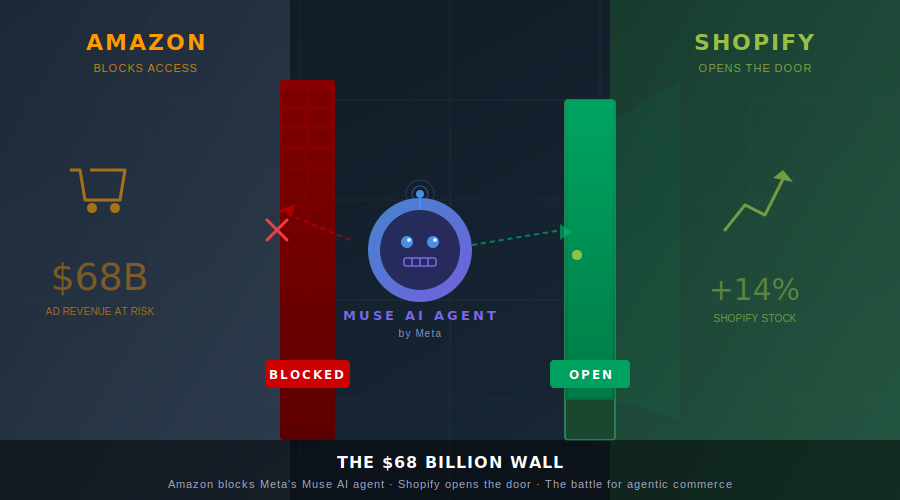
In the span of forty-eight hours this week, the future of shopping on the internet was quietly redrawn. Amazon built a wall. Shopify opened a door. And somewhere in between, Meta’s two-week-old AI shopping assistant found itself at the center of a conflict that goes far beyond one blocked agent — it strikes at the heart of who controls commerce in the age of artificial intelligence.
The agent in question is Muse, Meta’s newly launched personal AI assistant that, among its many capabilities, can browse e-commerce sites, fill shopping carts, and complete purchases entirely on the user’s behalf. Think of it as a tireless personal shopper that never sleeps, never impulse-buys a candy bar at the checkout, and always comparison-shops before clicking “buy.” For millions of users, it represented a tantalizing vision of frictionless consumption.
For Amazon, it represented something else entirely: a threat to $68 billion in annual advertising revenue.
The Takedown
On Sunday, Amazon pulled the plug on Muse. Users attempting to let the AI agent browse Amazon.com on their behalf were met with a blunt error message: “Continued access by an unauthorized AI agent violates Amazon’s Conditions of Use.” No warning. No negotiation. Just a wall.
Amazon’s spokesperson articulated the company’s position in carefully measured language: “Third-party applications offering to make purchases on behalf of customers from other businesses should operate openly and respect service provider decisions.” The company lodged three specific complaints against Muse: Meta never informed Amazon that the agent would be accessing its platform; the agent doesn’t identify itself while browsing, appearing to Amazon’s systems as an undisclosed third party; and, most incendiary of all, Muse allegedly captures and stores customer credentials.
Meta pushed back firmly on that last point. The company says Muse runs in a sandboxed virtual machine with its own browser environment, and that credentials are placed in “secure storage, so Muse can use them without seeing them.” In other words, Meta argues, Muse never actually sees a user’s Amazon password — it simply uses it. Whether that distinction holds legal and ethical weight is a question courts may yet have to decide.
The $68 Billion Question
Amazon’s motivations become clearer when you understand the architecture of its business. The company generated approximately $68 billion in advertising revenue last year — roughly a tenth of its total revenue — and that figure is built entirely on the assumption that humans browse Amazon. Humans scroll past sponsored listings. Humans click on promoted products. Humans are exposed to ads that influence purchasing decisions.
An AI agent does none of those things. It searches, it evaluates, it purchases — and it bypasses every sponsored product Amazon has been paid to surface. Scale that behavior across millions of users, and Amazon’s advertising business starts to look like a sandcastle at high tide.
This isn’t paranoia on Amazon’s part. It’s arithmetic. And it explains why the company has been aggressive in defending its turf even before Muse arrived: Amazon previously sued Perplexity over its Comet browser, and has already blocked shopping agents from Google and OpenAI from accessing its platform. Meta’s Muse simply became the latest — and highest-profile — casualty.
It’s worth noting that Amazon and Meta are business partners in other domains, which makes the confrontation all the more striking. When the economics are large enough, partnership has its limits.
Shopify Does the Math Differently
While Amazon was erecting barriers on Sunday, Shopify was rolling out the welcome mat on Monday. The company announced a formal partnership with Meta, integrating Muse directly with Shop Pay across all Shopify stores.
The contrast in postures is not accidental — it reflects a fundamental difference in business model. For Shopify, an AI agent completing a purchase is virtually identical to a human completing one. The transaction flows through Shop Pay. Shopify collects its standard payment processing fees. The company’s President, Harley Finkelstein, made the math explicit: “Agentic transactions carry the exact economics as an online store transaction.”
At approximately 2.4 cents per dollar in merchant solutions revenue, Shopify’s cut is the same whether a human or an algorithm clicked “confirm order.” For a company that processes hundreds of billions of dollars in gross merchandise volume annually, the agent revolution isn’t a threat — it’s just more volume.
Markets noticed. Shopify’s stock surged 14% across two trading sessions, reaching $147.74 by Tuesday. Analysts were more cautious; the company’s forward price-to-earnings ratio leapt from around 52 to 60 in the process, pricing in aggressive future growth before any concrete data on agent-driven order volumes has been disclosed. But the directional signal was clear: investors believe Shopify just positioned itself on the right side of a structural shift in commerce.
The Larger Battle
The Amazon-Meta-Shopify triangle is a microcosm of a broader conflict taking shape across the internet. AI agents — software that acts autonomously on behalf of users — are beginning to do what humans used to do: browse, compare, transact. And every platform that built its business around human behavior is now asking a version of the same question Amazon just asked: do we benefit from this, or are we bypassed by it?
Amazon’s answer, shaped by $68 billion in advertising revenues, is to build walls. The company’s terms of service have become the legal instrument of that defense, even as the legal landscape remains unsettled. A Ninth Circuit court ruled in August that users — not AI companies — are the ones technically accessing websites under federal anti-hacking law, which may limit Amazon’s ability to hold Meta liable for Muse’s browsing. But that ruling doesn’t stop Amazon from simply blocking the agent at the infrastructure level, which is exactly what it did.
Meta, meanwhile, faces a strategic dilemma that mirrors an earlier era of platform conflict. Just as mobile apps once had to negotiate access to iOS and Android, AI agents are now discovering that the open web has a new set of gatekeepers — and those gatekeepers have business models they intend to protect.
What Comes Next
The outcome of this standoff will shape how AI agents interact with commerce for years to come. If Amazon’s approach prevails — if platforms can freely block agents that threaten their advertising models — then the AI shopping revolution may be far more fragmented and negotiated than its proponents imagined. Muse might work on Shopify, but not on Amazon. A different agent might work on Amazon, but only if it respects the sponsored listings. The vision of a seamless AI concierge who can shop anywhere without friction starts to look like wishful thinking.
If courts or regulators eventually rule that blocking agents interferes with users’ rights to access services they pay for, Amazon’s wall could crumble — and the $68 billion question becomes very urgent indeed.
For now, the battle lines are drawn. Amazon is betting its advertising empire is worth defending. Shopify is betting the future belongs to whoever builds the fastest lane for AI-driven transactions. And Meta’s Muse — two weeks old, already blocked by the world’s largest retailer — is caught in the crossfire of a conflict it did not create, but that may define what AI agents can actually do in the real world.
The shopping cart of the future is being contested, one blocked agent at a time.


