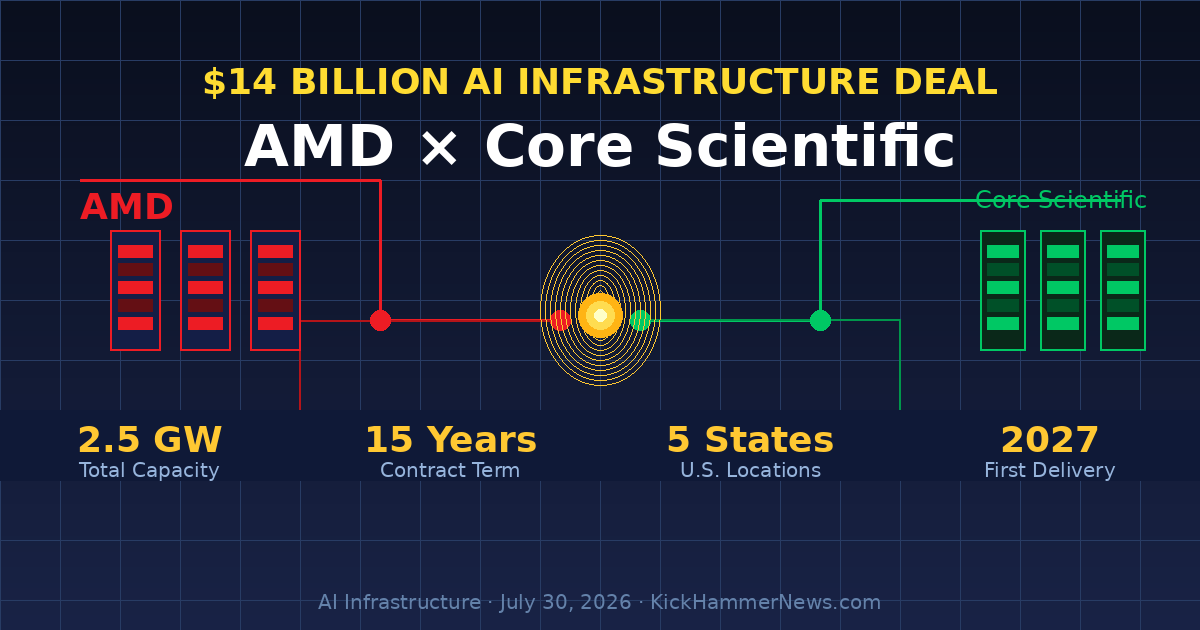
AMD’s 15-year, 2.5-gigawatt pact with the former Bitcoin miner signals a full-scale assault on NVIDIA’s grip over AI compute — and a dramatic reinvention of America’s data center landscape.
When AMD and Core Scientific announced their infrastructure partnership on July 28, 2026, the numbers alone commanded attention: 530 megawatts of AI data center capacity under 15-year agreements, scalable to 2.5 gigawatts across five U.S. sites, with more than $14 billion in potential contracted revenue. But behind the figures lies a story about two companies betting their futures on the AI infrastructure boom — and a chip giant’s most serious attempt yet to break NVIDIA’s stranglehold on the market.
From Bitcoin Rigs to AI Clusters
Core Scientific’s transformation is remarkable on its own terms. Not long ago, the company was best known as one of America’s largest Bitcoin miners, filling warehouses in Texas and the Southeast with SHA-256 ASICs and riding the volatile fortunes of the crypto market. When Bitcoin’s economics turned unfavorable in 2022, Core Scientific filed for bankruptcy. It emerged in 2023, restructured and determined to diversify.
The pivot to high-density AI colocation started in earnest through 2024 and 2025. The logic was straightforward: the same attributes that made Core Scientific good at Bitcoin mining — cheap power contracts, purpose-built facilities, engineering expertise in dense compute environments — translated directly to hosting GPU clusters for AI. The difference was that AI customers paid reliably on long-term contracts, not on the price of a volatile digital token.
The AMD deal, announced Tuesday, is the capstone of that transformation. Core Scientific will build and operate dedicated AI campuses across five states: 185 megawatts in Pecos, Texas; 110 megawatts in Hunt County, Texas; 120 megawatts in Dalton, Georgia; 82 megawatts in Muscogee, Oklahoma; and 32 megawatts in Auburn, Alabama. The first two sites — Pecos and Auburn — are set to deliver power in the first half of 2027, with all 530 megawatts delivered by the end of 2028.
AMD also received warrants to purchase Core Scientific shares as part of the deal, tying the chipmaker’s fortunes more closely to the infrastructure partner it is betting on.
AMD’s Play in the AI Arms Race
For AMD, the strategic stakes could not be higher. Despite strong GPU sales and meaningful market share gains, the company has watched NVIDIA consolidate a near-monopoly position in AI accelerator revenue. NVIDIA’s CUDA software ecosystem, accumulated over nearly two decades, remains the default for AI researchers and enterprise customers alike. AMD’s ROCm software stack is mature and capable, but switching costs are real and inertia is powerful.
What AMD can offer that NVIDIA currently cannot is guaranteed capacity at scale. By locking in 2.5 gigawatts of dedicated infrastructure with a cooperative partner, AMD can promise enterprise customers something increasingly scarce: a place to run their workloads. As hyperscalers like Microsoft, Google, and Amazon build their own in-house silicon and compete intensely for independent capacity, the ability to point a prospective customer at a dedicated campus with power, cooling, and networking already arranged is a significant differentiator.
The deal also encompasses the full AMD stack. Core Scientific’s facilities will be designed around AMD Instinct GPUs — the MI300 series and its successors — alongside EPYC CPUs for the CPU-intensive parts of AI inference pipelines. The two companies will collaborate on physical infrastructure design from the ground up, meaning the campuses will be purpose-optimized for AMD hardware rather than retrofit from a generic design.
The Power Question
A deal of this magnitude does not happen without confronting the fundamental constraint on AI’s growth: electricity. The 530 megawatts under contract in the initial phase, and the 2.5 gigawatts in the option, represent an enormous draw on local grids and power infrastructure.
Pecos, Texas — where the largest single site will sit — has become one of the de facto centers of the American AI infrastructure build-out. The Permian Basin region has access to substantial transmission capacity and wind generation, and Texas’s deregulated grid, managed by ERCOT, offers flexibility that regulated markets in other states do not. Hunt County, also in Texas, adds another large footprint in a state that has aggressively positioned itself as an AI infrastructure destination.
The geographic spread across Georgia, Oklahoma, and Alabama is also intentional. It diversifies grid exposure, takes advantage of power contracts in different regional transmission organizations, and builds political support across multiple states — a consideration that has become more important as federal and state governments scrutinize the impact of AI data centers on grid reliability and consumer electricity rates.
All five sites will be built to handle the power density requirements of modern GPU clusters, which routinely demand 30 to 50 kilowatts per server rack, compared to 5 to 10 kilowatts for a traditional enterprise rack. That density requires specialized cooling, structural reinforcement, and power distribution that only purpose-built facilities can reliably provide.
What It Means for the Industry
The AMD-Core Scientific deal is the latest and largest signal of a structural shift in how AI compute is procured. Historically, AI companies rented capacity from hyperscalers by the hour or the month. The era of long-term, dedicated infrastructure contracts — sealed years before the facilities exist — reflects a conviction that AI demand will remain sustained and that generic cloud capacity will be insufficient for the most demanding workloads.
NVIDIA has pursued a similar strategy, most visibly in the Stargate joint venture with OpenAI, SoftBank, and Oracle, which announced plans for $500 billion in U.S. AI infrastructure investment earlier this year. The AMD deal is smaller in announced scale but more concrete in its contractual commitments: 15-year agreements with defined power milestones are not aspirational press releases.
For Core Scientific, the deal cements a position as a Tier 1 AI infrastructure partner rather than a speculative crypto-adjacent data center operator. The $14 billion in contracted revenue over the agreement’s life provides a financial foundation that most companies in the colocation business would envy.
For AMD, the bet is existential in a more subtle way. If Instinct GPUs and ROCm can prove themselves at scale inside purpose-built campuses where AMD controls the hardware stack end to end, the performance and compatibility arguments against switching from NVIDIA weaken considerably. The company is not just building data centers; it is building a reference implementation of what an AMD-native AI cluster looks like at full production scale.
The Road Ahead
The first real test will come when Pecos and Auburn come online in early 2027. AMD’s ability to fill that capacity with paying customers — whether hyperscalers, enterprise AI teams, or AI-native companies — will determine whether the deal’s ambitions translate into realized revenue.
The broader build-out to 2.5 gigawatts is not guaranteed. It is subject to options and milestones, and the AI infrastructure market in 2028 may look very different from today’s. Models may become more efficient, reducing compute per inference. New chip architectures may emerge. The regulatory environment around energy consumption may tighten.
But the announcement represents something more than a construction contract. It is a statement that AMD believes the AI compute market is large enough, durable enough, and important enough to justify one of the most significant infrastructure commitments in the company’s history — and that Core Scientific, reborn from bankruptcy, has become a credible partner in building the physical layer of the AI economy.
For a former Bitcoin miner and a chip company long overshadowed by its larger rival, that is not a small thing.
Sources: The Block · Data Center Dynamics · Seeking Alpha · TechTimes


