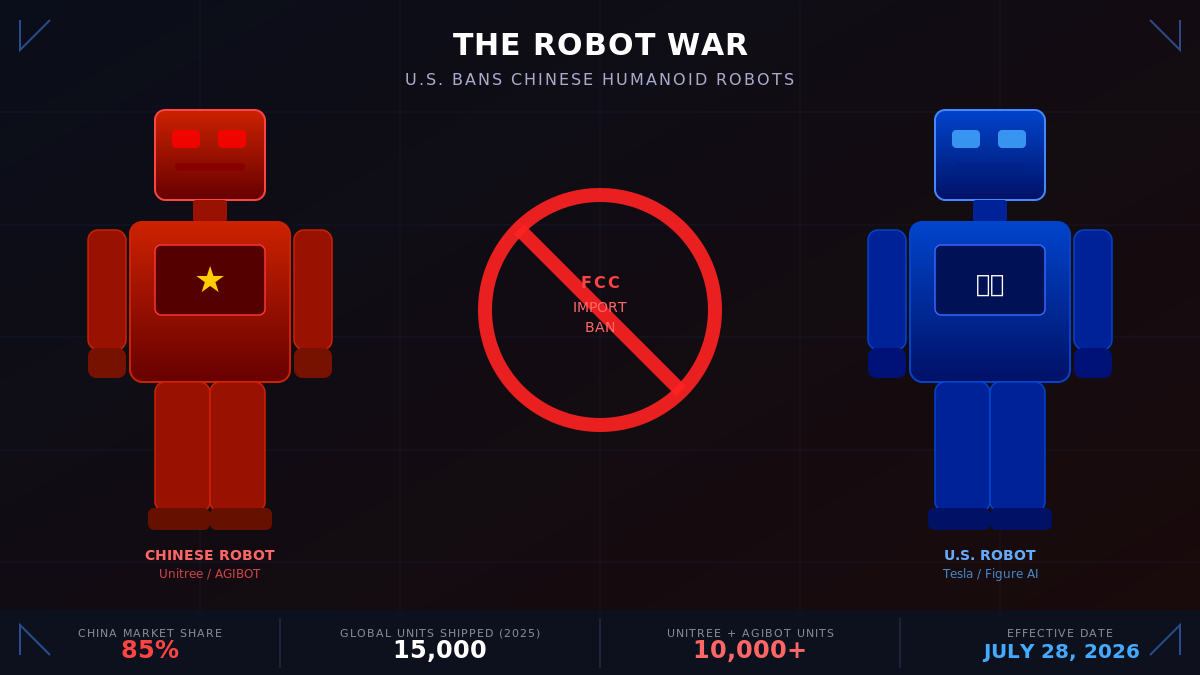
In a sweeping move that marks the latest front in the U.S.-China technology Cold War, the Federal Communications Commission has announced an immediate ban on new imports of foreign-made humanoid robots and quadruped robots — a policy that takes direct aim at China’s dominant grip on the global robotics market. The decision, which took effect last week, reflects growing anxiety in Washington about a new class of AI-powered machines that can walk, talk, collect data, and — according to regulators — potentially serve as sophisticated surveillance tools embedded in American homes, warehouses, and factories.
The Decision and Its Rationale
The FCC’s ban follows a national security determination issued by a White House-convened interagency body, which concluded that internet-connected humanoid robots pose unacceptable risks to American privacy and cybersecurity. According to the agency’s formal finding, these robots “collect data that could be leveraged by malign actors to surveil Americans, enhance the capabilities of foreign intelligence services, or to remotely commandeer the robots.”
The ban applies to newly imported models that have not yet received FCC authorization for sale in the United States. Existing devices already in circulation are not affected, nor does the rule prohibit Chinese companies from continuing to service previously approved models. But the message from Washington is unmistakable: the era of open importation of Chinese-made humanoid robots is over.
The FCC’s action closely mirrors its earlier campaign against Chinese telecommunications gear. Huawei, ZTE, and Chinese-made security cameras from companies like Hikvision and Dahua were gradually restricted and then banned from U.S. networks over the past decade under similar national-security justifications. Humanoid robots, regulators now argue, represent a far more intimate and potentially dangerous category of connected device — one that moves through private spaces, gathers audio and video, and can be remotely updated or commanded.
China’s Robot Dominance
To understand why Washington acted, it helps to appreciate just how thoroughly Chinese companies have come to dominate this emerging industry. Of the approximately 15,000 humanoid robots shipped globally in 2025, two Chinese firms — Unitree and AGIBOT — each accounted for more than 5,000 units. By comparison, American counterparts including Tesla’s Optimus division and Figure AI shipped a few hundred units combined, according to figures from technology research group Omdia.
Overall, China commands an estimated 85% share of the global humanoid robot market — a dominance built on aggressive government subsidies, a deep domestic supply chain for components, and a willingness to price hardware at margins that Western manufacturers cannot match. Unitree’s G1 and H1 series robots, for example, were selling at price points that undercut American competitors by tens of thousands of dollars.
The Pentagon had already grown alarmed. Earlier this year, the Department of Defense formally added Unitree, along with several other major Chinese technology companies, to its list of firms alleged to have ties to or aid the Chinese military — a designation that typically precedes further trade restrictions.
Winners: American Robotics Manufacturers
The ban removes, at least from the U.S. market, the dominant competitors that had been capturing share with superior shipment volumes. Tesla, Figure AI, Boston Dynamics (owned by South Korean conglomerate Hyundai), and emerging startups like Agility Robotics and 1X Technologies stand to be the primary domestic beneficiaries.
Tesla CEO Elon Musk has long positioned his Optimus humanoid robot as a multi-trillion-dollar opportunity. The company has struggled to scale production, but without Chinese robots flooding the U.S. market, domestic buyers — from logistics firms and automakers to retailers and care facilities — will have fewer alternatives as they begin deploying humanoid labor. Analysts at Goldman Sachs had projected the global humanoid robot market could reach $38 billion by 2035; U.S.-based companies now have a protected runway to capture a larger share of that domestic slice.
Figure AI, which counts Microsoft, Nvidia, and Amazon among its backers, has been deploying robots in BMW and UPS facilities. The company could see accelerated contract wins from enterprises that were previously evaluating lower-cost Chinese alternatives.
Losers: Chinese Manufacturers, and Potentially U.S. Buyers
For Unitree and AGIBOT, the ban closes off the world’s largest consumer economy just as the humanoid robot market is entering its most explosive growth phase. Both companies are widely expected to pivot aggressively toward European and Southeast Asian markets, where no equivalent ban currently exists. Beijing’s Foreign Ministry accused Washington of “overstretching the concept of national security to suppress Chinese companies” and said China would take “all necessary measures” to defend its companies’ rights.
Beyond the geopolitics, U.S. buyers may pay a real price. Chinese humanoid robots were significantly cheaper, and their removal from the market reduces competitive pressure on domestic manufacturers to hold down prices. Analysts say the near-term impact on American businesses hoping to automate warehouse or factory floors will be cost inflation and extended wait times for domestic units whose production lines are still ramping.
A New Tech Cold War Front
The humanoid robot ban is being interpreted widely as an extension of the same logic that drove U.S. restrictions on advanced semiconductors, drone components, and telecommunications equipment. Washington increasingly views any AI-powered, internet-connected hardware developed by Chinese companies as a potential vector for intelligence collection or sabotage — regardless of whether specific incidents have been documented.
The move also arrives at a diplomatically sensitive moment. Chinese President Xi Jinping is reportedly expected to visit the United States in September for a summit with President Donald Trump, and Beijing has signaled that continued technology restrictions could complicate those talks. Whether the robotics ban becomes a bargaining chip — or a source of lasting friction — will become clearer in coming months.
The Bigger Picture: Embodied AI as National Security
What makes this moment historically significant is the category of technology at stake. Previous tech-war battles were fought over silicon chips, software, and wireless infrastructure. The humanoid robot represents something new: embodied AI — systems that perceive, reason, and act in the physical world, operating inside buildings, alongside humans, with sensors that can capture everything from face geometry to the layout of a factory floor.
Security researchers have pointed out that a remotely compromised humanoid robot isn’t just a data breach — it is a physical presence that can be misused in ways traditional devices cannot. The FCC’s determination appears to reflect exactly that concern.
For now, the robots already deployed across American facilities will keep working. But the pipeline of new Chinese models — increasingly capable, increasingly affordable, and increasingly autonomous — has been cut. The question for the American robotics industry is whether domestic manufacturers can scale fast enough, and cheaply enough, to fill the gap before enterprises lose patience and lobby for exceptions.
The robot war has officially begun.


