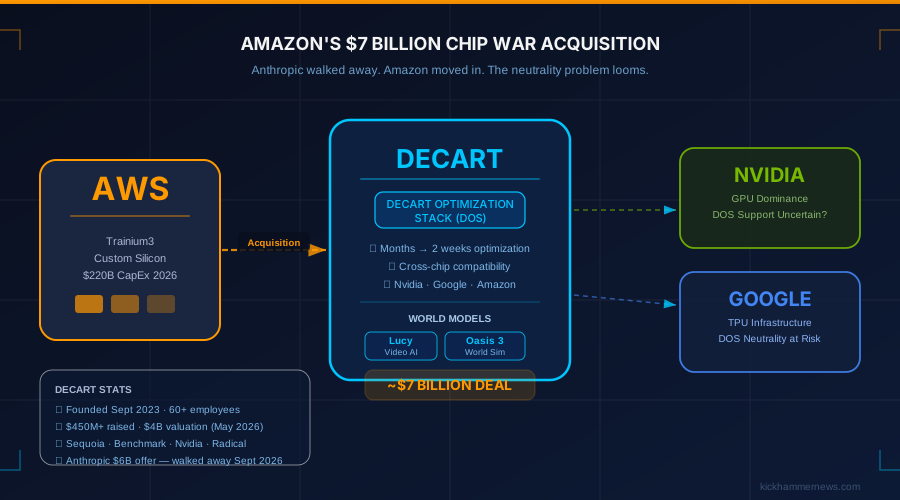
The Wall Street Journal dropped a bombshell Saturday evening: Amazon is in serious talks to acquire Decart, a three-year-old Israeli AI startup, for approximately $7 billion. A deal, according to people familiar with the matter, could be finalized within days — unless talks collapse or a rival swoops in to outbid. The story is big news on its own. But the full picture behind it reveals something much larger than a single acquisition: a high-stakes war for control of the AI infrastructure layer, where controlling the software that runs AI models on chips may matter just as much as building the chips themselves.
What Decart Actually Does — and Why Everyone Wants It
Founded in September 2023 by Israeli brothers Dean and Orian Leitersdorf and their colleague Moshe Shalev, Decart built a product that sounds deceptively mundane: software that makes AI models run efficiently on different kinds of chips. The company calls it the Decart Optimization Stack, or DOS.
In practice, DOS is anything but mundane. Getting a large AI model to run optimally on a specific processor — whether that’s an Nvidia GPU, a Google TPU, or Amazon’s home-grown Trainium chip — is a complex, painstaking process. Historically, it took AI teams three to six months to optimize a model for a new hardware target. Decart’s software has slashed that timeline to roughly two weeks. For a company like Amazon Web Services, which is betting billions on its proprietary Trainium chips as a competitive alternative to Nvidia, that matters enormously.
But DOS is only half the story. Decart has also built two world models that have attracted attention in their own right:
Lucy, a real-time video model capable of editing live video footage at speed, which Nvidia has backed directly. Oasis, a world simulation model that generates interactive, photorealistic environments responding dynamically to user input — originally made famous for creating a Minecraft-like environment from scratch, and now on its third generation (Oasis 3), which can simulate hours of photorealistic autonomous driving scenarios.
The company employs more than 60 people and has raised over $450 million in total funding, including a $300 million round in May 2026 that valued it at $4 billion. Its investor roster reads like a who’s-who of AI infrastructure: Radical Ventures, Sequoia Capital, Benchmark, Nvidia Ventures, and Adobe Ventures.
Anthropic Said No. Amazon Said Yes.
Here’s the wrinkle that makes this story more interesting than a straightforward acqui-hire: Amazon isn’t the first major AI company to want Decart. It’s just the one that’s still in the room.
Bloomberg reported last month that Anthropic — which Amazon has already backed to the tune of billions as part of its Alexa AI strategy — was in serious discussions to acquire Decart for approximately $6 billion. Anthropic ultimately walked away after conducting due diligence, with the reasons for its exit still unclear.
Amazon then moved in, reportedly raising the offer to approximately $7 billion — $1 billion above the price that gave Anthropic pause. The sequence raises obvious questions. What did Anthropic find during due diligence that concerned it? And if Anthropic saw something worth walking away from, why is Amazon now willing to pay even more?
The likely answer is that Amazon and Anthropic are making entirely different bets. Anthropic’s core business is building and selling large language models; DOS, for all its cleverness, is infrastructure tooling that doesn’t map neatly to Anthropic’s product roadmap. Amazon, by contrast, is a hardware and cloud infrastructure company that desperately needs Decart’s technology to make its Trainium chip a credible Nvidia alternative. AWS reportedly gave Decart early access to its next-generation Trainium3 chips months before they became broadly available — and came away so impressed by the Leitersdorf brothers and Shalev that senior AWS engineers championed the acquisition internally.
The Real Stakes: Amazon’s Chip Independence Play
To understand why Amazon would pay $7 billion for a 60-person company, you have to understand the stakes of the AI chip market.
Nvidia’s GPU dominance over AI training and inference has become a critical vulnerability for every hyperscaler. Microsoft has been developing its own Maia chips. Google has its TPUs. Amazon has Trainium. But building a chip is only half the problem. Getting AI developers to actually use that chip — rather than defaulting to the Nvidia hardware they already know — requires the kind of optimization software that Decart has spent three years building.
DOS is, in effect, a hardware compatibility layer. If Amazon owns it, it dramatically lowers the switching cost for any AI developer who wants to move workloads from Nvidia GPUs onto Trainium. A process that would otherwise require months of specialized engineering work can happen in two weeks using DOS. That makes Trainium a realistic alternative rather than an aspirational one.
Amazon is spending approximately $220 billion in capital expenditure this year — largely on data center infrastructure and AI chips. Against that backdrop, a $7 billion acquisition to make its chip strategy actually land with developers is a rounding error.
The Neutrality Problem
There’s a catch, and it’s one that any serious Decart customer will be thinking about: DOS currently supports not just Amazon’s Trainium chips, but also Nvidia’s GPUs and Google’s TPUs. That neutrality is, arguably, the product’s most important feature. It means AI companies can use DOS without locking themselves into any single hardware vendor — they can optimize for Trainium today and pivot to Nvidia next quarter if the supply situation changes.
If Amazon acquires Decart, that neutrality disappears — or at least becomes suspect. Developers using DOS will have to trust that their AWS-owned optimization stack will continue to provide best-in-class support for Nvidia GPUs and Google TPUs, even though Amazon directly competes with both Nvidia and Google in AI infrastructure. History suggests that’s a difficult promise to keep indefinitely.
This is the same tension that plays out every time a platform company acquires a middleware player: GitHub and Microsoft, Instagram and Meta, YouTube and Google. The product often survives the acquisition. The neutrality rarely does.
A Market in Motion
The Decart talks are part of a broader wave of infrastructure-layer AI acquisitions that has accelerated in October 2026. Nvidia is reportedly in early discussions to acquire Reflection AI, the open-weight frontier model startup, at a potential $25 billion valuation — a deal that would give Nvidia its own frontier model to pair with its chips and Hugging Face distribution network (acquired in September for $12.9 billion). SpaceX picked up Cursor, the AI coding assistant, for $60 billion. AMD acquired World Labs, the 3D spatial intelligence startup, for $8.2 billion. Stripe bought OpenRouter for $7.2 billion.
The pattern is consistent: every company that makes money from the AI stack wants to own more of it. Amazon is no different.
What makes Decart particularly valuable as an acquisition target is that it sits at the intersection of two adjacent markets: hardware optimization (DOS) and generative world models (Lucy and Oasis). The world model business is still nascent, but if interactive simulation environments become a key component of robotics training, autonomous vehicle development, and gaming, Decart’s Oasis platform could be worth a significant portion of that $7 billion price tag on its own.
The Bottom Line
Three years ago, the Leitersdorf brothers and Moshe Shalev set out to solve a narrowly defined problem: making it faster and cheaper to run AI models on different chips. That focus turned out to be extraordinarily well-timed. The AI chip market fragmented in ways that nobody predicted, Nvidia’s dominance created a political problem that hyperscalers needed to solve, and Decart built exactly the tool that makes chip alternatives viable.
Now Amazon is reportedly willing to pay $7 billion for the result — more than Anthropic was willing to pay, more than Nvidia reportedly offered during earlier conversations, and nearly double Decart’s May valuation.
Whether the deal closes or another bidder emerges, the Decart story is a case study in what it means to build infrastructure at exactly the right moment. In 2026’s AI market, the unsexy plumbing that makes chips work can be worth more than the models that run on them.


