The draft S-1 filed with Goldman Sachs and Morgan Stanley this week contains some of the most extraordinary financial figures in Silicon Valley history. Here’s what they actually mean.
The numbers landed quietly, as these things usually do — a draft prospectus circulating among bankers and a handful of lawmakers before the official filing, the kind of document that leaks in pieces until the whole picture assembles itself. But Anthropic’s preliminary S-1, reported by the Wall Street Journal on October 21, 2026, is anything but quiet. It reveals a company that generated $16.3 billion in revenue in the first six months of this year, reported an $80.7 billion net loss in the same period, and is targeting a public market valuation of up to $2 trillion — more than the current market caps of most Fortune 500 companies, achieved by a company that didn’t exist five years ago.
To understand what these numbers mean, you have to look at them carefully. Because the headline loss figure, shocking as it sounds, is almost entirely an accounting artifact. And the revenue figure, remarkable as it sounds, may actually be understating how fast things are moving.
The Revenue Picture: 15x in Twelve Months
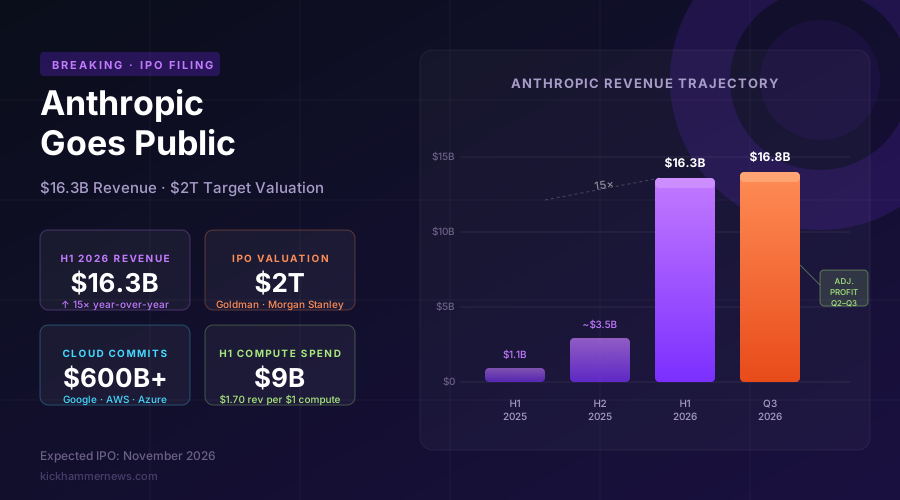
Anthropic generated roughly $1.1 billion in revenue in the first half of 2025. In the first half of 2026, it generated $16.3 billion. That is not a typo. That is a 15-fold increase in twelve months.
To put that in context: Amazon Web Services, widely considered one of the most successful enterprise technology businesses ever built, took until its eighth year to cross $10 billion in annual revenue. Anthropic crossed $16 billion in a single half-year — and that number has continued to accelerate. The company reportedly reached $16.8 billion in Q3 2026 alone, up approximately 45 percent from Q2, suggesting the full-year figure will land somewhere around $50 billion.
At that pace, Anthropic would be one of the fastest-growing companies of its scale in the history of enterprise software. And unlike many AI companies that have leaned heavily on one-time deals or pilot programs to fluff their numbers, Anthropic’s revenue reflects widespread adoption of its Claude model across enterprises, developers, and direct consumer subscribers.
The filing also discloses a metric that will get a lot of attention from investors: roughly $1.70 of revenue per dollar of compute spending. That ratio — the efficiency with which Anthropic converts infrastructure cost into revenue — is a critical indicator of whether AI at this scale is actually a sustainable business, or a subsidy play. The $1.70 figure suggests it is, at least for now, a real business.
The Loss That Isn’t (Mostly)
The $80.7 billion net loss will dominate coverage, and it deserves scrutiny. About $72 billion of it is non-cash — accounting adjustments tied to convertible notes and other financing instruments that are standard in large pre-IPO structures. The actual cash picture is substantially different: Anthropic spent about $9 billion on compute and infrastructure in the first half, compared to $7.3 billion for all of 2025, and the company reports achieving adjusted profitability and positive free cash flow in Q3 for the second straight quarter.
That distinction matters enormously. A company burning $80 billion in cash would be in existential trouble. A company whose GAAP loss is dominated by non-cash charges on financing instruments, while generating positive free cash flow on an adjusted basis, is a company making rational choices about how to fund its growth. The accounting complexity is unusual in scale, but not in structure.
What it does reveal is the staggering capital intensity of this industry. Nine billion dollars in compute in six months. More than seven billion in the same period last year. And that’s just what the company spent — the cloud commitments tell the fuller story.
$600 Billion in Infrastructure Promises
The filing discloses approximately $450 billion in committed cloud agreements over the next seven to ten years: $111 billion with Google Cloud, $110 billion with AWS, and $31 billion with Microsoft Azure. Add other infrastructure commitments and the total rises above $600 billion — with a potential ceiling near $750 billion if ongoing negotiations close.
Critically, about 80 percent of those commitments are non-cancellable. Anthropic is not hedging. It is making the most expensive long-term infrastructure bet in the history of AI, with virtually no exit ramp built in.
These numbers explain why the IPO is happening now. The compute requirements for frontier AI development are so capital-intensive that even a company generating $16 billion in a single half-year needs public markets to fund what comes next. And they reveal something else: the major cloud providers — Google, Amazon, Microsoft — have made Anthropic the centerpiece of enormous revenue bets of their own. They need Anthropic to succeed as much as Anthropic needs their capacity.
The Risk Factors Worth Reading
Every S-1 contains risk factors, and Anthropic’s include the standard boilerplate about competition and regulatory uncertainty. But two stand out.
The first is customer concentration. Roughly 20 to 25 percent of Anthropic’s first-half 2026 revenue came from just two unnamed customers, with no long-term contracts in place. That is a significant dependency for a company at this scale. If either of those customers were to reduce spend, shift to a competitor, or renegotiate pricing, the revenue impact would be visible in quarterly results immediately.
The second is what the filing describes as “catastrophic incident” risk — a catch-all for the possibility that one of Anthropic’s models causes or enables significant harm, triggering regulatory or legal consequences that could reshape the business. This is not boilerplate. Anthropic has been unusually candid about the existential risks of advanced AI, and including that language in its public disclosures is a form of honest self-assessment that distinguishes it from competitors.
The $2 Trillion Question
The private market valued Anthropic at $965 billion in May. The IPO, led by Goldman Sachs and Morgan Stanley and expected as soon as November, is targeting up to $2 trillion — more than doubling that valuation in roughly six months.
That would make Anthropic, on its first day of trading, one of the most valuable companies in the world. More valuable than JPMorgan Chase. More valuable than Johnson & Johnson. Comparable to Google at the time of its 2004 IPO relative to the broader market.
The valuation rests on a bet: that Anthropic can sustain something like its current trajectory for long enough to justify what is being asked of investors. The revenue growth suggests it might. The compute commitments show the scale of the table stakes. And the non-cash losses, properly understood, reveal a company that has structured itself to run fast and hard rather than quietly.
There is also a detail worth noting for anyone who thinks of Anthropic purely as a commercial entity. The company has pledged approximately 20 percent of its shares to a public benefit fund — the proceeds earmarked for research and public goods related to the responsible development of AI. It has also committed $200 million to study AI’s effects on labor markets. These are not trivial sums.
What This Tells Us About the AI Economy
Anthropic’s filing is not just a company story. It is a window into what the AI economy actually looks like at scale.
What it shows: growth rates that have no precedent in enterprise software at this revenue level. Capital requirements that are redefining what it means to be a technology company. Revenue efficiency that, while still developing, is no longer hypothetical. And concentration risks that will make institutional investors scrutinize customer contracts carefully.
The AI boom is real. The numbers say so. But the IPO will also be the moment that AI companies face the accountability that comes with quarterly earnings calls, public scrutiny of every number, and investors who need to see sustained results — not projections, not benchmarks, not research breakthroughs, but revenue and margins and customer retention.
Anthropic filed for that accountability voluntarily, with $16.3 billion in first-half revenue as its opening argument.
The market will decide if that’s enough.


