Microsoft’s October 2026 Patch Tuesday introduced Risk Cohorts, an experimental vulnerability-grouping system designed to help enterprise security teams cut through the noise of record-breaking CVE counts — but experts say it’s a promising first step that still has significant gaps.
October’s Patch Tuesday arrived with 1,413 CVEs on the scorecard — a record-breaking total that underscores how rapidly the vulnerability disclosure landscape has changed. But buried beneath the headline numbers was something arguably more significant than the count itself: Microsoft’s Security Response Center (MSRC) quietly unveiled Risk Cohorts, a new conceptual framework for thinking about patch prioritization that could reshape how enterprise security teams approach their monthly update cycles.
What Are Risk Cohorts?
Risk Cohorts are groups of vulnerabilities that share a common assessment question about your environment. Instead of organizing CVEs by their technical root cause (buffer overflow, use-after-free, privilege escalation) or by their CVSS score, cohorts group them by the question a security administrator needs to answer before deciding how urgently to patch.
MSRC offered three archetypal cohort questions in its accompanying blog post:
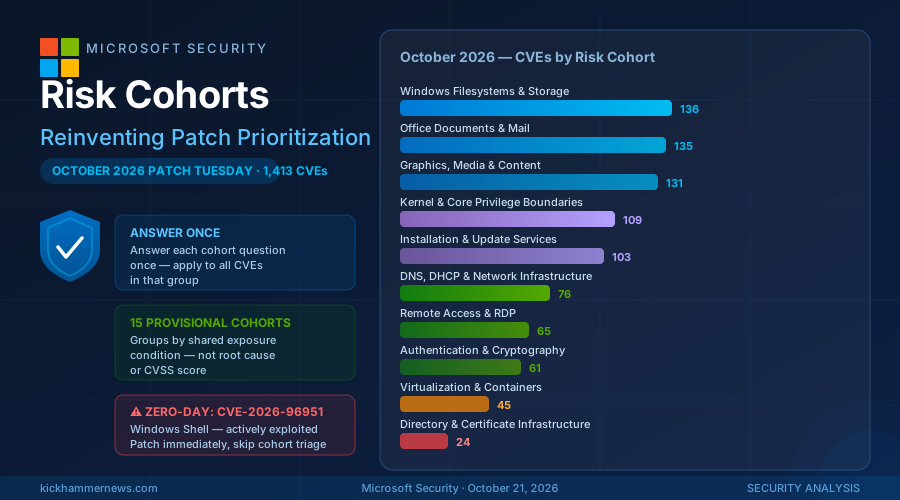
The logic is elegant in its simplicity. If your organization can answer “Yes, our invoice-processing servers handle untrusted documents from clients,” that single answer applies to every CVE in the Office Documents and Mail Clients cohort (135 CVEs in October’s release), rather than requiring a security analyst to re-examine that same environmental question 135 times independently.
The October Cohort Breakdown
For the October 2026 release, MSRC defined 15 provisional cohorts. The three largest by CVE count were:
Together, these three cohorts account for 402 vulnerabilities, or roughly 28% of the total. The Windows Core and Kernel Privilege Boundaries cohort added another 109, while Windows Installation, Deployment, and Update Services contributed 103 — two categories that should draw immediate attention in any organization running automated deployment pipelines or shared endpoint management infrastructure.
The other cohorts span DNS/DHCP infrastructure (76 CVEs), Remote Access and RDP deployments (65), authentication and cryptography (61), networking and protocol stack (53), virtualization and containers (45), network file sharing (39), endpoint management and security controls (38), web/RPC/messaging services (27), and directory/federation/certificate infrastructure (24).
The Zero-Day That Demands Immediate Action
Despite the cohort framework’s emphasis on risk-based prioritization, the October release included at least one vulnerability — CVE-2026-96951 — that bypasses any need for cohort analysis: it was already being actively exploited in the wild at the time of disclosure. This Windows Shell zero-day should be treated as a top-tier priority regardless of where it falls in any cohort mapping exercise, a point security researchers universally emphasized in post-Tuesday briefings.
Why This Matters for Enterprise Teams
For security operations centers wrestling with alert fatigue and shrinking patch windows, the sheer volume of modern Patch Tuesdays has become a genuine operational crisis. September 2026 brought 973 CVEs; July saw 570. October’s 1,413 represents a new high-water mark, and there’s little reason to expect a structural reversal of this trend.
The traditional approach — triage every CVE individually against CVSS scores and Microsoft’s own exploitability indices — doesn’t scale at 1,400+ CVEs per month. Security teams are forced to make implicit prioritization decisions without a structured framework, often defaulting to “patch everything Critical/High” or “patch whatever gets media coverage.”
Risk Cohorts offer a different mental model. Rather than asking “how bad is this CVE?”, they prompt teams to ask “do we have the environmental condition this cohort targets?” If you don’t run RDP gateway infrastructure, the Remote Access and RDP Deployments cohort (65 CVEs) may warrant less urgency regardless of individual CVE severity scores. If your file servers process untrusted backup workloads from partner networks, the Storage and Backup cohort jumps immediately to the front of the queue.
This environmental-condition-first approach aligns well with how mature security teams already think about risk, but it provides a shared vocabulary and a documented framework that smaller teams — without dedicated threat intelligence staff — haven’t previously had access to.
Limitations and Gaps
Security researchers have been quick to note that Risk Cohorts, in their current experimental form, have significant limitations that enterprises should understand before leaning on them too heavily.
The most notable gap: an independent analysis found approximately 289 CVEs in October’s release that don’t map to any cohort at all. These unmapped vulnerabilities include high-profile flaws affecting Exchange Server and SharePoint — two of the most targeted applications in enterprise environments. Skipping cohort analysis for these CVEs could leave critical exposure unaddressed.
MSRC itself was careful to characterize cohorts as experimental and provisional, explicitly noting that they “are not a new vulnerability classification or prioritization framework” and that they don’t change Microsoft’s existing update guidance. There are currently no tools that integrate cohort data into vulnerability management platforms, so security teams must manually cross-reference the published CVE-to-cohort mapping document — an additional workflow step that partially undermines the efficiency gains the framework promises.
CVEs within a single cohort can also vary dramatically in their actual exploitation prerequisites, affected Windows versions, and attack complexity. A cohort answer of “Yes, we have affected infrastructure” still requires per-CVE review to understand which specific assets are exposed and what compensating controls might apply.
The Road Ahead
Despite these limitations, the introduction of Risk Cohorts signals a meaningful shift in how Microsoft is thinking about its relationship with enterprise security teams. The acknowledgment that raw CVE counts and severity ratings alone are insufficient for practical patch management is significant coming from the MSRC itself.
The experimental label also suggests this is a framework Microsoft intends to iterate on. Future releases could see cohort definitions refined, unmapped CVEs incorporated, and potentially tooling built into the Security Update Guide or Microsoft Defender Vulnerability Management to automate cohort-based triage workflows.
For now, the most practical approach is to use Risk Cohorts as a starting point for team conversations and documentation — answering each cohort’s environmental question once and recording it — while continuing to apply traditional prioritization criteria (confirmed exploitation, severity, asset criticality, business impact) in parallel.
The goal is not to replace rigorous CVE analysis. It’s to stop starting from zero every month.
Sources: Microsoft Security Response Center, Netizen Security Blog, Admin365 Blog, it-connect.tech, TechTimes


