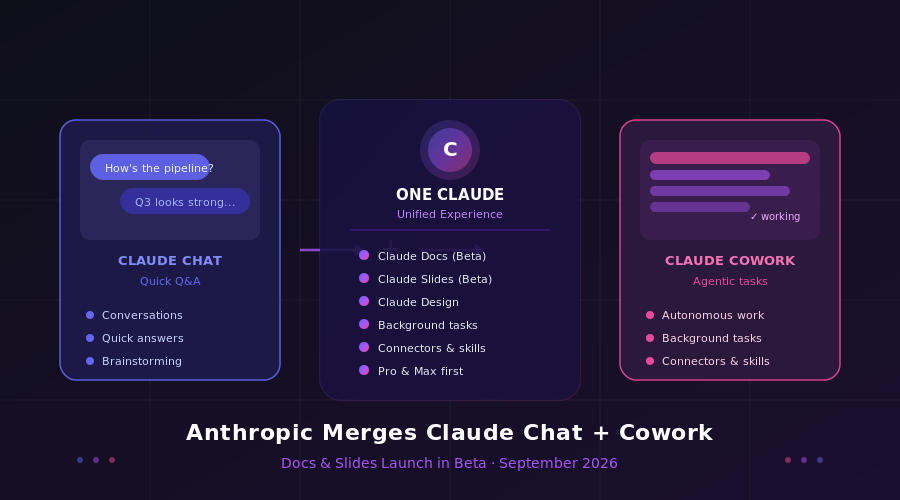
Anthropic is drawing the curtain on one of the most persistent frustrations in AI product design: the forced choice between a quick conversational assistant and a more capable agentic workspace. Starting today, Claude Cowork and Claude Chat are merging into a single, unified experience — and the company is rolling out two brand-new tools, Claude Docs and Claude Slides, in beta alongside that merger.
The move signals a broader philosophical shift at Anthropic. Rather than treating light-touch conversations and long-running autonomous tasks as fundamentally different things requiring different products, the company is betting that users want one AI that can do both without context-switching. It is a significant departure from how most AI platforms have approached the agentic era.
What’s Actually Changing
Until now, Claude had two distinct modes. The familiar chat interface was designed for back-and-forth dialogue — asking questions, brainstorming, getting quick answers. Claude Cowork, meanwhile, was a separate product aimed at “bigger assignments,” where Claude could autonomously work through multi-step tasks, use connectors and skills, and continue operating in the background even after a user closed their browser or laptop.
That distinction is going away. Going forward, Claude can handle both from the same conversation thread. A user can ask a quick question about their sales pipeline, then immediately ask Claude to compile that data into a polished weekly report in their usual style, flag any slippages, and generate five leadership slides summarizing the key takeaways — all in a single thread, without switching apps or modes.
Critically, Claude can continue working on longer tasks even after the user closes their device. When it needs clarification, it asks. When it’s done, it checks in. Users retain final say over the output.
Anthropic says the previous split was creating friction that didn’t serve users: Cowork was reserved for bigger assignments, while Design handled visual work. Users had to decide where a request belonged and could not carry work between those spaces. The new unified model removes that cognitive overhead entirely.
Claude Docs and Claude Slides Enter Beta
Alongside the merger, Anthropic is launching two new collaborative tools that were previously absent from both Chat and Cowork.
Claude Docs gives users a co-writing environment inside Claude. Rather than asking Claude to generate text and then copying it elsewhere, Docs creates a live, shareable document that persists with its own URL. Users can edit directly, ask Claude for revisions, or let Claude take the first pass while they provide direction. Documents can be commented on, shared with teammates, and scheduled for automatic updates — so a weekly report can be configured to refresh every Monday without additional prompting.
Claude Slides brings presentation creation into the same unified experience. Users can ask Claude to draft a presentation from existing content, refine individual slides, and download the result as a PowerPoint file or PDF. The feature addresses one of the most common AI workflow pain points: generating compelling presentation content from within a conversation, rather than copying text into a separate app and reformatting manually.
Both Docs and Slides are in beta and available now to Pro and Max subscribers. Claude Design — the company’s visual generation tool — is also moving into the chat experience, meaning illustrations, graphics, and design assets can be requested from the same thread where a user is drafting a document or building a presentation.
Enterprise administrators will have control over when and whether Docs, Slides, and Design are enabled across their organizations, and will receive at least 30 days’ notice before any organization-wide changes.
The Competitive Context
Anthropic’s announcement arrives at an increasingly crowded moment in the AI assistant market. OpenAI has been testing Sponsored Agents within ChatGPT, turning the conversation interface into an ad platform where users interact directly with business-sponsored bots. Google has been expanding Gemini’s footprint across its productivity suite. Microsoft’s Copilot continues to deepen its integration across Office 365.
What sets today’s Claude announcement apart is its emphasis on continuity and user control. Unlike autonomous agent frameworks that can feel opaque or unpredictable, Anthropic is explicitly designing for a model where Claude asks before acting by default. An optional keep-working mode allows the AI to continue and check in only when a closer review is needed — but even then, users retain final say.
The promise of a persistent, shareable workspace — one where a document, presentation, or running analysis lives at a single URL accessible across devices — is also new competitive ground. Most AI-generated content today exists only within a single conversation and disappears or becomes inaccessible when a session ends. Claude’s new model treats AI-generated work as a real artifact with a life beyond the prompt that created it.
Rollout Timeline
The unified Claude experience is rolling out first to Pro and Max subscribers on web, desktop, and mobile. Team plan users and Free users will receive the update in subsequent weeks. Enterprise customers will see changes according to their own administrator-controlled schedules.
Existing Cowork users will find all of their previous chats, projects, artifacts, connectors, and skills intact in the new unified experience. No migration is required. Existing chat users need no new workflow at all — the change will simply make more capabilities available within the interfaces they already use.
Claude Docs, Slides, and Design are currently in beta. As with most Anthropic beta features, they will likely evolve substantially based on user feedback before a broader stable release.
What This Means for Users
For individual professionals, the practical effect is significant: the assistant that already knows your writing style, your connected tools, your preferred formats, and your ongoing projects can now also build and maintain real documents and presentations alongside you — and keep working on them in the background while you attend to other things.
For teams, the implications are broader. A shared document that Claude can update on a schedule, drafted from live connector data, with built-in revision support, represents a genuinely new kind of collaborative workflow — one where the AI is less a tool you use once and more a persistent collaborator embedded in your regular rhythm.
Anthropic’s bet is that users who have been choosing between ask Claude and let Claude work have been dealing with an artificial constraint all along. Today’s announcement removes it. Whether the unified experience lives up to that promise — and whether the beta tools mature quickly enough to become staples of professional workflows — will be the real test of how big this product moment turns out to be.


