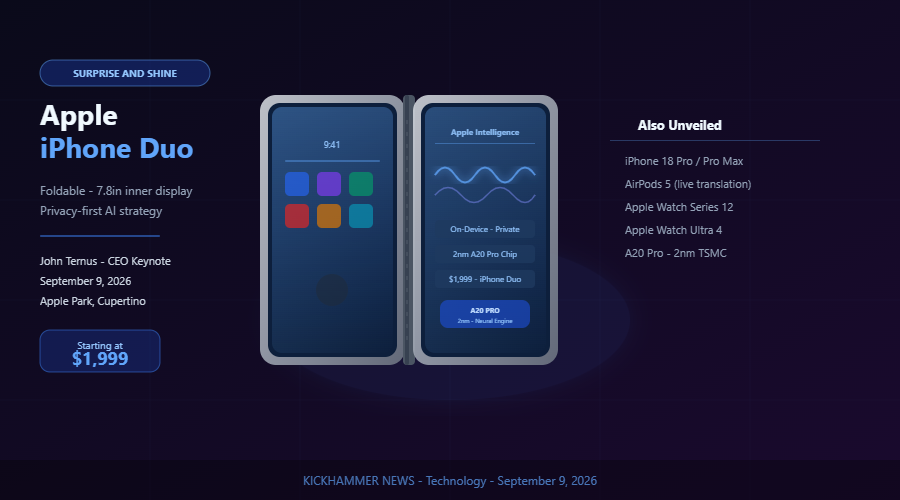
Apple held its most consequential product launch in years on Wednesday, September 9, 2026 — and for the first time in more than a decade, the person standing on the Apple Park stage wasn’t Tim Cook. CEO John Ternus, who officially took the reins from Cook on September 1, used his inaugural keynote to make a statement that will define Apple’s trajectory for years: the iPhone is already the world’s best AI device, and Apple has no intention of chasing its rivals’ cloud-first strategies.
The event, cheekily titled “Surprise and Shine,” delivered on its name. Apple unveiled the foldable iPhone Duo, the iPhone 18 Pro and Pro Max, AirPods 5, Apple Watch Series 12, and Apple Watch Ultra 4 — a product slate so ambitious that even veteran Apple watchers described it as one of the company’s most loaded launches ever.
The iPhone Duo: Apple’s Foldable Moment
The centerpiece announcement was the foldable iPhone Duo, a device Apple has been rumored to be developing for years and whose existence it finally confirmed. The Duo features a book-style clamshell design with a 5.5-inch outer display and a 7.8-inch inner display when fully unfolded. It starts at $1,999 — a price that positions it above Samsung’s Galaxy Fold lineup and signals Apple’s intent to enter the foldable market as a premium-tier player from day one.
Ternus introduced the Duo by calling it “the most personal screen Apple has ever made,” leaning into the device’s ability to shift between compact and expansive modes for different contexts. The outer display is fully functional for calls, messages, and notifications. The inner display transforms the Duo into what Apple described as “a full-canvas experience” — essentially a small iPad that fits in a pocket.
The Duo runs Apple Intelligence features natively, with on-device processing handled by the same A20 Pro chip that powers the iPhone 18 Pro. Apple emphasized privacy repeatedly throughout the Duo’s presentation, noting that the device keeps sensitive data local rather than transmitting it to cloud servers. In a market where competitors have leaned heavily on cloud-hosted AI models, Apple is positioning local processing as a feature, not a limitation.
The A20 Pro: The First 2nm Flagship Chip
If the iPhone Duo was the emotional centerpiece of the event, the A20 Pro was the technical one. Apple unveiled what it called the first high-volume smartphone processor manufactured on TSMC’s 2-nanometer process node — a milestone in semiconductor miniaturization that gives Apple a meaningful lead over Android competitors still manufacturing on older nodes.
Ternus described the A20 Pro as purpose-built to optimize on-device AI, with a new Neural Engine architecture that Apple claims delivers twice the inference performance of the A19 Pro at the same power envelope. That performance headroom matters for Apple’s AI strategy: the company has staked its competitive position on the idea that on-device AI can match or exceed cloud-hosted alternatives for the vast majority of real-world tasks, while offering the privacy guarantees that differentiate Apple’s ecosystem.
The A20 Pro powers both the iPhone 18 Pro and Pro Max, which received $100 price increases over last year’s models. The standard iPhone 18 lineup, which Ternus did not dwell on, continues with existing chip architectures.
Apple’s AI Strategy Under Ternus: Privacy as a Moat
The “Surprise and Shine” event was as much a strategic statement as a product launch. Ternus, who spent his career as Apple’s head of hardware engineering before being tapped as Cook’s successor, used the keynote to articulate his vision for how Apple competes in the AI era — and it’s a vision that leans hard on Apple’s traditional strengths.
“The best AI device,” Ternus said, “is the one that knows you best and keeps that knowledge safe.” The line drew applause, but it also drew a sharp contrast with rivals like Google and Meta, whose AI strategies depend heavily on harvesting user data in the cloud to power personalization at scale.
Apple’s approach is different by design. The company pays Google roughly $1 billion annually to license Gemini for features within the rebuilt Siri that can’t be handled on-device — a pragmatic concession to the reality that Apple doesn’t have a frontier model of its own. But Ternus positioned that arrangement as a bridge, not a destination, signaling that Apple’s longer-term goal is to reduce its dependence on external AI providers as its own on-device capabilities mature.
That strategy comes with real risks. Apple enters the AI race as the only major technology company without a frontier model, and the gap between on-device AI and the capabilities offered by full-scale cloud models is substantial. But Apple also enters with structural advantages: unmatched hardware-software integration, a billion-plus device install base, and a privacy reputation that no competitor can easily replicate.
AirPods 5, Apple Watch Series 12, and the Broader Lineup
Beyond the Duo and the A20 Pro, Apple announced AirPods 5 with an improved H3 chip that adds real-time language translation to on-ear audio — a feature that uses on-device AI to translate conversations in 37 languages with a claimed latency of under 200 milliseconds. The Apple Watch Series 12 introduces a new health sensor suite that adds continuous blood glucose monitoring for the first time, a feature that regulatory watchers have anticipated for years. Apple Watch Ultra 4 received a titanium case redesign and expanded satellite connectivity.
What the Event Means
The “Surprise and Shine” event accomplished something strategically important beyond its individual product announcements: it gave Ternus a clear narrative for his tenure. Apple under Cook was a company that executed brilliantly on hardware but arrived late to AI. Ternus is inheriting that position but articulating a distinct theory of competition — one that bets on privacy-first, on-device intelligence as a durable differentiator rather than a temporary gap to be closed.
Whether that bet pays off will depend on how quickly on-device AI capabilities improve, how consumers weigh privacy against raw AI performance, and whether Apple can make meaningful progress on its own model development. But on September 9, 2026, with a foldable iPhone and a 2nm chip on stage, Ternus at least showed he knows how to make an entrance.


