A landmark partnership between Qualcomm and Amazon’s cloud unit puts the mobile chipmaker at the center of the data center AI arms race — and sends Nvidia a clear message.
When Qualcomm announced a multi-generational AI chip partnership with Amazon Web Services on September 8, 2026, it was more than a business deal. It was a declaration that the AI inference chip market — long treated as Nvidia’s exclusive domain — is entering a new competitive era.
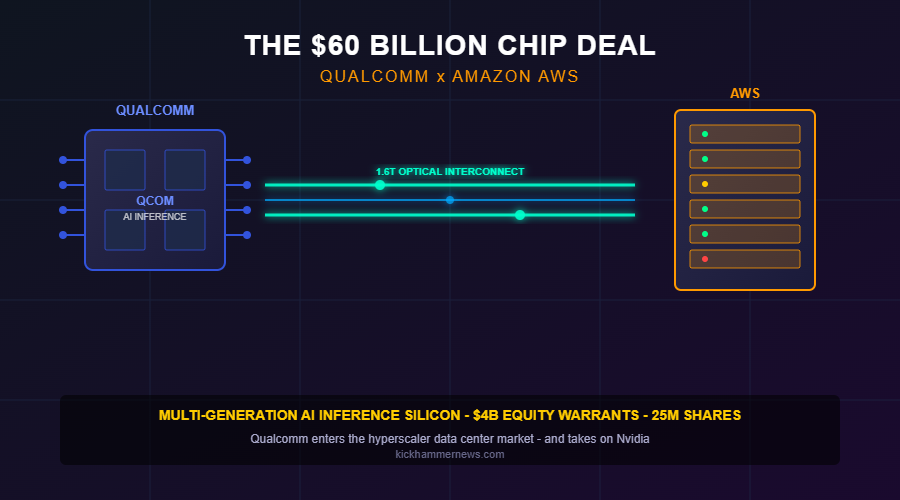
The two companies will co-design multiple generations of custom AI inference chips and jointly develop optical interconnect solutions capable of speeds extending to 1.6 terabits per second and beyond. As part of the financial structure, Qualcomm issued Amazon an equity warrant allowing the cloud giant to purchase up to 25 million shares of Qualcomm common stock at $161.26 per share — a potential equity stake valued at approximately $4 billion. Those warrants vest in tranches tied to specific commercial milestones, including the purchase of up to $60 billion worth of Qualcomm’s server chips and related technology over the partnership’s lifetime.
Qualcomm’s stock rose 10% on the announcement.
Why This Deal Is Significant
For years, Nvidia has dominated the AI training and inference chip markets with an almost unassailable combination of hardware performance and software ecosystem (CUDA). Big tech companies — AWS, Google, Microsoft, Meta — have responded by designing their own custom AI chips: Trainium and Inferentia at Amazon, TPUs at Google, and so on. But custom silicon is expensive to design and takes years to bring to production.
Partnering with an established chip designer like Qualcomm offers an alternative path. Qualcomm brings proven silicon design expertise, manufacturing relationships, and a strong track record in power-efficient processing from its mobile chip business. AWS brings massive scale, deep knowledge of inference workloads, and the cash to make a multi-generational commitment credible.
Critically, this is Qualcomm’s first major partnership with a Western hyperscaler for data center AI silicon. While Qualcomm has had success in edge AI — embedding its Snapdragon chips in smartphones, PCs, and automotive systems — the data center market has remained beyond its reach. This deal changes that calculus decisively.
Inference: The Battleground That Matters Now
The AI chip conversation has historically focused on training — the massive compute required to build large models. Nvidia built its dominance on H100 and H200 GPUs that can run training jobs at scale. But as AI models become deployed products rather than research projects, inference is becoming the larger economic opportunity.
Inference is what happens when you ask an AI assistant a question, when a recommendation system suggests a product, when an AI agent executes a workflow. Every query to ChatGPT, Claude, or Gemini is an inference workload. At the scale of millions or billions of daily queries, inference costs dwarf training costs in the long run.
Qualcomm’s architecture has significant advantages for inference specifically. Its chips are designed for power efficiency — a direct consequence of years of optimization for battery-constrained mobile devices. In a data center context, power efficiency translates directly to operating cost and heat management, both of which are critical constraints as data centers scale to meet AI demand. The company has argued that its inference chips can deliver competitive performance at substantially lower power draw than Nvidia alternatives.
The optical interconnect component of the partnership is also notable. As AI models grow larger and inference increasingly involves multiple chips working in concert, the speed at which those chips can communicate with each other — and with memory — becomes a bottleneck. The move to 1.6T optical interconnects is part of a broader industry push to relieve that constraint, and Qualcomm and AWS co-developing that technology together suggests a deep integration that goes well beyond simply buying chips.
The Competitive Context
This deal does not happen in isolation. Several dynamics are converging that make the timing logical.
Nvidia’s dominance has made hyperscalers uncomfortable. When a single supplier controls the compute that your entire AI business runs on, that is a supply chain vulnerability — and a negotiating disadvantage. Every major cloud provider has responded by investing in alternative chip strategies, whether custom silicon or alternative suppliers. AWS’s Trainium chips are already in production, but custom silicon design is slow and expensive. A partnership with Qualcomm gives AWS a faster path to diversifying its inference supply chain.
Meanwhile, Qualcomm has been aggressively expanding into the data center market. Its Oryon CPU architecture, which powers Snapdragon X series PC chips, has demonstrated that the company can design competitive high-performance silicon outside the mobile category. The AWS partnership is the highest-profile validation yet of that expansion strategy.
The deal also arrives as AI chip export restrictions continue to fragment the global market. US-designed AI chips face export controls that limit their sale to certain markets, particularly China. This has accelerated efforts by companies everywhere to develop alternative chip architectures and supply chains. In that context, Qualcomm’s partnership with AWS is part of a broader re-alignment of the AI chip industry around resilience and redundancy.
What It Means for Amazon
For AWS, the partnership is consistent with a long-term strategy of reducing dependence on any single supplier while keeping pace with competitors Google Cloud and Microsoft Azure in AI infrastructure. AWS has already made significant investments in custom silicon through its Annapurna Labs subsidiary, which designed the Graviton general-purpose chips and the Trainium and Inferentia AI chips. Adding Qualcomm-designed inference chips gives AWS another tool in that kit — and the equity warrant structure means that if Qualcomm’s chips perform at scale, AWS gets financial upside from the partnership’s success.
The $60 billion commitment over the life of the partnership is substantial even by hyperscaler standards. It signals that AWS views inference compute as a long-duration investment, not a one-generation experiment.
The Road Ahead
The first chips from the partnership are unlikely to appear for at least two to three years, given the typical design and manufacturing timelines for custom silicon. That means Nvidia’s position in the near term remains secure. But the strategic signal is clear: the biggest cloud provider in the world has made a multi-generational bet on Qualcomm as an inference chip supplier.
If the chips perform as hoped, this partnership could meaningfully erode Nvidia’s share of the data center inference market over the latter half of the decade. That prospect alone explains why Qualcomm’s stock moved 10% in a single session — and why the rest of the AI chip industry will be watching every development in this collaboration very closely.
Sources: CNBC, TechTimes, Quartz, StockTitan


