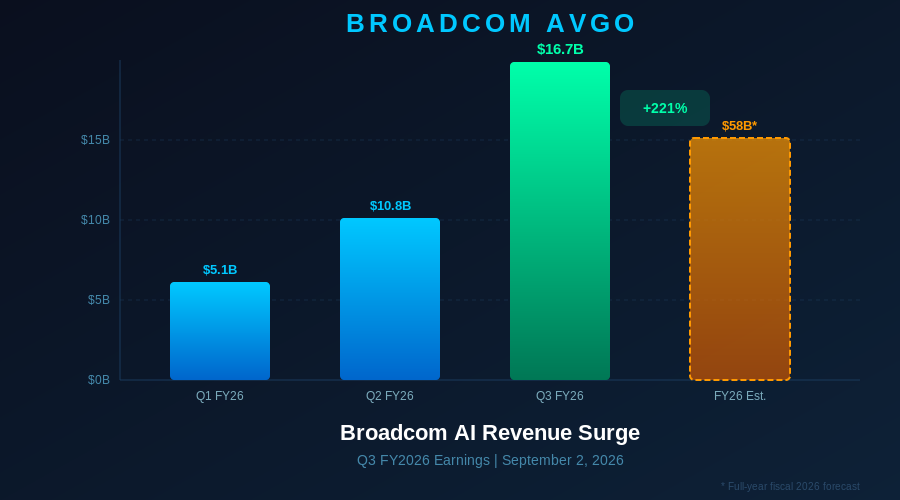
Broadcom delivered what may be the most staggering quarterly earnings report in semiconductor history last week. Its AI revenue reached $16.7 billion in the third quarter of fiscal year 2026 — a 221% jump year-over-year and a 54% leap from the prior quarter alone. The numbers aren’t just impressive; they signal a structural shift in where the money flows as the AI buildout accelerates beyond anything analysts projected even twelve months ago.
Total revenue for the quarter came in at $29.6 billion, up 86% from a year earlier. CEO Hock Tan described the results as a reflection of “hyperscaler demand unlike anything we’ve seen in our history,” and the data backs him up.
Custom Silicon Is Now the Core
For years, Broadcom’s AI story was primarily about networking — the Ethernet switches and optical interconnects that tie together GPU clusters. That remains a meaningful business, but the headline now belongs to custom AI accelerators, or XPUs. These chips, designed specifically for individual hyperscalers rather than sold as general-purpose hardware, represented the majority of Broadcom’s AI semiconductor revenue in Q3.
The company delivered Google’s Ironwood TPU v7 in high volume during the quarter and began production shipments of the next-generation TPU v8I, which Broadcom says operates at densities that would be impossible on standard GPU infrastructure. The relationship with Google has been a decade in the making, but the current scale is unprecedented: Broadcom is now a critical manufacturing and design partner for what will become one of the largest installed bases of custom AI silicon in the world.
Beyond Google, Broadcom has disclosed that it serves six XPU customers in total. The other five have not been publicly named, but analysts believe the roster includes Meta, ByteDance, and at least two sovereign or enterprise entities that have contracted for large-scale custom inference hardware. Each engagement represents a multi-year commitment, which gives Broadcom unusually high revenue visibility in a sector known for volatility.
Guidance That Defies Conventional Scale
Broadcom raised its fiscal 2026 AI revenue forecast to $58 billion — up 186% year-over-year from fiscal 2025’s baseline. Then it went further. The company provided fiscal 2027 guidance of approximately $115 billion in AI revenue, and fiscal 2028 guidance of $230 billion. These aren’t vague long-range targets; Broadcom has characterized them as grounded in existing customer commitments and contracted pipeline.
If those numbers hold, Broadcom’s AI segment alone will generate more revenue in fiscal 2028 than the entire global semiconductor industry produced in chips for all applications as recently as 2019. That’s not a comparison designed to be taken literally — but it captures the order-of-magnitude shift underway.
The stock market has responded accordingly. Shares of AVGO have climbed more than 180% over the past twelve months, making Broadcom one of the most valuable companies on earth and cementing Hock Tan’s reputation as one of the most prescient executives in technology.
Why Custom Over Commodity?
The fundamental economics of XPUs vs. standard GPUs help explain the trajectory. A hyperscaler building a proprietary model at scale — a Google Gemini, a Meta Llama, a sovereign foundation model — has workloads that differ enough from generalized GPU profiles that custom silicon offers meaningful efficiency gains. When you’re running inference at a billion requests per day, even a 20% efficiency improvement translates directly into billions of dollars of operational savings annually.
Broadcom’s model is to co-design these chips with the customer, leverage TSMC’s leading-edge fabs for manufacturing, and take a substantial margin for the design and supply chain expertise. The customer gets a chip optimized for their exact architecture. Broadcom gets a long-term, high-margin revenue stream that deepens with every generation of model the customer trains.
That flywheel is now spinning at full speed. Google’s TPU program is in its seventh generation. The transition from v7 to v8I in a single fiscal quarter illustrates how rapidly customers are iterating — and how locked-in the partnership has become.
Networking Remains a Tailwind
While XPUs dominate the headlines, Broadcom’s networking business is also accelerating. The company’s Tomahawk and Jericho switch families are deployed in virtually every major hyperscale AI cluster, and the shift to 800G and 1.6T Ethernet is adding significant incremental revenue as cluster sizes grow. Broadcom’s bet on Ethernet over InfiniBand as the fabric of choice for AI infrastructure has largely played out in its favor, with most new large-scale deployments — particularly those not tied to NVIDIA’s NVLink ecosystem — running Broadcom switches.
Optical components, where Broadcom has made multiple acquisitions over the past three years, are growing even faster. The move to co-packaged optics for switching, which eliminates external optical transceivers and dramatically reduces power consumption, is expected to become mandatory at 1.6T speeds. Broadcom’s early investment in this area positions it to capture that transition.
What Could Go Wrong?
Investors and analysts who have followed Broadcom for years tend to offer one consistent caveat: customer concentration. Google alone likely represents 30-40% of Broadcom’s AI revenue today. A strategic pivot by Google — toward NVIDIA, or toward in-house design capability at the chip level — would be material.
There’s also a tariff and export control overhang. The current regulatory environment has pushed several non-US customers to accelerate their XPU programs partly to reduce dependence on US-designed chips, which creates opportunity for Broadcom but also introduces geopolitical risk to any cross-border manufacturing or IP arrangement.
Competitive pressure from Marvell, which runs a similar custom silicon business, is real but manageable at current scale. Marvell has a meaningful relationship with Amazon’s Trainium program, but Broadcom’s design depth and existing customer base give it a structural advantage in winning new XPU engagements.
The Bigger Picture
Broadcom’s Q3 results are a data point in a broader story: the hyperscale AI buildout is not slowing down. Capital expenditures across the four largest cloud providers exceeded $300 billion on an annualized basis as of mid-2026, and the majority of that is flowing into AI infrastructure. Broadcom sits at a chokepoint — custom silicon, high-speed networking, optical interconnects — where very few companies can compete at the required scale.
The $230 billion AI revenue forecast for fiscal 2028 would have seemed absurd two years ago. After a quarter like this, it just looks like a roadmap.
This article covers Broadcom’s third quarter fiscal year 2026 earnings, announced September 2, 2026.


