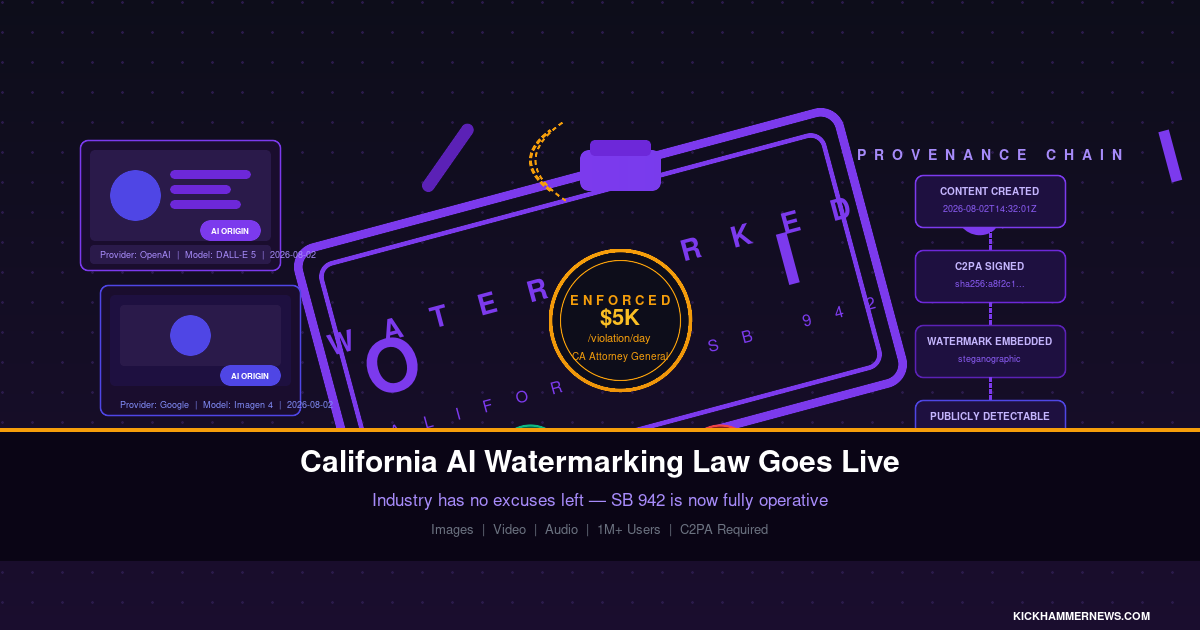
The California AI Transparency Act (SB 942) became operative today, August 2, 2026, forcing the world’s largest AI companies to stamp their synthetic content or face $5,000-per-day fines.
It has been nearly two years since Governor Gavin Newsom signed Senate Bill 942 into law. Today, after a delayed rollout, a legislative patch, and months of scrambling by major technology companies, the California AI Transparency Act is finally operative. As of this morning, any generative AI provider serving more than one million monthly users in California must embed machine-readable provenance data in the images, video, and audio their systems produce — and offer a free public tool to detect that content. The era of anonymous AI-generated media is, at least in California, officially over.
What the Law Actually Requires
SB 942 draws a clear line between what it does and does not cover. The law applies exclusively to images, video, and audio — text is explicitly excluded. That means AI-generated essays, emails, chatbot conversations, and code are outside its scope, but AI-generated photos, synthetic voices, deepfake videos, and music produced by models like Suno or Udio are squarely within it.
Covered providers — defined as businesses operating generative AI systems with over one million monthly California visitors or users — face three core obligations:
Latent disclosures. Every covered piece of AI-generated content must carry embedded, machine-readable metadata marking it as synthetic. The law directs providers to use “widely accepted industry standards,” which in practice means the C2PA (Coalition for Content Provenance and Authenticity) specification — the same open standard already adopted by Adobe, Microsoft, Google, and others. This metadata must survive the full content lifecycle: reuse, redistribution, and third-party modifications.
Manifest disclosures. Users must be given the option to add a visible, human-readable label to their AI-generated content — something equivalent to a watermark or overlay that signals the image or audio was made by a machine.
Free detection tools. Providers must make a publicly accessible AI detection tool available at no cost, allowing any person to query whether a given piece of image, video, or audio content was produced by the provider’s system.
Penalties run to $5,000 per violation, with each calendar day of non-compliance counted as a separate violation. A provider out of compliance for a single month could face more than $150,000 in fines — and a prevailing plaintiff can also recover attorney’s fees.
A Law Two Years in the Making
SB 942 passed the California Legislature in 2024 and was signed by Newsom in September of that year, though the governor’s signing statement pointedly acknowledged “implementation challenges” and encouraged the legislature to revisit the law before it took effect. The legislature responded in late 2025 with Assembly Bill 853, which pushed the operative date from January 1, 2026 to today — and added a new layer of obligations for hosting platforms, set to kick in on January 1, 2027.
The delay bought the industry several months to build compliance infrastructure, but it also produced a curious alignment: August 2, 2026 is the same day the European Union’s AI Act Article 50 became applicable. Article 50 imposes similar transparency and labeling requirements on AI systems operating in the EU, meaning that for multinational AI companies, today was a single, unavoidable deadline that applied simultaneously across two of the world’s largest regulatory regimes. Compliance teams at major labs have been treating August 2 as a unified global go-live date for the past year.
Who Is Affected — and How Prepared Are They?
The law effectively applies to every company operating at meaningful scale in the AI content generation space. That means OpenAI, Anthropic, Google DeepMind, Meta, and xAI on the foundation model side, along with platforms like Midjourney, ElevenLabs, Adobe Firefly, Suno, and any other service generating AI images, audio, or video for millions of users.
Preparedness varies. Google has been ahead of the curve, having reportedly watermarked more than 20 billion AI-generated images through its SynthID system — a proprietary approach that embeds imperceptible signals into pixel data in ways that survive compression and cropping. TikTok, a major distributor of AI-generated content even if not a generator itself (and therefore subject to the hosting platform provisions arriving in January 2027), has labeled more than 1.3 billion videos.
OpenAI moved aggressively on C2PA metadata in its image generation pipeline in 2025, ensuring that images produced by DALL-E and GPT-4’s image capabilities carry provenance credentials. Smaller players are less uniformly prepared; legal observers expect enforcement activity to focus initially on providers who haven’t taken any visible compliance steps rather than on companies that attempted good-faith compliance but fell short on technical specifics.
The Bigger Picture: Content Provenance as Infrastructure
What makes SB 942 significant beyond its immediate compliance obligations is the precedent it sets. For the first time, a major jurisdiction is legally requiring that AI-generated content carry verifiable origin information — not as a voluntary best practice, but as a condition of operating. That changes the calculus for the entire content supply chain.
Newsrooms, social media platforms, advertisers, and court systems have all struggled to build reliable workflows for determining whether a given image or piece of audio is authentic. A legal mandate that forces AI providers to bake provenance into their outputs — and to maintain it through redistribution — doesn’t solve the problem of AI-generated disinformation, but it creates a layer of accountability that didn’t previously exist.
The C2PA specification, which SB 942 effectively endorses by reference, works like a chain of custody for media. Each time a C2PA-credentialed image is edited, redistributed, or used as training data, the credential can be updated to reflect that history. The goal is a world where a news editor, a social media moderator, or a judge can query the provenance of any piece of content and receive a verified account of how it was made.
What Comes Next
The hosting platform obligations arriving on January 1, 2027 will extend SB 942’s reach significantly. Under those provisions, platforms that distribute AI-generated content — not just companies that produce it — will face their own disclosure requirements. That means YouTube, TikTok, Meta’s social properties, and X will all need to build infrastructure for surfacing and preserving C2PA credentials in content uploaded by third parties.
For today, though, the immediate question is whether California’s attorney general will begin enforcement promptly or give companies a grace period to achieve full technical compliance. The law provides no explicit grace period. The $5,000-per-day clock started this morning.
The age of unaccountable AI-generated media in California is over — at least on paper. Whether enforcement follows is the next chapter.


