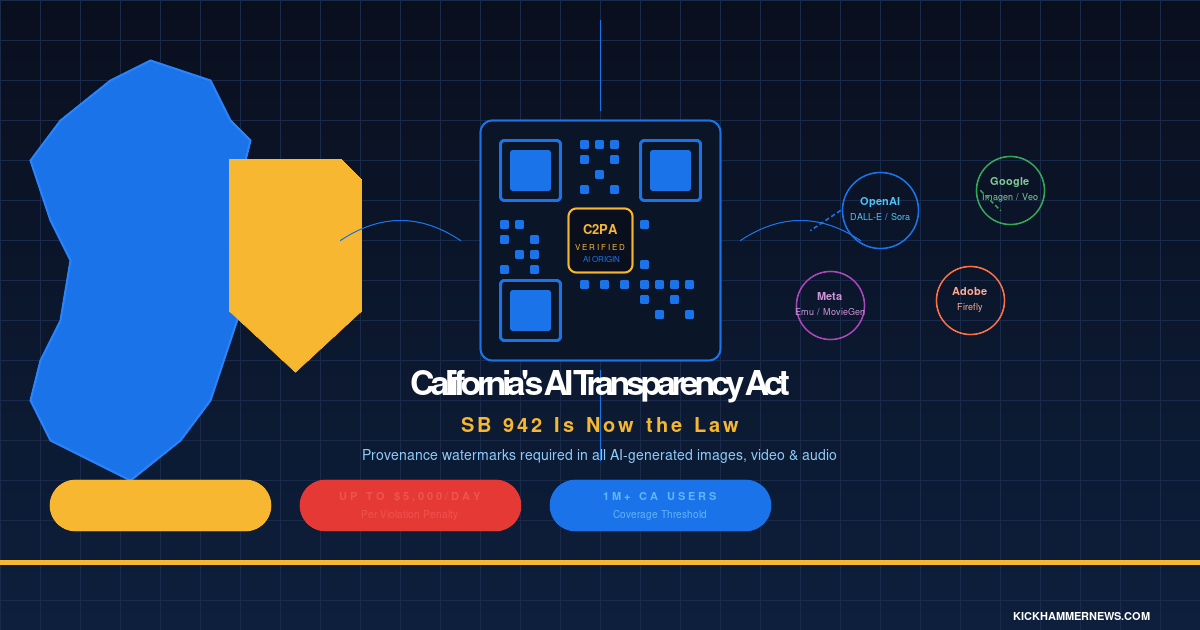
Today, August 2, 2026, marks a turning point in the fight against AI-generated misinformation. California’s Senate Bill 942 — the AI Transparency Act — became operative, instantly converting months of compliance preparation into a legal obligation for every major AI company operating in the state. For the first time in the United States, large generative AI providers must embed cryptographic provenance data into every image, video, and audio clip their systems produce. The era of easily deniable synthetic media is, at least in legal terms, over.
What the Law Actually Requires
SB 942 targets the largest AI platforms — those with more than one million monthly visitors or users accessible within California. That threshold captures virtually every name-brand AI product on the market: OpenAI’s DALL-E and Sora, Google’s Imagen and Veo, Adobe Firefly, Meta’s Emu and MovieGen, Midjourney, Stability AI, and dozens of others.
The law’s core mandates are threefold. First, covered providers must embed a latent disclosure — a machine-readable provenance record — into every image, video, or audio output generated or substantially altered by their AI systems. This hidden watermark must include the provider’s name, the AI system name and version, a creation timestamp, and a unique content identifier. Critically, the law requires this disclosure to be “permanent or extraordinarily difficult to remove,” language that in practice mandates cryptographic or steganographic embedding rather than easily-stripped metadata tags.
Second, providers must offer users the option to attach a visible disclosure label to their generated content — a human-readable notice confirming the media was AI-produced.
Third, every covered provider must operate a free public detection tool allowing anyone — not just paying customers — to submit a piece of content and check whether it originated from that provider’s AI system.
The law’s technical framework is built around the C2PA specification — the Coalition for Content Provenance and Authenticity standard developed by Adobe, Microsoft, Google, BBC, and others. C2PA defines a cryptographically signed “content credential” that travels with a media file and can be verified by any compliant tool. SB 942 does not explicitly mandate C2PA by name, but its language about “widely accepted industry standards” and permanent, machine-readable watermarks points squarely at the C2PA ecosystem.
A Law Two Years in the Making
The road to today’s operative date was longer than legislators initially planned. Governor Gavin Newsom signed SB 942 into law in September 2024, originally setting a January 1, 2026 effective date. But as compliance teams inside AI companies scrambled to build watermarking pipelines, it became clear the industry needed more runway. In October 2025, Newsom signed Assembly Bill 853, which pushed the operative date to August 2, 2026, while also adding a new obligation: starting January 1, 2027, hosting platforms must offer users the ability to detect and label AI-generated content uploaded to their platforms.
The delay was quietly welcomed by the industry, which used the extra time to build and test C2PA credential generation at scale. OpenAI had already integrated C2PA into DALL-E 3 in late 2023 and expanded it to Sora in 2025. Google and Adobe followed. But the watermarking problem is harder than it sounds: embeddings must survive format conversions, compression, screenshots, and social media re-uploads while remaining detectable. Some academic researchers have published methods for stripping current watermarks, and the robustness question remains actively contested.
Enforcement with Teeth
What distinguishes SB 942 from many tech transparency laws is its enforcement mechanism. Violations are subject to civil penalties of up to $5,000 per violation per day, enforceable by the California Attorney General, city attorneys, and county counsels. Prevailing plaintiffs are also entitled to attorney’s fees and costs. For a company generating millions of media files daily, non-compliance is not a theoretical risk — it’s an existential financial exposure.
The California AG’s office has not publicly announced an enforcement timeline or grace period, leaving compliance teams in an uncomfortable state of legal uncertainty on Day One. Industry observers expect the AG to initially focus on larger, well-capitalized violators rather than small startups, but the law’s text provides no formal carveout for smaller covered providers.
Why Text Was Left Out
SB 942 conspicuously applies only to images, video, and audio — not to AI-generated text. This is a deliberate legislative choice that has drawn both praise and criticism. Proponents argue text is far harder to watermark reliably and that images and video pose the most acute misinformation risks in the short term. Critics point out that large language models now generate the majority of synthetic content by volume, and that text-only outputs remain entirely unregulated under the new law.
The exclusion of text means platforms can continue to operate AI writing assistants, chatbots, and content generators without any disclosure obligation for the text outputs themselves. That gap is likely to be the focus of SB 942’s follow-on legislation.
The Broader Landscape
California’s move does not exist in a vacuum. The EU AI Act, which entered full enforcement in August 2026 for high-risk systems, includes its own synthetic content disclosure requirements. China has operated AI-generated content labeling rules since 2023. The U.S. federal government passed the Great American AI Act in June 2026, which includes funding for watermarking research and voluntary standards but stopped short of mandating provenance embeddings at the federal level.
That patchwork means companies now face potentially conflicting obligations across jurisdictions. A provider compliant with California’s C2PA-aligned requirements may still need to modify its watermarking approach to satisfy EU specifications. The Coalition for Content Provenance and Authenticity has been lobbying for its specification to serve as the global default, but harmonization remains a work in progress.
What Comes Next
For the 100-plus companies that fall under SB 942’s scope, today is not a finish line — it’s a starting gun for enforcement risk. Compliance teams will spend the coming weeks reviewing their watermarking pipelines, testing detection tools, and briefing legal counsel on exactly what “per violation per day” means for their content volumes.
For consumers, the practical impact may be subtle at first. Most people do not use C2PA content credential viewers in their daily digital lives. The real-world effect of SB 942 will depend heavily on whether browsers, social platforms, and operating systems surface provenance data to ordinary users — a second-order adoption problem that the law does nothing to solve on its own.
But the legal baseline it establishes is significant. For the first time in the U.S., a synthetic image, video clip, or audio file generated by a major AI system must carry, embedded in its very data, a record of its origin. Whether that record gets checked is another question. That it must exist at all is a new fact in the world.
SB 942 applies to providers with over 1 million monthly users or visitors accessible within California. Enforcement is handled by the California Attorney General’s office.


