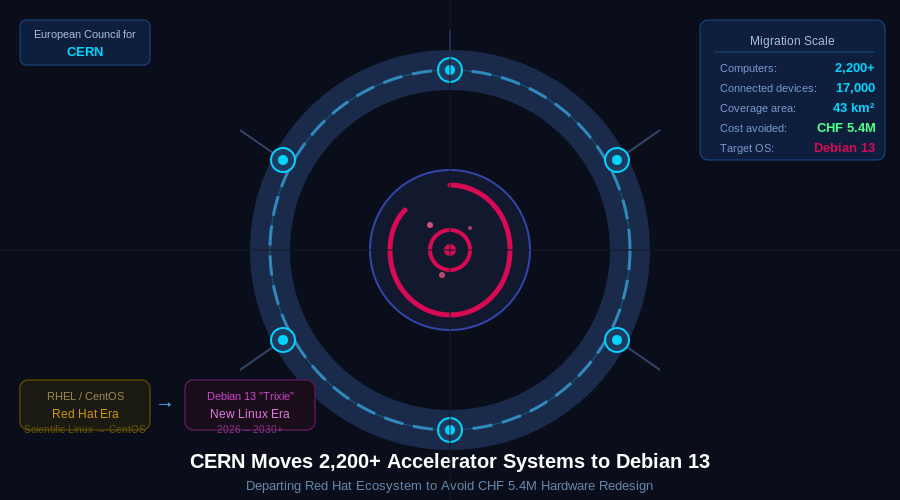
When physicists talk about particle collisions inside the Large Hadron Collider, they typically measure outcomes in femtoseconds. But when CERN’s accelerator controls team talks about its Linux migration, they measure the stakes in Swiss francs — specifically, the CHF 5.4 million it would have cost to stay on Red Hat Enterprise Linux. That price tag, combined with a looming deadline and an uncomfortable hardware compatibility reality, is what drove one of the most significant Linux migrations in scientific history: moving more than 2,200 industrial computers and embedded systems to Debian 13 “Trixie” by the end of 2026.
A Long History With Red Hat
CERN has operated at the bleeding edge of particle physics for decades, but its Linux infrastructure has historically been conservative. The organization’s accelerator control systems — the machines that talk directly to the equipment steering beams around a 27-kilometer ring — moved through the Red Hat ecosystem across multiple generations. From Scientific Linux (a RHEL-compatible distribution CERN co-developed with Fermilab) through the CentOS era, the accelerator controls team built deep integration with that software stack.
The relationship worked well for years. Scientific Linux gave CERN predictability and control over a base system, while remaining compatible with the broader Red Hat ecosystem that dominated enterprise Linux at the time. When CentOS offered a free, downstream clone of RHEL, the transition there was a natural continuation.
Then things started to change.
The CentOS Disruption
When Red Hat cut CentOS 8’s support lifespan from 2029 to the end of 2021, it wasn’t just an inconvenience — it was a signal about who controlled the CentOS roadmap. For an organization like CERN, whose accelerator operation follows a carefully planned multi-year schedule of running periods, technical stops, and long shutdowns, that kind of unpredictability is genuinely dangerous. You cannot patch a particle accelerator’s control layer on short notice.
CERN’s controls team initially explored staying within the Red Hat ecosystem. CentOS Stream was evaluated as a path forward, with the plan to validate Stream 9, move to Stream 10, and eventually Stream 11. At the same time — and critically — the team began preparing a fallback. They started making CERN’s software integration layer distribution-agnostic and identified Debian as the alternative.
That fallback would become the primary plan.
The x86-64-v2 Problem
The decision point arrived in 2023, disguised as a compiler flag. Red Hat’s choice to enable `-march=x86-64-v2` as the default compiler target for RHEL 9 — and therefore CentOS Stream 9 — introduced a minimum CPU instruction set requirement that older hardware could not meet.
For desktop users or modern server deployments, this is largely a non-issue. But CERN’s accelerator control infrastructure is not made of recent commodity hardware. Many of the embedded systems and front-end computers interfacing with accelerator electronics are purpose-built devices with specialized hardware boards designed for long operational lifetimes. Running a risk analysis in Q2 2023, CERN’s team found that the x86-64-v2 requirement would affect roughly 47 percent of the embedded control computers.
The numbers that followed were sobering. Staying on the Red Hat path would require redesigning approximately 11 hardware board types, bringing in additional electronic and software engineers, reorganizing rack infrastructure, and most systems would face disruption during commissioning. Even with flawless execution, the team estimated only about a 20 percent chance of getting everything working without significant issues.
The cost? Approximately CHF 5.4 million. And the deadline was firm: the accelerator infrastructure needed to be operational by Q4 2026.
The decision, as CERN engineers Federico Vaga and Nikos Tsipinakis explained at MiniDebConf Winterthur 2026, was to treat this as a software problem requiring a software solution — migrate to Debian rather than redesign the hardware.
The Scale of What’s Moving
To understand why this migration matters beyond CERN, it helps to appreciate the scale. The accelerator control infrastructure spans roughly 43 square kilometers. The 2,200-plus computers being migrated connect to approximately 17,000 devices — sensors, power converters, magnet controllers, beam instrumentation systems, and specialized electronics found nowhere else on Earth.
These are not general-purpose workstations. They are front-end computers that sit close to the accelerator equipment, often in environments with elevated radiation, and they run continuously during operational periods when beam is circulating. Rebooting them casually is not an option. The choice of Linux distribution for these systems directly affects the reliability of science that costs hundreds of millions of euros per year to run.
Importantly, the migration is scoped specifically to the accelerator control layer. CERN’s massive compute farms, the Tier-0 grid for LHC data processing, and the broader data center infrastructure will continue running on AlmaLinux and RHEL. This is not a wholesale rejection of enterprise Linux — it is a targeted response to a specific compatibility and cost problem in the embedded controls domain.
Rethinking How Linux Gets Delivered
The move to Debian also gave CERN’s team an opportunity to modernize how the operating system is deployed and maintained across such a geographically distributed and operationally constrained environment.
The new deployment model decouples the bootloader, kernel, initial RAM disk, and userspace into separately managed components, rebuilding delivery around Kubernetes. This architecture gives the controls team finer-grained control over what gets updated when and allows individual components to be updated independently of the full OS image — a meaningful operational advantage in an environment where update windows are dictated by the accelerator’s beam schedule rather than convenience.
Device driver management also received attention. Rather than relying on distribution-specific assumptions, CERN has been working to make its custom hardware drivers more portable and less tightly coupled to any single Linux flavor. That investment in portability reduces the risk of finding themselves in the same position again if Debian’s direction ever changes.
Picking the Right Long-Term Target
Even the choice of how long to stay on Debian 13 involved careful engineering analysis. The accelerator’s operational schedule creates hard constraints: a Linux version needs to remain in supported status for as long as CERN needs to run it, and updates need to be carefully validated before being applied to live production systems.
Debian 13 “Trixie” provides standard long-term support through 2030. CERN is considering either moving to Debian 15 at that point, or remaining on Trixie under the Debian Extended Long-Term Support (ELTS) program, which would extend coverage to 2033. The team specifically highlighted the need to avoid having to “hotpatch a live particle accelerator” — a vivid way of explaining why lifecycle planning matters so much in this environment.
The Broader Signal
CERN’s migration is a high-profile data point in a pattern that has been building since Red Hat’s CentOS pivot. Government agencies in France and Germany have announced Linux migrations from Windows infrastructure. Steam’s Linux gaming share has surpassed five percent. Enterprise desktop Linux adoption is rising as Windows 10’s October 2026 end-of-support approaches.
What makes the CERN story distinct is that it represents a migration away from Red Hat-based Linux specifically — and toward Debian. The message it sends to other scientific and industrial organizations running long-lived embedded systems on RHEL-compatible distributions is clear: if CERN can move 2,200 accelerator control computers to Debian while keeping the LHC running, the barrier to doing something similar in other domains is lower than it might appear.
By December 2026, Debian 13 will be able to claim that it is running at the heart of the world’s most powerful particle accelerator. That is not a typical entry in a Linux distribution’s deployment resume.
Sources: Linuxiac, The Register, Phoronix, InfoQ, GIGAZINE, DEV Community