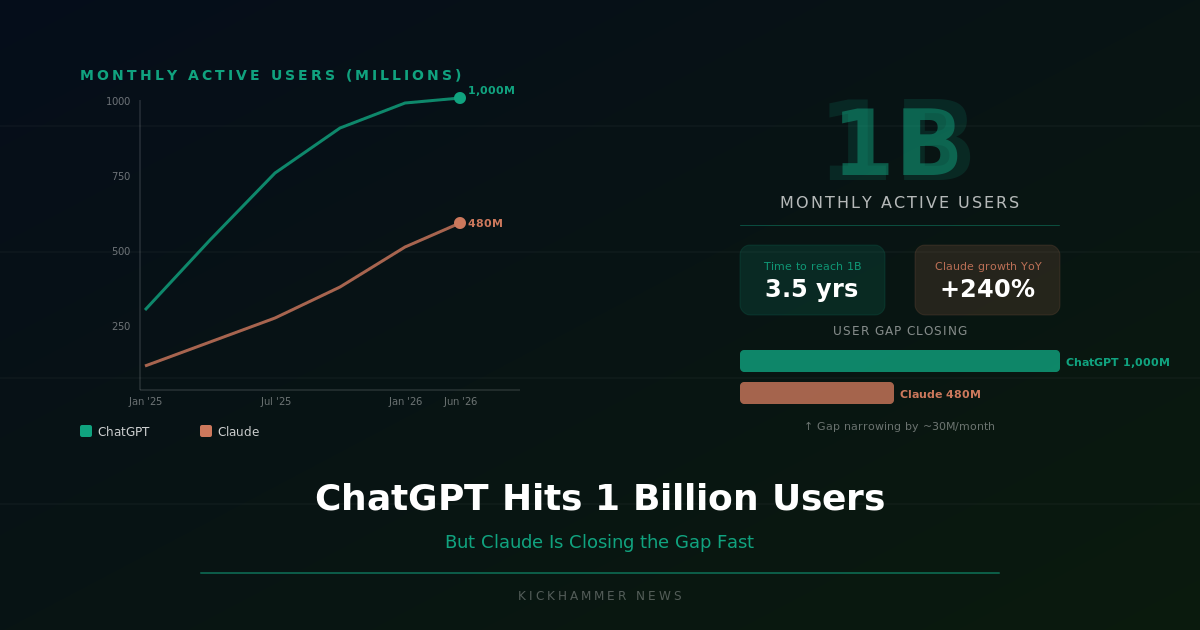
The AI assistant race just hit a historic milestone, and the numbers behind it tell two very different stories about where consumer AI is headed.
OpenAI’s ChatGPT has officially crossed the threshold of one billion monthly active users, becoming the fastest application in history to reach that benchmark — surpassing Google Maps, TikTok, Instagram, and YouTube, all of which took between five and eight years to achieve the same feat. ChatGPT did it in roughly three years from its November 2022 launch.
But buried in that headline triumph is a subplot that may prove more consequential for the industry’s future: Anthropic’s Claude is growing at 640% year over year, a pace that makes ChatGPT’s own impressive 62% growth look almost modest by comparison.
The Fastest App to a Billion
The milestone was confirmed by market intelligence firm Sensor Tower in early June 2026, counting monthly active users of the ChatGPT mobile app. While the figure reflects app usage rather than the full web and API ecosystem, it underscores something that was unimaginable just a few years ago: a conversational AI has become as ubiquitous as the world’s most dominant social and utility platforms.
For context, consider the company ChatGPT keeps in the billion-user club. YouTube took eight years to reach the milestone. Instagram needed roughly the same. TikTok, widely considered the fastest-growing social app of the modern era before ChatGPT, took about five years. ChatGPT rendered those records obsolete.
The factors driving ChatGPT’s explosive adoption are well-documented: an intuitive interface that lowered the barrier to AI interaction, aggressive rollout of the free tier, integration with Microsoft’s Office suite and Bing, and a relentless cadence of model updates that kept the product relevant through an era of furious competition. OpenAI’s decision to make GPT-4 capabilities broadly accessible through ChatGPT Plus — and eventually to free users in limited form — seeded a habit loop across demographics from students to enterprise professionals.
The Number That Should Worry OpenAI
And yet, despite its billion-user crown, OpenAI has reason to pay attention to its closest rival.
Claude, Anthropic’s AI assistant, now counts approximately 56 million global monthly active app users — a figure that represents roughly 5.6% of ChatGPT’s user base. On its own, that gap looks enormous. But the trajectory is what matters: Claude’s 640% year-over-year growth rate is more than ten times faster than ChatGPT’s.
That kind of compounding, if sustained, changes the competitive picture rapidly. Smaller starting bases grow more easily, of course — but 640% growth in a market this competitive, against a product this entrenched, isn’t a statistical artifact. It reflects real switching behavior.
Sensor Tower data adds another dimension to the story. US users who installed Claude during Q1 2026 spent approximately 5% less time on ChatGPT within one month of making the switch. That’s a meaningful signal: Claude isn’t just attracting new-to-AI users; it is pulling engaged, active ChatGPT users into its orbit. In product terms, that’s the harder kind of growth to achieve — and the kind that actually threatens market share.
Why Claude Is Gaining Ground
Anthropic’s ascent is the product of several converging trends.
First, Claude has built a strong reputation in enterprise and professional settings. Where ChatGPT initially won on consumer accessibility, Claude has distinguished itself on reasoning quality, instruction-following, and longer-context handling — capabilities that matter disproportionately to power users, developers, and businesses. Claude’s extended context windows and its performance on complex multi-step tasks have made it the preferred tool in knowledge-work environments.
Second, Anthropic has been aggressive on model iteration. The Claude Opus and Claude Sonnet families have delivered consistent performance gains, and each major release has generated fresh attention and trial. In the attention economy of AI tools, regular marquee upgrades are a marketing strategy as much as a technical one.
Third, Anthropic has invested heavily in trust and safety as a differentiator. In an era when AI hallucinations, data privacy concerns, and regulatory scrutiny are live issues for enterprise buyers, Anthropic’s “safety-focused” brand positioning has resonated — particularly in regulated industries like finance, healthcare, and law where Claude has seen strong adoption.
Finally, the competitive landscape itself has changed. The era of ChatGPT as the only serious consumer AI assistant is over. Google’s Gemini, Meta’s AI integrations, and Claude have created a multi-product market in which users comparison-shop and maintain multiple AI relationships. Claude benefits from that fragmentation.
What a Billion Users Actually Means
ChatGPT’s billion-user milestone is genuinely significant, not just as a marketing achievement but as a structural shift in how people interact with technology. A billion monthly active users represents a behavioral change at civilizational scale — AI-assisted search, writing, coding, tutoring, and creative work are now mainstream behaviors, not early-adopter experiments.
That scale creates compounding advantages for OpenAI: more data for model training, more leverage in enterprise negotiations, more consumer inertia to overcome. Network effects in AI are subtler than in social media, but they exist — through integrations, APIs, developer ecosystems, and organizational habits that solidify over time.
But the same scale creates vulnerabilities. Serving a billion users is an infrastructure challenge. Maintaining quality and safety at that volume is operationally demanding. And the expectations of a billion-user base create pressure to monetize aggressively, which risks the user experience degradation that has undermined other platforms at scale.
Claude, still at 56 million users, operates without those constraints. It can prioritize quality, experiment with pricing and features, and build enterprise relationships with a flexibility that billion-user platforms tend to lose.
The Race Is Just Getting Started
The most important thing about both of these numbers — ChatGPT’s billion and Claude’s 640% — is that they exist in a market that is still in its earliest innings.
AI assistant penetration among global internet users remains relatively low when measured against the opportunity. The next growth frontier — integrations into workplace software, mobile operating systems, automotive interfaces, consumer devices — remains largely uncaptured. Both OpenAI and Anthropic are racing to win those integrations, as are Google, Meta, and a growing field of specialized competitors.
The billion-user milestone belongs to ChatGPT. But if the current growth trajectories hold, the next chapter of this race will be considerably more contested than the last.
Data sourced from Sensor Tower market intelligence. ChatGPT user figures reflect monthly active mobile app users and do not include web or API usage.


