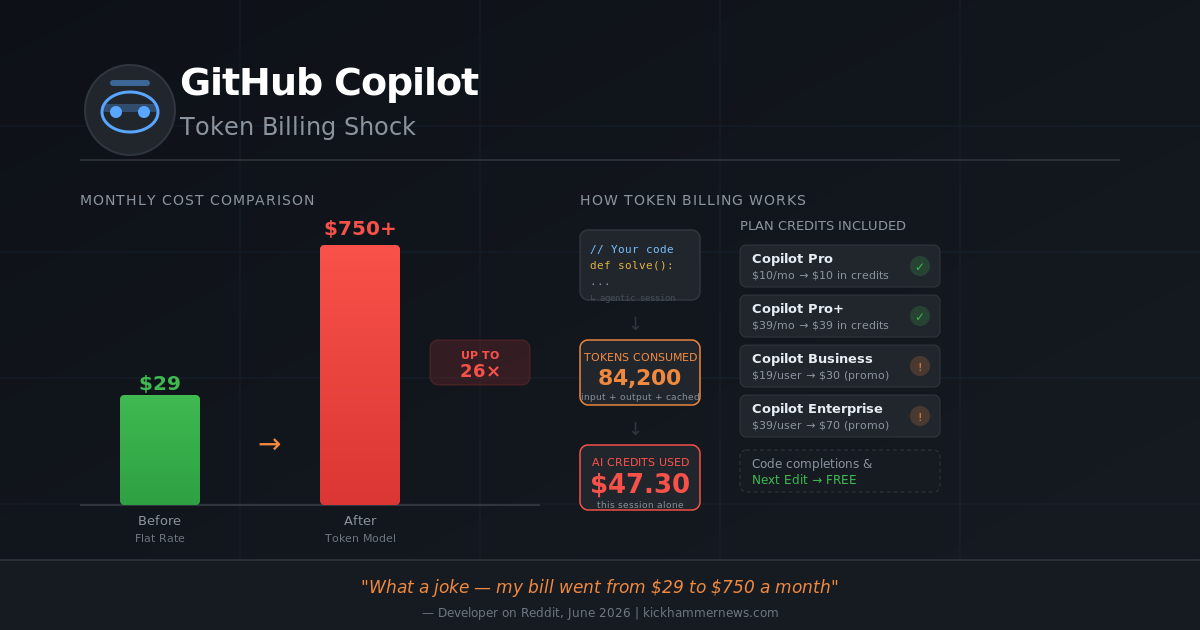
For millions of developers, GitHub Copilot has been the defining AI tool of the past three years — a reliable, flat-rate coding companion that sat quietly in the IDE, answering questions and completing functions for a predictable monthly fee. That era officially ended on June 1, 2026, when Microsoft flipped the switch on a new token-based billing model that has left swaths of developers stunned, frustrated, and in some cases, reaching for the cancellation button.
The change — weeks in the making after a late-April announcement — replaces the old premium request unit (PRU) system with a new currency called “GitHub AI Credits.” Usage is now calculated based on how many tokens a session consumes, covering input, output, and cached tokens, billed according to GitHub’s published API rates for each AI model. On the surface, the base subscription prices haven’t changed: Copilot Pro remains $10 per month, Pro+ at $39, Business at $19 per user, and Enterprise at $39 per user. But what has changed is what those monthly payments actually buy — and for developers leaning heavily on Copilot’s newer agentic features, the difference has been jarring.
From Coding Assistant to Agentic Platform
To understand why GitHub made this move, it helps to look at what Copilot has become. When it launched in 2021, Copilot was a glorified autocomplete tool — powerful, but contained. It suggested the next line of code. Today, Copilot is something fundamentally different: an agentic platform capable of running autonomous, multi-step coding sessions that can span hours, iterate across entire repositories, and spin up sub-agents to tackle parallel tasks.
“Copilot is not the same product it was a year ago,” the company wrote in its official announcement on April 27. “Agentic usage is becoming the default, and it brings significantly higher compute and inference demands. Today, a quick chat question and a multi-hour autonomous coding session can cost the user the same amount.”
That last sentence is key. Under the old model, GitHub was effectively subsidizing heavy agentic use — absorbing enormous inference costs behind a flat fee that made no distinction between a developer asking a one-liner question and another running a full-blown autonomous refactoring job for six hours. Financially, it was untenable, and the company has said as much: the old premium request model “is no longer sustainable.”
The Sticker Shock
The problem is that the transition arrived with real pain for a significant slice of users. Developers who had been doing exactly what GitHub encouraged them to do — lean into Copilot’s agentic features, use multi-model sessions, run long autonomous coding sprints — are now facing bills they didn’t see coming.
On Reddit and X, the reactions have been swift and sharp. One user posted that while they had been paying around $29 per month, their projected bill under the new model would balloon to nearly $750. “This new usage model is just stupidly expensive. I’m adjusting mine by cancelling. At that cost, it is no longer cost-effective or useful in any practical way,” they wrote, in a post that quickly gathered hundreds of upvotes.
Even more striking was a screenshot shared by another developer showing costs apparently jumping from approximately $50 to $3,000. “WOW, didn’t expect new pricing model to be this ridiculous,” that user wrote.
Reports across developer forums indicate cost increases ranging from 10x to 50x for heavy users. The figures have been met with equal parts outrage and skepticism — with some in the community arguing that developers burning through that many tokens are operating in unsustainable ways.
The Divide in the Developer Community
Not everyone is sympathetic to the backlash. A counterargument has emerged: developers seeing the sharpest increases are likely “vibe coders” — those who fire off long, sprawling AI-driven sessions without much discipline around token efficiency. If you’re prompting carefully and using Copilot as a targeted tool rather than an autonomous agent running unattended, some argue, your costs under the new model shouldn’t be dramatically higher.
“The vast difference between some of us working all day and still barely having overage and then these screenshots. I struggle to believe it’s complexity differences in the workload,” wrote one commenter. “The only way it gets crazy like that is if you are purely ‘vibe coding’ with a ton of bloated iterations. It’s pretty affordable for even small outfits if used as a tool, on pretty much any provider.”
There’s a third camp, though, and perhaps the most pointed one: those who argue that Microsoft bears direct responsibility for the mess, because it actively encouraged the behavior it is now penalizing.
“To all the people blaming the people who actually used the system the way Microsoft built it — and even encouraged it to be used this way — the only one at fault here is Microsoft,” wrote one developer. “Microsoft provided this billing method and they kept making it easier and easier to burn through massive numbers of tokens on single premium requests that could churn for hours or even days while spawning dozens or even hundreds of sub-agents.”
What the New Model Actually Looks Like
Under the new structure, each monthly plan includes a corresponding monthly allotment of AI Credits, priced at face value: a $10 Pro subscription includes $10 in monthly AI Credits, a $39 Pro+ subscription includes $39 in credits, and so on. Critically, basic code completions and Next Edit suggestions remain included in all plans and do not consume credits — so for developers using Copilot primarily as a traditional autocomplete tool, the impact may be minimal.
For businesses, GitHub has offered a grace period: Copilot Business customers will receive $30 in monthly AI Credits (up from the standard $19) for June, July, and August. Enterprise customers get $70. Admins also gain new budget control tools, allowing spending limits to be set at the enterprise, cost center, or individual user level — a feature that may offer some relief for engineering managers watching line items balloon.
Annual plan subscribers get a slight reprieve: they’ll remain on the old premium request-based pricing until their plan expires, though model multipliers have already increased for them as of June 1.
What Comes Next
GitHub Copilot’s token billing change may be the most visible example yet of a pattern playing out across the AI industry: the loss-leader phase is ending. Tools that were priced aggressively to drive adoption are now being repriced to reflect actual infrastructure costs — and the developers who built workflows around cheap, subsidized AI are finding themselves at the sharp end of that correction.
Whether this is a necessary maturation of the AI tools market or a bait-and-switch on loyal early adopters depends largely on who you ask. But the market will provide its own answer quickly. Competitors including Cursor, Windsurf, and various Copilot alternatives are already reporting upticks in interest and sign-ups. GitHub knows it: the company is betting that the quality of its platform, its deep integration with GitHub’s broader ecosystem, and the convenience of its agentic features will keep enough customers in the fold even as prices rise.
For now, the developer community is recalibrating — counting tokens, auditing workflows, and deciding whether GitHub Copilot at its new price is still the tool they want in their corner.


