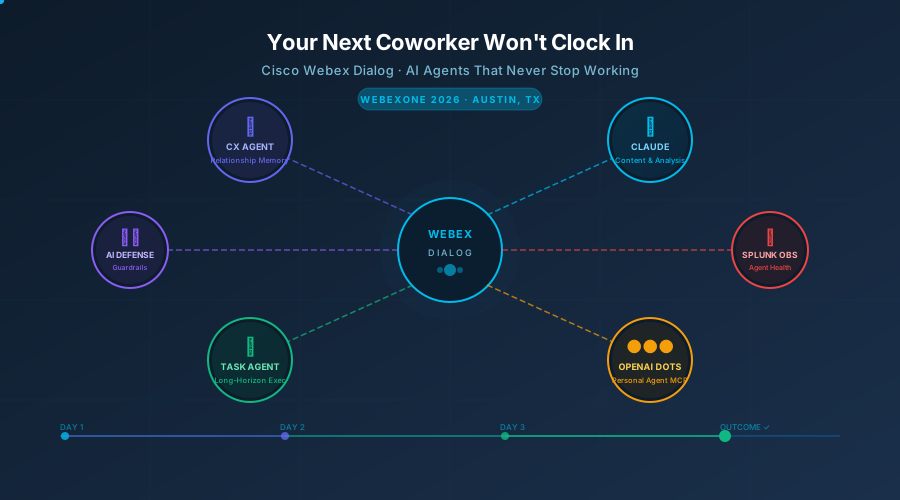
Cisco’s WebexOne 2026 wasn’t just a product event. It was a declaration that AI agents are moving from assistants you summon to colleagues that never leave.
At WebexOne 2026 in Austin, Texas, Cisco unveiled a sweeping set of AI updates to its Webex platform that collectively add up to something bigger than any single product: a bet that the enterprise collaboration stack of the next decade isn’t a chat window with a chatbot button — it’s a managed workforce of AI agents that work alongside humans, remember every customer interaction, escalate intelligently, and keep pursuing outcomes long after you’ve logged off.
The centerpiece of the announcement was Webex Dialog, an agentic harness built beneath the Webex AI Agent platform. But Dialog is only part of the story. What Cisco laid out at WebexOne is a full-stack architecture for something the industry has been trying to define: the AI-native enterprise.
The Problem Dialog Is Solving
Most AI agents today live in a moment. You ask them a question. They answer it. Conversation over. Even the most capable large language models — GPT-6, Claude Opus 5, Gemini Ultra — tend to reset their relationship with you every session. They have no persistent memory of your history, no standing mission, and no way to do work on your behalf after the window closes.
In consumer life, that’s inconvenient. In enterprise customer service, it’s a structural failure.
Consider a typical contact center scenario: a customer calls about a billing dispute, gets transferred twice, reaches a chatbot, explains the situation again, gets told to call back tomorrow. Every transition is a context collapse. Every handoff starts from zero.
Webex Dialog is Cisco’s answer to that problem. Built on a state engine that can run multiple customer journeys simultaneously, Dialog gives AI agents four core capabilities: relationship context that combines a customer’s full history with enterprise data; onboarding and optimization that indexes a company’s existing handbooks, knowledge bases, and procedures so agents can be trained on policy as fast as they’re deployed; a self-learning loop that improves agent behavior after each interaction while staying within enterprise guardrails; and long-horizon task execution that lets a fleet of coordinated agents continue working on a customer’s behalf across channels and time — even when no human is on the line.
Vinod Muthukrishnan, Cisco’s VP and General Manager of Webex Customer Experience, framed this as a third phase of agent evolution: beyond task execution and workflow automation, into the business of managing ongoing customer relationships.
“We are moving away from a world where we build agents to where we train and onboard agents like digital co-workers,” said Snorre Kjesbu, Cisco’s SVP and GM of Collaboration.
What “Long-Horizon” Looks Like in Practice
To understand why long-horizon execution matters, Cisco walked through a demo at WebexOne that is worth unpacking.
A customer with a documented medical emergency requested a refund for a nonrefundable flight. Under standard policy, it would have been denied and the customer moved on. Under Dialog, the AI agent instead located the airline’s exception process, opened an internal escalation ticket, and made the case to a human specialist — citing the customer’s loyalty status, lifetime booking value, and a recent delay that had been the airline’s fault. It also checked insurance eligibility by querying the customer’s personal AI agent directly.
The task ran for two days. The customer received daily status updates on WhatsApp.
Muthukrishnan’s summary of the demo captured the intent precisely: “It’s demonstrating agency, but it’s not making stuff up.”
That phrase matters. Enterprise AI buyers are not worried about whether AI agents are smart enough. They’re worried about whether they can be trusted to operate inside policy without going rogue — and whether there are clear guardrails, audit trails, and human override points when things go wrong.
Governance Is the Real Product
Cisco is betting that the companies that will win the AI enterprise market won’t win on model performance alone. They’ll win on governance.
The AI Agent 360 control plane — announced earlier in 2026 and expanded at WebexOne — gives teams a unified environment for designing, testing, deploying, and optimizing agents. Agent Observability, built on Splunk, links agent behavior to operational data: how often agents escalate, where they fail, what business outcomes they drive. That feature is targeted for general availability in December 2026.
Running beneath all of it is Cisco AI Defense, the company’s AI security layer, which embeds security and policy controls at the agent execution level rather than bolting them on as an afterthought.
“It’s never been harder to make it enterprise grade,” Muthukrishnan said. Governance, he argued, is “the most important part of the story.”
For enterprise IT buyers, this is exactly what they want to hear. The question in most large organizations isn’t “should we use AI agents” — that debate ended in 2025. The question is “how do we deploy AI agents at scale without a governance disaster?” Cisco is positioning its entire stack as the answer.
The AI Aggregator Move
One of the most strategically interesting parts of WebexOne 2026 wasn’t Dialog at all — it was Cisco’s simultaneous partnerships with both Anthropic and OpenAI.
Claude in Webex, built on Anthropic’s Claude Managed Agents framework, will let teams analyze data, generate content, and take coordinated action using shared enterprise context, without leaving Webex. On the same stage, Cisco announced an integration with OpenAI Dots via Model Context Protocol (MCP), with plans to offer Dots inside Webex as an always-on personal agent.
Cisco is also adding native Google Meet support in RoomOS 27 — alongside Webex, Microsoft Teams, and Zoom — which it called “making Cisco the most open collaboration hardware on the market.”
The message is deliberate: Cisco is not picking winners in the AI model race. It is building the layer that sits above the models — the enterprise infrastructure for deploying whichever agents your organization needs, governed by a single security and observability stack. In that framing, Claude and OpenAI aren’t competitors to Cisco; they’re tenants in Cisco’s enterprise platform.
This is the same move Cisco made in networking thirty years ago: don’t own the content, own the pipes. Now they want to own the collaboration substrate that AI agents flow through.
What’s Actually Available Now
A note of caution is warranted. WebexOne 2026 was heavy on roadmap and relatively light on general availability.
Webex Dialog is in beta expected in Q1 2027 — not available to buy today. Agent-to-agent coordination is slated for December 2026. Agent Observability with Splunk is also December 2026. The Claude Managed Agents integration is coming “soon,” with no hard date. The Webex Contact Center MCP Server is in beta with general availability planned for October 2026 — this month.
What is generally available now is the Webex AI Agent for Unified Contact Center Enterprise — including voice support for Contact Center Express, available this month. AI Agent 360’s design and testing environment has been available since earlier in 2026. The Cisco Ceiling Speaker Pro is expected to take orders later this quarter.
Cisco’s footnote to the announcement was explicit: “Cisco is still developing many of the named products and features, and release dates can change.”
For enterprise buyers, this requires calibration. WebexOne was a strategic declaration of Cisco’s direction — and it’s a compelling direction — but the full build-out of Dialog’s capabilities is a 2027 story, not a 2026 one.
Why This Matters
What Cisco announced at WebexOne 2026 is, at its core, a reframing of what enterprise collaboration software is supposed to do.
The original framing: collaboration tools help humans talk to each other more efficiently. Email, then IM, then video calls, then real-time documents. The tool is infrastructure; the workers are human.
The new framing: collaboration tools are the operating environment for a mixed workforce of human and AI agents. The tool is the layer through which all work — human and automated — flows, gets tracked, gets governed, and gets audited.
That is a much larger business, and it is what every major enterprise software company — Microsoft, Salesforce, ServiceNow, Google — is trying to occupy simultaneously. Cisco’s advantages in this race are real: a trusted network infrastructure brand, deep enterprise relationships built over decades, and a credible security story at a moment when AI governance is the question every CIO is asking.
The question is whether Cisco can execute a Q1 2027 delivery schedule on Dialog and make the governance promise real. If it can, the company that built the internet’s backbone may have just built the backbone for the AI-native enterprise.
Webex Dialog is expected in beta in Q1 2027. WebexOne 2026 took place October 7–8 in Austin, Texas.


