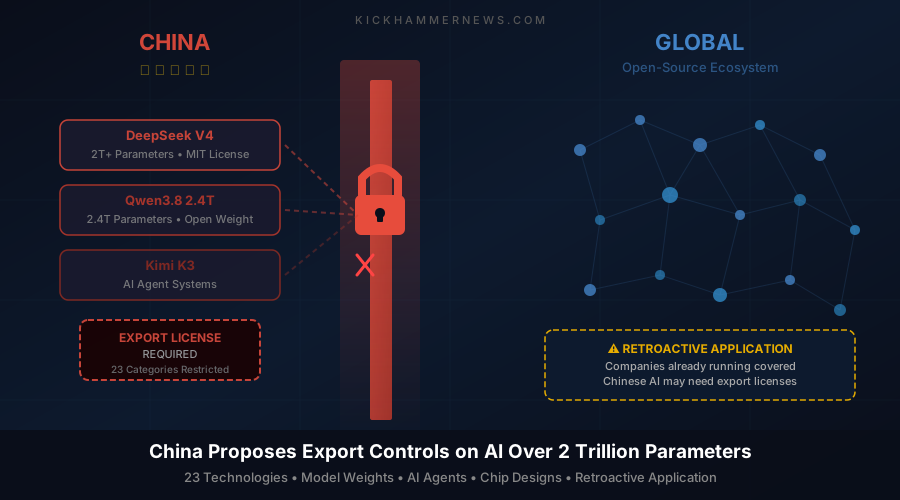
Beijing’s new draft rules would restrict exports of AI models over 2 trillion parameters, open-weight model weights, and AI agents — and may apply retroactively to anyone who has already licensed covered Chinese AI.
For years, the AI export control story has run in one direction: the United States restricting advanced semiconductor exports to China, trying to slow Beijing’s compute advantage. Then, last week, Beijing flipped the script.
China’s Ministry of Commerce, working with the Cyberspace Administration and six other agencies, published a draft regulatory notice proposing export controls on 23 categories of advanced AI technology. The list covers AI models over 2 trillion parameters, AI agent systems, open-weight model weights for large foundation models, AI chip designs, and related training infrastructure. The consultation period closed October 18. Implementation is expected within 60 days.
The implications are sweeping — and they reach far beyond China’s borders.
What the 23 Technologies Actually Cover
The draft regulation defines its scope carefully, and several categories are immediately striking.
Large foundation model weights is the one that will keep enterprise lawyers awake. Any AI model exceeding 2 trillion parameters — including the dense equivalent of mixture-of-experts models — would require an export license to transfer, license, or deploy outside China. That threshold captures DeepSeek V4, Qwen3.8 2.4T, and an expanding tier of Chinese frontier models that have been openly distributed on Hugging Face under permissive licenses.
AI agent systems are listed as a separate category, defined as systems capable of autonomous goal-directed behavior, tool use, and multi-step reasoning across real-world APIs. That description matches nearly every agentic framework built on top of covered foundation models.
Open-weight model file transfers — the actual weight tensors, tokenizer configurations, and GGUF/GGML quantized files that developers download and run locally — are explicitly listed. This is not limited to enterprise API access; it appears to cover the direct download of Chinese model weights from hosting repositories.
The remaining 19 categories span advanced AI chip designs, training cluster configurations, AI-powered industrial inspection systems used in semiconductor fabs, AI tools used in critical infrastructure management, and specialized military and dual-use AI evaluation frameworks.
The Retroactivity Shock
The most alarming provision — flagged immediately by compliance attorneys at multiple firms — is the apparent retroactive application.
According to an analysis published by TechTimes based on the draft text, China’s new controls “apply now if you licensed or deployed covered Chinese models.” Companies that downloaded DeepSeek V4 weights in January 2026 under an MIT license, integrated Qwen into customer-facing products, or contracted with a Chinese AI vendor for model access may now need a Chinese export license to continue operating those deployments — or to transfer model weights between systems across borders.
This is uncharted legal territory. Export controls typically restrict future transactions. A retroactive application to already-licensed software would be without modern precedent in technology regulation. Legal observers are divided on whether the draft’s language is intentionally backward-looking or simply poorly scoped. Either way, Chinese regulators have signaled they will interpret broadly.
Why Beijing Is Doing This
The timing is not random. The US-China AI trade truce — an informal détente on AI technology exchange that had lasted from late 2025 through most of 2026 — is “fraying,” according to diplomatic sources cited by The National News. Three factors are converging.
First, Chinese frontier AI has become genuinely competitive. DeepSeek V4.1-Flash last week became the top-ranked model on the DeepSWE coding benchmark, surpassing Claude Opus 5 and GPT-5.6 Sol. When Chinese AI was catching up, Beijing had incentive to distribute it freely to accelerate adoption and undermine the US market position. Now that Chinese AI is at or near the frontier, Beijing has reason to treat model weights as a strategic national asset.
Second, the US government’s October 2025 chip export controls — which restricted not just Hopper-class hardware but also the software stack required to run advanced inference clusters — are being processed by Beijing as a declaration of asymmetric warfare. Controlling AI model exports is partly retaliatory, and partly a signal that China will not accept a framework where it is a net technology importer.
Third, PLA researchers have flagged specific security concerns about Chinese AI models being fine-tuned and red-teamed by foreign militaries. If the base weights of Chinese frontier models are openly available on Hugging Face, Western defense researchers can study, test, and develop countermeasures against Chinese AI capabilities. Export controls close that window.
The Open-Source Ecosystem Fracture
The AI open-source community — which has relied on cross-border weight sharing as a foundational assumption — is reacting with alarm.
The Hugging Face repositories for DeepSeek V4, Qwen3.8, Kimi K3, and GLM-5.3 collectively have tens of millions of downloads, the majority from outside China. If China applies export licensing requirements to those weights, Hugging Face (a French-American company) may be legally required to geo-block Chinese model downloads for non-licensed users. The alternative — applying for export licenses on behalf of millions of individual users — is administratively impossible.
The Stanford Internet Observatory’s Center for AI Policy, which has published extensive analysis of the Chinese open-weight ecosystem, issued a rapid assessment: the controls, if implemented as drafted, “would effectively end the period of free movement of Chinese AI weights and force a bifurcation between the Chinese AI ecosystem and the global open-source one.”
Hugging Face CEO Clément Delangue has not commented publicly. DeepSeek’s corporate parent, High-Flyer Capital Management, declined to comment.
What Happens to Companies Running Chinese AI Right Now
For enterprises, the immediate calculus is complicated. Three situations require immediate legal review:
Any company that downloaded and is running Chinese model weights on its own infrastructure needs to determine whether those weights meet the 2-trillion-parameter threshold. Dense-equivalent calculations for mixture-of-experts models are not yet standardized, and the draft regulation does not specify a formula.
Any company that has deployed Chinese AI agent systems — whether as standalone products or as backend services within a larger stack — needs to assess whether that deployment constitutes an export under Chinese law if any element of the system crosses a border (data, inference calls, weight hosting).
Any company that signed enterprise agreements with Chinese AI vendors — including agreements for API access to covered models — needs legal review of whether those contracts now require supplemental Chinese export licenses.
The Broader Geopolitical Inflection
Viewed from a distance, October 2026 may mark the moment the AI world definitively split into blocs.
On one side: the US and its allies managing a regime of chip export controls, compute capacity restrictions, and FTC enforcement actions against frontier AI labs. On the other: China constructing its own mirror apparatus — export controls on model weights, national AI sovereignty frameworks, and the explicit framing of advanced AI as a “dual-use technology with national security implications.”
The free flow of AI technology that characterized 2024 and early 2025 — when DeepSeek’s R1 release was celebrated globally as a win for open science — now looks like a brief window that is closing fast.
The question enterprises face is no longer which AI model is most capable. It is which AI model they are legally permitted to run — and under whose regulatory jurisdiction they are prepared to operate.
The answer, increasingly, depends on where the weights were trained.


