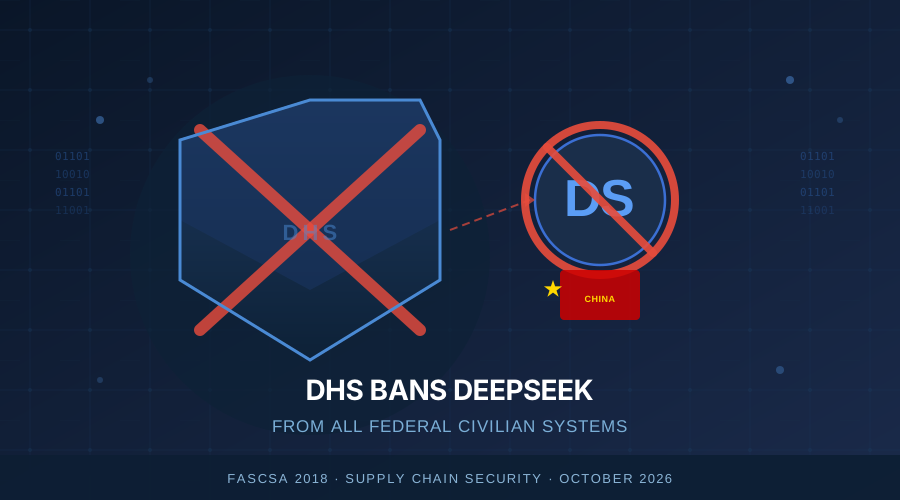
The Department of Homeland Security has formally ordered every civilian federal executive-branch agency to remove DeepSeek from its information technology systems, invoking the Federal Acquisition Supply Chain Security Act of 2018 in what marks the first time that law has been applied to a generative artificial intelligence model. The directive, signed by DHS Secretary Markwayne Mullin, lands as Washington and Beijing trade escalating restrictions on technology and sets a precedent that security experts expect other governments — and private enterprises — to follow.
What the Order Covers
DHS docket DHS-2026-0628 directs agencies to stop acquiring, installing, or using any product or service from Hangzhou DeepSeek Artificial Intelligence Co., Ltd. and its affiliates. The scope is deliberately broad: the prohibition explicitly includes “third-party products or services developed using DeepSeek implementations,” closing the back door that might have allowed vendors to keep serving federal clients by quietly routing inference through DeepSeek’s cheaper API while presenting a proprietary interface to government customers.
Agencies must scrub existing deployments and audit procurement pipelines for any dependencies on the Chinese model. Interim guidance published alongside the order encourages IT teams to monitor network traffic, enhance logging, and control data exfiltration while removal is underway. Agencies that cannot remove DeepSeek without compromising a mission-critical function may apply for a 60-day exception, but must provide a “compelling justification” and a remediation timeline — a high bar that analysts expect few agencies to clear.
The Security Logic
The DHS order articulates three overlapping threat vectors that set DeepSeek apart from other AI tools already in use by federal workers.
First, data residency. DeepSeek stores inference logs, user prompts, and model outputs on servers physically located in China. Under China’s 2017 National Intelligence Law, any Chinese company must cooperate with national intelligence agencies on request. For federal users who might casually feed draft memos, policy documents, or sensitive statistics into an AI assistant, that creates a direct pathway for sensitive material to reach Chinese intelligence services — a risk that has materialized repeatedly with consumer apps like TikTok.
Second, digital fingerprinting. Unlike some enterprise AI platforms, DeepSeek’s consumer-facing interface collects personally identifiable information and browser-level behavioral data. Combined with the prompt content itself, this data could help analysts build detailed profiles of U.S. government employees and their areas of interest.
Third, supply-chain integrity. The order raises the possibility that DeepSeek models could contain embedded vulnerabilities or malicious code — a concern that has grown more plausible since U.S. frontier AI companies, including OpenAI and Anthropic, accused DeepSeek’s developers of systematically distilling capabilities from their closed models without authorization. If model weights were built using improperly obtained training data or altered inference chains, subtle backdoors become harder to rule out without extensive red-teaming.
A Landmark Use of Supply-Chain Authority
What gives this action particular weight is the legal vehicle chosen. The Federal Acquisition Supply Chain Security Act, enacted in 2018, was designed to give the government sweeping authority to exclude foreign technology from federal procurement when it poses unacceptable risk — no specific criminal indictment required, no treaty violation needed. It has previously been used to bar Huawei network equipment and ZTE hardware from federal networks. Applying it to a generative AI model is new territory, and security attorneys say the docket language suggests the government views AI models as supply-chain components on par with routers and base stations.
That framing has implications beyond DeepSeek. If AI model weights are classified as supply-chain infrastructure, every AI vendor serving the federal government may eventually face formal security reviews, country-of-origin audits, and data-handling attestations that currently apply only to hardware. Moonshot AI’s Kimi and Alibaba’s Qwen models were cited in background briefings as sharing similar risk profiles, though neither was named in the current order.
Who Is Affected — and Who Benefits
The direct impact on DeepSeek’s business is modest: federal civilian agencies were never a significant customer base for a model distributed primarily as an open-weight release and consumer product. The reputational damage, however, may be more durable. Enterprise risk officers at major contractors, financial institutions, and critical infrastructure operators are expected to cite the federal order as justification for their own blanket restrictions on Chinese AI models — whether or not those models present comparable risk in a non-government context.
The principal beneficiaries are U.S. AI providers. OpenAI, Anthropic, and Google have been competing vigorously on price and capability at a time when DeepSeek’s V4.1 Flash and comparable open-weight models were undercutting commercial API rates by 80% or more. Removing DeepSeek from one procurement channel does not resolve the broader competitive pressure, but it consolidates the most regulated slice of the market for domestic vendors at a moment when federal AI spending is accelerating.
U.S. government-specialized SaaS vendors face the most immediate operational challenge. Firms that built federal-facing products on DeepSeek’s inference backend — attracted by its dramatically lower token costs — must now either migrate to pricier providers or risk losing contracts when compliance reviews arrive.
The Broader Signal
Read alongside the DHS order, recent weeks tell a coherent story about where U.S.-China AI competition is heading. Congress has tightened chip export controls. The Commerce Department has restricted cloud access for Chinese AI developers. Courts have seen trade-secret suits alleging unauthorized model distillation. The executive branch has now extended supply-chain exclusion authority to AI software itself.
Taken together, these moves signal that the U.S. government intends to treat frontier AI not merely as a productivity tool but as a technology with national security implications comparable to semiconductor manufacturing or satellite communications. That shift in framing — from AI-as-software to AI-as-strategic-infrastructure — may prove to be the most consequential aspect of the DeepSeek ban. The order names one Chinese model today. The precedent it establishes could apply to many more tomorrow.