Meituan’s LongCat-2.0 is a 1.6-trillion-parameter coding model trained entirely on domestic Chinese silicon. Its debut is a direct challenge to Washington’s export-control strategy — and it’s open source.
Published: July 4, 2026
For years, the prevailing assumption in Washington and Silicon Valley was that export controls on advanced semiconductors would keep China from building frontier-scale AI. That assumption just took a serious blow.
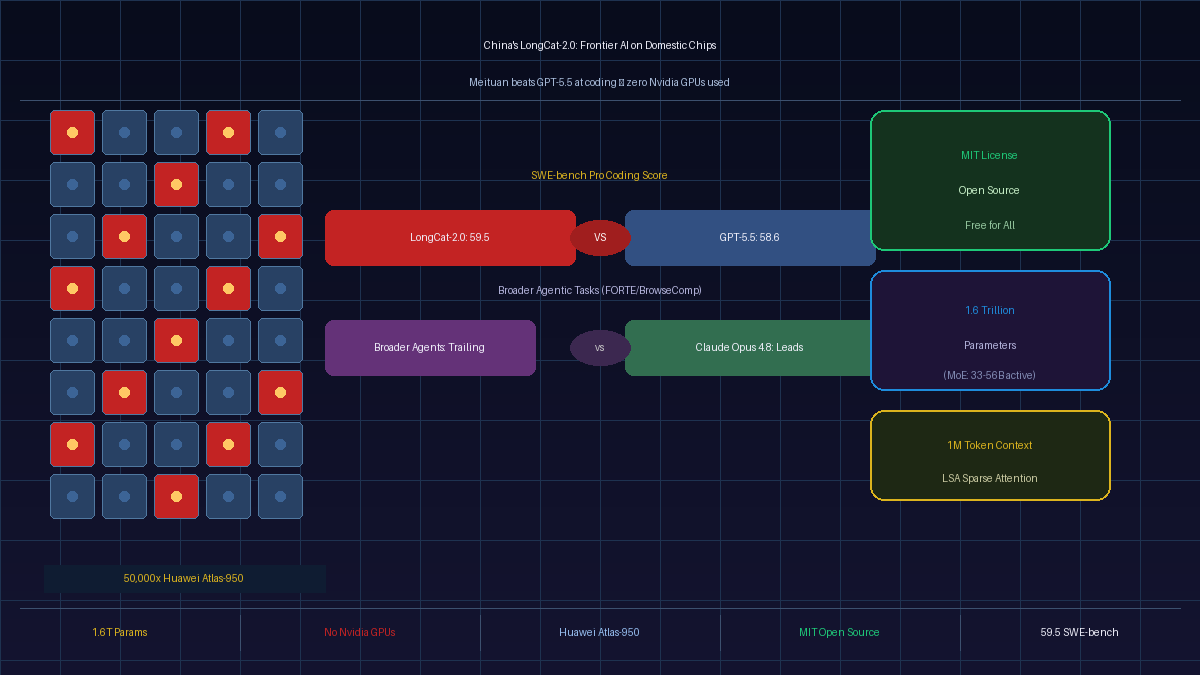
On June 30, 2026, Meituan — China’s dominant food-delivery and services giant — open-sourced LongCat-2.0, a 1.6-trillion-parameter agentic coding model. The extraordinary detail: every step of its training was performed on domestic Chinese hardware, specifically a 50,000-card cluster of Huawei’s Atlas-950 AI accelerators. Not a single Nvidia H100 or A100 touched it.
The model doesn’t just exist as a symbolic chip-independence trophy. By key benchmarks, it outperforms OpenAI’s GPT-5.5 at software engineering — and it’s free for anyone to download.
What LongCat-2.0 Actually Is
LongCat-2.0 is a Mixture-of-Experts (MoE) model, which means despite its staggering 1.6 trillion total parameters, only 33 to 56 billion are active on any given token. That dynamic activation range is managed by what Meituan calls Zero-Compute Experts — an architecture innovation that keeps inference costs tractable even at this scale.
The model was designed from the ground up for agentic coding: multi-step software engineering, long-horizon tool use, self-correction, and complex code generation across many languages and environments. It supports a native 1-million-token context window — enough to hold an entire large codebase — using a technique called LSA sparse attention, which avoids the quadratic memory cost that makes long contexts so expensive on conventional transformers.
A third architectural pillar, called MOPD (Multi-Objective Path Dispatch), routes each task across specialized expert groups: an Agent cluster, a Reasoning cluster, and an Interaction cluster. The result is a model that is not generalist soup but purpose-built machinery for the kind of multi-step software work that enterprise teams are actually trying to automate.
The Benchmark That Matters
The benchmark number that has the AI industry buzzing is LongCat-2.0’s score of 59.5 on SWE-bench Pro, the community’s toughest real-world software engineering test. GPT-5.5 scores 58.6 on the same benchmark.
On SWE-bench Multilingual — testing code across non-English programming ecosystems — LongCat-2.0 scores 77.3. On Terminal-Bench 2.1, which measures command-line and shell-automation capability, it scores 70.8.
These numbers don’t represent complete dominance across all tasks. Anthropic’s Claude Opus 4.8 still outperforms LongCat-2.0 on broader agentic benchmarks including FORTE and BrowseComp. But on the specific vertical of software engineering, a model built entirely on Chinese chips has drawn level with or surpassed the best American closed-source models.
Before its open-source release, LongCat-2.0 had been quietly accessible through the OpenRouter API — where, according to Meituan’s announcement, it had risen to the top of OpenRouter’s coding leaderboard. That real-world signal carries more weight than lab benchmarks alone.
The Chip Story Is the Real Story
The performance numbers are impressive. But what makes LongCat-2.0 geopolitically significant is the hardware.
The United States has spent the better part of three years systematically cutting China off from the most powerful AI training chips. Nvidia’s H100, H200, and Blackwell lines are all restricted from export to China. The policy logic was straightforward: if you can’t access cutting-edge accelerators, you can’t train cutting-edge models.
Meituan’s announcement is a direct challenge to that logic. Their 50,000-card Atlas-950 cluster — built on Huawei’s proprietary interconnect fabric, HCCL — was used for the full training pipeline end-to-end. The company is explicit about this: LongCat-2.0 is the first trillion-parameter model trained entirely on domestically developed compute.
That claim will face scrutiny. Details about the Atlas-950’s specs remain partially opaque, and independent verification of the training run is still emerging. But the model exists, it runs, and it scores where it scores. The results are harder to dispute than the hardware claims.
Open Source as Strategy
Releasing LongCat-2.0 under an MIT license isn’t just about sharing research credit. It’s a calculated move. Open-source models from Chinese companies — DeepSeek-R1 earlier this year, now LongCat-2.0 — have consistently disrupted Western AI pricing and positioning by giving developers free alternatives that perform at or near frontier level.
With LongCat-2.0 available on Hugging Face with no usage restrictions, enterprise developers evaluating expensive coding-assistant subscriptions now have a credible open-weights alternative that reportedly leads the field on software engineering tasks. That is a real competitive pressure on companies like GitHub Copilot, Cursor, and Cognition.
There is also a softer diplomatic dimension. By open-sourcing the model, Meituan invites global developers to use, audit, and build on it — positioning China’s AI work as a contribution to the broader research community rather than a nationalistic project.
What This Means for the Export Control Debate
LongCat-2.0 will almost certainly reignite the debate about whether semiconductor export controls are working as intended.
Advocates for controls will point out that the Atlas-950 cluster is almost certainly less efficient than an equivalent Nvidia installation, meaning more power, more time, and higher cost per training run. China is not ahead — it’s paying a steep penalty to stay in the game.
Critics will counter that the model arrived anyway. If a food-delivery company can spin up a 1.6-trillion-parameter frontier model on domestic chips and post results that beat GPT-5.5 at coding, the premise that export controls buy decisive time has been seriously challenged.
What both sides will agree on: the gap that controls were supposed to preserve just got a lot narrower on the day that matters most — the day you can actually use the model.
The Bigger Picture
LongCat-2.0 is one data point, not the whole story. US labs still lead on most dimensions of frontier capability. Anthropic’s Claude Opus 4.8, OpenAI’s GPT-5.5, and Google’s Gemini 3 Pro remain ahead on broad benchmarks. And the full stack of infrastructure, talent, and ecosystem that China needs to match America’s AI output is still being built.
But milestones have a way of accelerating investment and ambition on both sides. The fact that a Chinese company trained a legitimate frontier model on domestic hardware — and then handed it to the world for free — marks a turning point that governments, investors, and developers will be parsing for months.
The message from Meituan is clear enough: the chips didn’t stop them. The question now is what Washington does next.
Sources: [VentureBeat](https://venturebeat.com/technology/meituan-open-sources-longcat-2-0-the-1-6t-near-frontier-agentic-coding-model-thats-been-leading-openrouter-trained-entirely-on-chinese-chips/) | [SiliconANGLE](https://siliconangle.com/2026/06/30/chinas-meituan-open-sources-massive-longcat-2-0-ai-model-saying-trained-domestic-chips/) | [LongCat AI](https://www.longcatai.org/news/longcat-2) | [South China Morning Post](https://www.scmp.com/tech/tech-trends/article/3358854/china-debuts-biggest-ai-model-trained-local-chips-meituan-releases-longcat-20)


