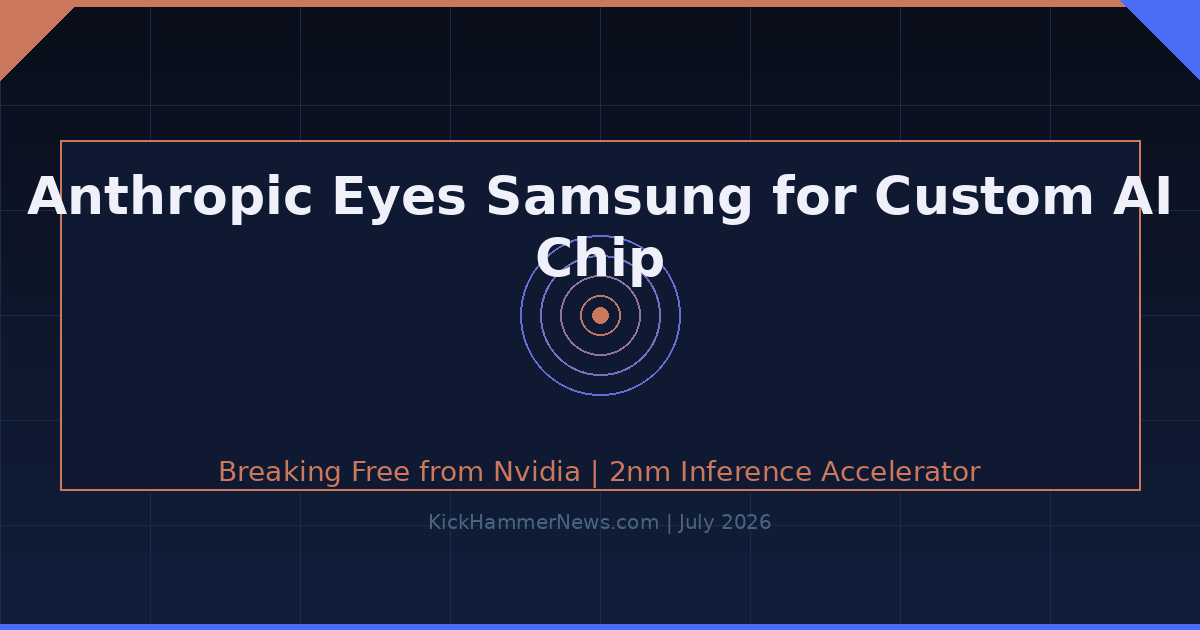
Anthropic, the AI safety company behind the Claude family of models, is in early discussions with Samsung Electronics to design and manufacture a custom AI accelerator chip — a move that, if it comes to fruition, would mark one of the most significant strategic pivots in the company’s history. Reported by The Information on July 2, the talks signal that Anthropic is no longer content to rent compute from the cloud giants and is instead charting a course toward controlling its own silicon destiny.
From Safety Lab to Chip Maker?
The conversations between Anthropic and Samsung are described as exploratory — neither company has committed to a deal, and the details of what the chip would actually do remain unresolved. According to reports, Anthropic has not yet determined the chip’s specific capabilities, power envelope, or how it would slot into a server rack alongside other hardware. What is clear, however, is the target manufacturing process: Anthropic is evaluating Samsung’s cutting-edge 2nm fabrication node, which would place any resulting chip at the forefront of semiconductor density alongside offerings from TSMC and Intel Foundry.
The choice of Samsung is notable on multiple levels. The Korean chipmaker is not only a leading semiconductor manufacturer but also a strategic investor in Anthropic — Samsung participated in the company’s $65 billion Series H funding round in May 2026, alongside SK Hynix and Micron. That round, which valued Anthropic at roughly $300 billion, included a cohort of hardware partners who clearly see Claude as a long-term bet. Building a chip together would deepen that partnership from financial to deeply operational.
The Inference Imperative
The chip under discussion would focus primarily on AI inference — the process of running trained models to generate responses — rather than on training new ones. This distinction matters enormously. Training a frontier model like Claude Opus requires vast, tightly interconnected clusters of GPUs running for months. Inference, by contrast, happens billions of times per day as users send messages, run agents, and trigger API calls. The economics of inference are where AI companies live or die at scale.
Custom inference silicon can slash costs dramatically. Unlike general-purpose Nvidia GPUs — which carry substantial overhead for workloads outside of AI — an accelerator designed specifically for transformer-based inference can strip away everything irrelevant and optimize relentlessly for the matrix multiplications, attention mechanisms, and memory bandwidth that actually matter. OpenAI’s recently unveiled Jalapeno chip, built in collaboration with Broadcom and disclosed on June 24, reportedly demonstrated roughly 50% cost savings over standard GPU inference in early testing. That number, if it holds up at production scale, represents a competitive moat that pure GPU users simply cannot match.
Anthropic is watching closely. With Claude powering an expanding empire of enterprise contracts, agentic frameworks, and API integrations, inference costs are among the largest line items on the company’s balance sheet. A successful custom chip program could transform that liability into an advantage.
The Man Who Built OpenAI’s Chip
Perhaps the clearest signal that Anthropic is serious came in early June, before The Information’s report was even published: Anthropic quietly hired Clive Chan, the second engineer ever to join OpenAI’s dedicated custom silicon team. Chan spent two and a half years at OpenAI building the Broadcom-designed inference accelerator that eventually became Jalapeno. His arrival at Anthropic — weeks before chip talks with Samsung became public — suggests this initiative has been in motion longer than the headlines imply.
Building a hardware team from scratch is genuinely difficult. The institutional knowledge required to take a chip from architecture sketches through silicon tape-out and into production at scale is scarce, expensive, and slow to acquire. Chan’s hire is Anthropic’s acknowledgment that it cannot simply write a spec and hand it to a foundry — it needs people who have done this before, under production pressure, at a company that was also learning as it went.
A Crowded Race for Custom Silicon
Anthropic is not alone in recognizing that the future of AI compute may not belong entirely to Nvidia. The past eighteen months have seen an explosion of custom chip ambitions across the industry. OpenAI’s Jalapeno became public knowledge just ten days ago. Google has operated its custom Tensor Processing Units (TPUs) for years and continues to refine them. Amazon has its Trainium and Inferentia lines. Meta has disclosed its own inference accelerator roadmap. Even sovereign nations are investing in domestic AI chip programs.
What sets Anthropic’s situation apart is its position in the market: it is, by most metrics, the most safety-focused of the frontier labs, with a model lineup that skews toward enterprise and developer use cases that demand reliability and cost predictability above all else. A custom chip that reduces per-token costs for Claude Opus queries could be transformative not just for Anthropic’s margins but for the accessibility of its most powerful models to smaller customers who currently find Opus pricing prohibitive.
Samsung’s Strategic Bet
For Samsung, the talks represent an opportunity to prove that its foundry business can compete with TSMC for the most prestigious AI workloads. Samsung’s 3nm node has had a rocky reception compared to TSMC’s equivalent process, with lower yields that cost several major customers. The shift to 2nm is Samsung’s chance at redemption, and landing Anthropic — a company synonymous with cutting-edge AI — as a 2nm customer would be a powerful reference win.
Samsung also brings more than just wafer fabrication. Its advanced packaging capabilities, which allow multiple chiplets to be assembled into a single integrated package with high-bandwidth interconnects, are increasingly relevant for AI accelerators that must move massive amounts of data between compute dies and memory. The High-Bandwidth Memory (HBM) that Anthropic would need to pair with any inference chip is another Samsung strength — and SK Hynix, also an Anthropic Series H investor, is the world’s leading HBM supplier. The pieces of a vertically integrated supply chain are quietly assembling.
What Comes Next
For now, the Anthropic-Samsung discussions remain exactly what both sides describe them as: early-stage and exploratory. The road from talking to chip-in-production typically spans three to five years and requires surmounting enormous technical, organizational, and financial hurdles. Many companies have announced custom chip ambitions that quietly faded under the weight of those challenges.
But the context here is different from past announcements. Anthropic enters these talks with a strategic investor already on the Samsung side of the table, a chip engineer with rare relevant experience on staff, a clear and pressing economic motivation in inference cost reduction, and a competitive landscape where the cost of not having custom silicon is becoming more visible every quarter.
The AI chip arms race has a new, unexpected entrant — and it’s the company that built its reputation on being careful and deliberate about everything it does.
Sources: The Information, TechCrunch, Bloomberg, SiliconAngle, The Next Web