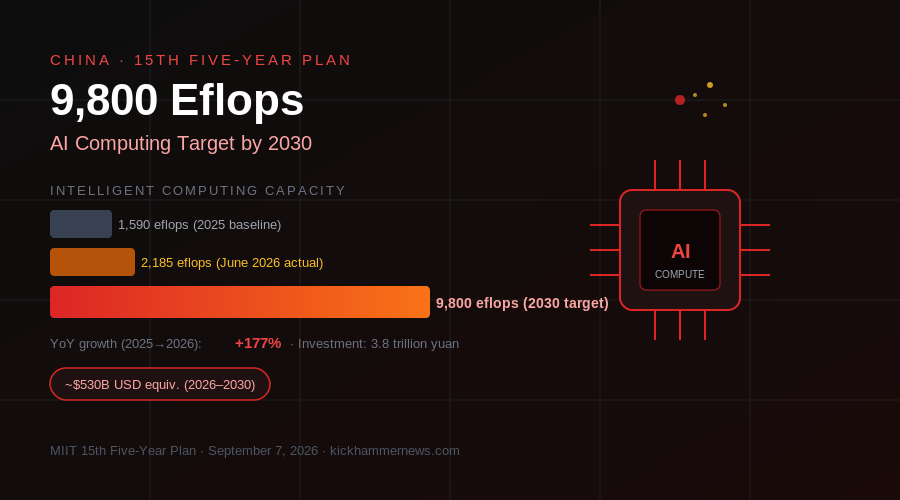
When China’s Ministry of Industry and Information Technology released its 15th Five-Year Plan for the information and communications sector this week, the headline figure was staggering: 9,800 eflops of intelligent computing capacity by 2030. That’s up from a 2025 baseline of just 1,590 eflops — a more than sixfold increase in five years — backed by 3.8 trillion yuan in cumulative information infrastructure investment over the plan period.
To put 9,800 eflops in perspective: one eflop equals one quintillion floating-point operations per second. The US, European Union, and all of their allied nations combined do not currently have AI computing infrastructure anywhere near this scale. If China hits its target, it will have reshaped the global AI power balance more dramatically than any single model release or research breakthrough could.
Whether it will get there is a genuinely open question. But the plan itself — its ambition, its specificity, and the political will behind it — is one of the most consequential AI policy documents of the decade.
Where China Stands Today
The plan’s context matters. China is not starting from zero. By the end of June 2026, China’s intelligent computing capacity had already reached 2,185 eflops at FP16 precision, up 177% from a year earlier. That trajectory is remarkable: China more than doubled its AI computing capacity in a single year, and it did so despite ongoing US export controls on advanced semiconductors.
Those export controls — which have restricted China’s access to NVIDIA’s most advanced chips, including the H100 and its successors — were supposed to slow China’s AI development. And they have, to some degree, in terms of raw hardware quality. But they appear to have had a less decisive effect on raw capacity than their architects hoped. China has responded by building more of what it can access, developing domestic alternatives through companies like Cambricon and Huawei’s Ascend division, and pursuing software-level optimizations that squeeze more performance from available hardware.
The 15th Five-Year Plan is a signal that China intends to keep accelerating regardless of what the US does on export controls.
What 3.8 Trillion Yuan Actually Buys
The plan calls for 3.8 trillion yuan — roughly $530 billion at current exchange rates — in cumulative information infrastructure investment between 2026 and 2030. This is not a budget line item for one project or one agency. It encompasses the full stack of digital infrastructure: data centers, fiber and wireless networks, computing hardware, cloud platforms, and the physical facilities that house them.
The 9,800 eflops target sits at the top of this pyramid. Achieving it will require an enormous buildout of AI data centers — facilities with the power supply, cooling infrastructure, and networking capacity to run hundreds of thousands of AI accelerators simultaneously. China has already been building these at a pace that has alarmed Western analysts. The new plan formalizes and accelerates that buildout.
It will also require a significant expansion of domestic AI chip manufacturing. SMIC, Cambricon, and Huawei are all being pushed to increase production of AI-capable silicon. The quality of these chips remains below what TSMC produces for NVIDIA, but the gap has been closing, and at sufficient scale, quantity has a quality of its own.
The Geopolitical Stakes
The 9,800 eflops target is not just an economic or industrial plan — it is a geopolitical signal. China is telling the world, and telling the US in particular, that it intends to compete at the frontier of AI regardless of what restrictions are placed on its access to Western technology.
This creates a genuine strategic dilemma for Washington. The export control regime was premised on the idea that choking off China’s access to advanced chips would meaningfully slow its AI development. The evidence increasingly suggests that while controls have imposed costs, they have not imposed the kind of decisive disadvantage that would allow the US to maintain overwhelming superiority.
At the same time, China’s plan raises the stakes for everyone else. If China reaches 9,800 eflops by 2030 — even 60% or 70% of that target — it will have AI training and inference capacity that dwarfs what is currently available in any other single country. That capacity is not just relevant to commercial AI applications. It is relevant to AI-enabled military systems, autonomous vehicles, surveillance infrastructure, and the kinds of large-scale scientific simulations that could accelerate progress in fields from materials science to drug discovery.
The Efficiency Question
One of the most important things to understand about the eflops race is what it does and doesn’t measure. Eflops counts raw floating-point operations — it does not account for the quality of the hardware, the efficiency of the software stack, or the talent available to use the capacity productively.
US and European AI labs have generally focused on doing more with less: techniques like mixture-of-experts architectures, quantization, and distillation have allowed frontier models to run on smaller, cheaper hardware without sacrificing much capability. If that trend continues, raw compute capacity becomes less determinative of AI outcomes than it once appeared.
China’s approach is more consistent with throwing compute at problems — building as much capacity as possible and using it to train ever-larger models. That strategy worked well for the first decade of deep learning. Whether it is the right strategy for the current moment, when algorithmic efficiency gains are moving faster, is debated among researchers.
But this is partly a false dichotomy. China’s AI labs — Baidu, Alibaba DAMO Academy, Zhipu AI, DeepSeek, and others — are not unsophisticated about efficiency. DeepSeek’s models in particular have attracted widespread attention for achieving frontier-level performance at unusually low training costs. China is pursuing both scale and efficiency, and a country with 9,800 eflops of capacity that is also good at efficiency is a formidable competitor.
What This Means for the Rest of the World
The 15th Five-Year Plan should be read as a forcing function. When a major state commits this clearly to a technology buildout, it changes the calculus for everyone else.
For the US, it strengthens the argument for the CHIPS Act and related efforts to rebuild domestic semiconductor manufacturing capacity. For Europe, it reinforces the case for sovereign AI investment — the idea that no region should depend entirely on foreign infrastructure for capabilities that are becoming central to economic and national security. For cloud providers everywhere, it is a reminder that the AI infrastructure race is as much about physical capacity as it is about model quality.
For smaller countries, it raises a harder question: if AI infrastructure becomes as concentrated as this plan implies — in the US, China, and to a lesser degree Europe — what does that mean for everyone else’s ability to shape how AI develops and is governed?
The 9,800 eflops target may or may not be achieved by 2030. Five-year plans are aspirational documents, and China’s track record of hitting ambitious infrastructure targets is mixed. But the direction of travel is clear. The world’s two largest economies are in an AI infrastructure race with no obvious finish line, and the plan released this week suggests that China is running it in earnest.
The rest of the world is watching — and increasingly, is going to have to decide what side of that race it wants to be on, and how.


