Europe has a new symbol of AI independence — and it just got €3 billion more powerful.
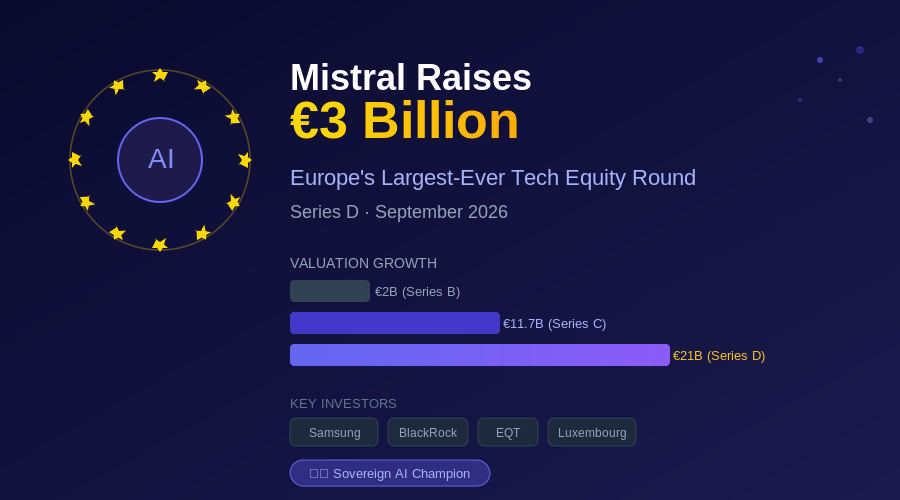
On September 8, 2026, Mistral AI announced the closing of a €3 billion Series D funding round, setting a new record as the largest equity fundraising round ever completed by a European technology company. Led by Samsung Electronics, with co-leads Scaleup Europe Fund (managed by EQT) and existing investor PSG Equity, the round also brought in Advent International, funds and accounts managed by BlackRock, and the Grand Duchy of Luxembourg as new investors. In just three years since its founding, Mistral has gone from a scrappy French startup to the undisputed flagship of European sovereign AI.
The raise values Mistral at more than €21 billion — nearly double the €11.7 billion valuation set during its September 2025 Series C, which was itself led by chip giant ASML. That kind of valuation acceleration would be notable in any tech sector. In the brutally competitive, capital-intensive world of frontier AI, it’s extraordinary.
What “Sovereign AI” Actually Means — and Why It Matters
“Sovereign AI” is a phrase that gets thrown around a lot, but Mistral’s approach gives it specific meaning. The concept refers to AI infrastructure that is controlled, governed, and hosted within a nation or region’s own legal and technical boundaries — rather than depending on hyperscalers headquartered in the United States or China.
For European governments, healthcare systems, financial institutions, and defense agencies, the appeal is obvious. They need AI they can actually trust: systems that won’t exfiltrate data to foreign servers, that comply with GDPR and other local regulations, and that can operate in sensitive contexts where cross-border data transfers are either legally prohibited or politically untenable.
Mistral has positioned itself as the answer to that need. Its flagship models — including the Mixtral MoE series and its enterprise-grade Le Chat platform — are built with deployment flexibility in mind. Customers can run them on-premises, in private clouds, or through Mistral’s own infrastructure. That’s a different value proposition than OpenAI, Google, or Anthropic, all of which are US companies subject to US law and the shifting priorities of US foreign policy.
The irony that critics have noted — and that Mistral itself acknowledges — is that sovereign AI built by a private company is still, in some meaningful sense, not sovereign. Mistral’s investors now include Samsung (South Korean), BlackRock (American), and EQT (Swedish). The company’s long-term independence is not guaranteed by its European origins. But for now, at least, it is headquartered in Paris, governed by French and EU law, and led by a team that has made European AI autonomy the explicit center of its mission.
The Funding Will Go Into Frontier Research and Compute
Mistral was unusually specific about how it plans to deploy the capital. The company said the round will “significantly expand its frontier research,” which it described as the foundation underpinning its infrastructure, products, and sovereignty positioning. It also plans to scale compute capacity for training powerful models, expand its infrastructure footprint, and accelerate commercial growth internationally.
That last point is significant. While Mistral’s brand is built on European sovereignty, its commercial ambitions extend well beyond the EU. The company already has customers across the Middle East, Asia-Pacific, and Latin America — regions where the desire for AI infrastructure that isn’t American-controlled is just as strong as it is in Europe, if not stronger.
The infusion of capital will also allow Mistral to compete more directly with the frontier model labs. Until now, Mistral has been competitive on efficiency — its Mixtral models have consistently punched above their weight class in benchmarks, often matching models several times their parameter count. But compute scale eventually matters, and €3 billion gives Mistral the runway to take on more ambitious training runs.
Samsung’s Strategic Bet
The choice of Samsung Electronics as lead investor is worth examining closely. Samsung is not a passive financial backer — it is one of the world’s largest semiconductor manufacturers, and it has a strategic interest in where the AI ecosystem develops.
By leading Mistral’s Series D, Samsung gains a significant stake in the most prominent non-US, non-Chinese AI model lab in the world. If sovereign AI becomes a durable trend — and there are strong reasons to believe it will — Samsung’s early bet on Mistral looks prescient. It also deepens Samsung’s relationships with European governments and enterprises at a time when the company is investing heavily in expanding its semiconductor fabrication capacity in Europe.
For Mistral, Samsung brings more than money. It brings manufacturing relationships, hardware access, and distribution channels that could accelerate the company’s ability to deploy AI at scale across enterprise and government customers in ways that fully integrated, cloud-agnostic solutions would require.
Europe’s Moment — and Its Test
Mistral’s Series D arrives at an inflection point for European tech policy. The EU AI Act is now in force, with major provisions having taken effect earlier this year. European governments are under pressure to develop domestic AI capabilities rather than depending entirely on American platforms. And the geopolitical turbulence of the past several years — from trade tensions to sanctions regimes to concerns about data sovereignty — has made the case for European AI independence more concrete than ever.
Mistral is the clearest beneficiary of that political environment. But it is also, in a sense, a test of whether Europe can actually build and sustain a competitive frontier AI company — not just regulate the ones built elsewhere.
The stakes are high. Frontier AI is not a slow-moving industry. The gap between the leading labs and their nearest competitors can widen dramatically in the span of a single training run. Mistral has shown it can be nimble and technically excellent. The €3 billion bet is that nimble and excellent, with enough capital behind it, can become dominant.
That outcome is far from guaranteed. OpenAI, Google DeepMind, Anthropic, and xAI are not standing still. Chinese labs like DeepSeek and Kimi continue to push the efficiency frontier in ways that complicate the value proposition of any single model provider. But Mistral’s position — as the sovereign AI option for governments and enterprises that want frontier capability without dependence on US or Chinese platforms — is genuinely differentiated.
The Bigger Picture
Mistral’s funding round is a data point in a larger trend: the global fragmentation of the AI stack. The era in which a handful of American companies controlled the full spectrum of AI development — foundation models, cloud infrastructure, deployment platforms, fine-tuning tools — is ending. It is being replaced by a more complex, multipolar landscape in which sovereign considerations shape which models get deployed where.
That’s good news for Mistral, and probably good news for AI users in Europe and beyond. Competition at the frontier, from multiple directions, tends to accelerate capability and lower costs. A world in which Mistral is a serious player is a world in which no single company can dictate the terms of AI deployment to every government and enterprise on the planet.
Whether €3 billion is enough to keep Mistral in that race for the long term remains to be seen. But it’s a serious answer to a serious challenge — and for European AI, that is something genuinely new.


