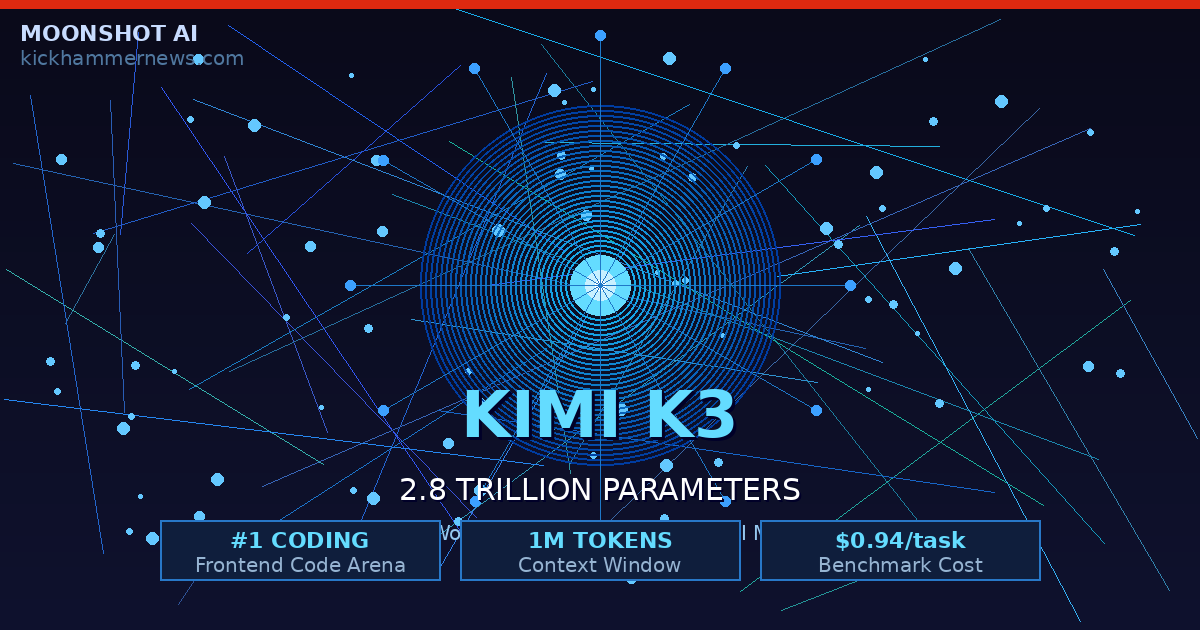
Just a few months ago, the AI community was debating whether China could close the gap with American frontier labs. That debate might be over. On July 16, 2026, Chinese AI startup Moonshot AI released Kimi K3, a 2.8-trillion-parameter model that it describes as its “most capable to date” — and the benchmarks are backing up the claim.
Kimi K3 is now the largest open-weight AI model ever released to the public, surpassing DeepSeek’s 1.6-trillion-parameter V4 Pro and dwarfing most of what Western labs have put out in open form. It’s available now through Moonshot’s website and API, with full open-weight release promised by July 27. For developers, researchers, and anyone paying attention to the shifting geography of AI power, this is a watershed moment.
What Makes Kimi K3 Different
At 2.8 trillion parameters, the sheer scale is the headline. But what separates Kimi K3 from a raw parameter count exercise is its architecture. Moonshot built K3 on two novel innovations: Kimi Delta Attention, a hybrid linear attention scheme that dramatically improves efficiency at long context lengths, and Attention Residuals, which change how information propagates between transformer layers. Together, Moonshot says these two changes deliver roughly a 2.5x improvement in scaling efficiency over its predecessor, Kimi K2.6.
The practical result is a model that supports a one-million-token context window natively — on par with the best in class — and performs “always-on” reasoning without requiring users to toggle a separate thinking mode. Unlike some reasoning models that rack up enormous token bills even for simple tasks, K3’s efficiency gains mean it can deliver deep analysis without burning through your compute budget unnecessarily.
The Benchmark Numbers
Moonshot is not being shy about the results. On the Artificial Analysis Intelligence Index, which evaluates real-world long-horizon knowledge work across dozens of domains and occupations, Kimi K3 scored 1,547 Elo — placing it behind only Claude Fable 5 and GPT-5.6 Sol, the two current frontier leaders, and significantly ahead of Claude Opus 4.8 and GPT-5.5.
On GDPval-AA v2, a benchmark that simulates tasks spanning 44 occupations across nine major industries, K3 scored 1,687 — again third overall, trailing Fable 5 Max at 1,815 and GPT-5.6 Sol Max at 1,747.8, but ahead of Claude Opus 4.8’s 1,600.
Where K3 truly surprised even skeptics was in coding. On the Arena.ai Frontend Code Arena, Kimi K3 ranked first overall with 1,679 points, besting Claude Fable 5 (1,631), GPT-5.6 Sol (1,618), and GLM-5.2 (1,587). It led six of seven frontend coding categories — only losing out to Fable 5 in gaming scenarios. For developers in particular, this is the benchmark that matters most day-to-day, and China just took the top spot.
Performance on structured coding benchmarks is similarly strong: 67.5 on DeepSWE, 81.2 on FrontierSWE, and 77.8 on Program Bench. These are not paper numbers; they reflect the kind of agentic, multi-step coding tasks that enterprises actually rely on.
Pricing and the Cost Equation
Kimi K3 is priced at $3 per million input tokens and $15 per million output tokens. In an era when frontier model pricing has become as strategically important as the models themselves, this deserves close examination.
Those numbers put K3 at roughly the same price point as Anthropic’s Claude Sonnet series — meaning Moonshot is positioning this as a premium product, not a loss-leader discount play. Compared to Kimi K2.6’s pricing of $0.95 input / $4 output, this is a dramatic increase. But compared to Anthropic’s Opus 4.8 at roughly $1.80 per task on Artificial Analysis’s benchmark suite, K3 comes in at $0.94 — essentially matching GPT-5.6 Sol’s $1.04 and undercutting Opus 4.8 by nearly half.
Put differently: Moonshot is pricing K3 like a frontier model and delivering frontier results at sub-Opus cost per completed task.
The Compute Question
There’s an obvious question hanging over any Chinese AI release right now: how did they train it? Moonshot AI’s own disclosures point to export-grade Nvidia silicon — the H20 chips made available to Chinese buyers before export restrictions tightened — as well as what the company describes as an unnamed “alternative GPU vendor.” The fact that K3 achieves its scale and efficiency on hardware that is, by definition, below the frontier of what Nvidia sells in the U.S., makes the architectural innovations even more impressive in hindsight.
It also underscores a broader point that has been building for the better part of a year: export controls can constrain Chinese AI labs at the hardware layer, but they cannot constrain algorithmic ingenuity. Moonshot has evidently found efficiency gains that make up for raw compute deficits — a pattern that echoes what DeepSeek demonstrated with its V3 and R2 models earlier this year.
What This Means for the Industry
Kimi K3 arrives just ahead of the 2026 World Artificial Intelligence Conference in Shanghai, where President Xi Jinping called for global AI cooperation — adding geopolitical weight to an already charged technical release. The timing is unlikely to be coincidental.
For Western AI labs, the message is clear: the lead that OpenAI and Anthropic have worked to maintain is measured in smaller and smaller increments. K3 is not the equal of Claude Fable 5 or GPT-5.6 Sol on most benchmarks — but it is competitive, it is cheaper per task, and it is open-weight. That last point may prove most consequential.
Open-weight models can be deployed on private infrastructure, fine-tuned by any organization with sufficient compute, and integrated without API fees. For enterprises, governments, and researchers in markets where data sovereignty is a priority, K3’s open-weight release on July 27 could trigger adoption curves that API-only models simply cannot match.
Looking Ahead
Moonshot has committed to releasing the full open weights of Kimi K3 by July 27 — less than two weeks away. That’s when the real-world testing begins in earnest. Self-hosted deployments, community fine-tunes, red-team evaluations: the AI ecosystem will have something substantial to probe.
Whether K3’s benchmark performance holds up under adversarial conditions, and whether the open weights unlock the kind of community innovation that made models like Llama transformative — those are questions July will answer.
What’s already clear is that Moonshot AI has announced itself as a genuine frontier lab. With Kimi K3, China doesn’t just have an AI race participant. It may have the lead in at least one category that matters a great deal to developers: the ability to write code.
Sources: Moonshot AI, Simon Willison’s Weblog, VentureBeat, CNBC, Tom’s Hardware, Fortune, Artificial Analysis


