Oracle made a move this week that quietly reshapes how enterprise software gets built. On July 14, the company announced a new AI-native builder experience for Oracle AI Agent Studio for Fusion Applications — one that opens the company’s agentic ERP platform to professional developers and, more significantly, to the AI coding agents those developers already rely on daily.
This isn’t an incremental patch. It’s Oracle pulling back the curtain on what it means to treat an ERP system not just as a system of record, but as a full development platform for autonomous enterprise software.
What Oracle Built
The announcement centers on an expansion of Oracle’s AI Agent Studio, which originally launched to let business users assemble AI agents using natural language and low-code tools. A March 2026 update introduced the concept of “Fusion Agentic Applications” — outcome-driven systems backed by coordinated teams of AI agents that reason, decide, and take action against live Fusion business data.
The July 14 update extends that same capability to professional developers and the coding tools they already use.
“We started with people who can use natural language or a little bit of coding,” said Natalia Rachelson, Oracle’s Senior Vice President of Applications Development, in an interview with SiliconANGLE. “These are no-code to low-code people, but we’re now going to go after what’s called pro-code people.”
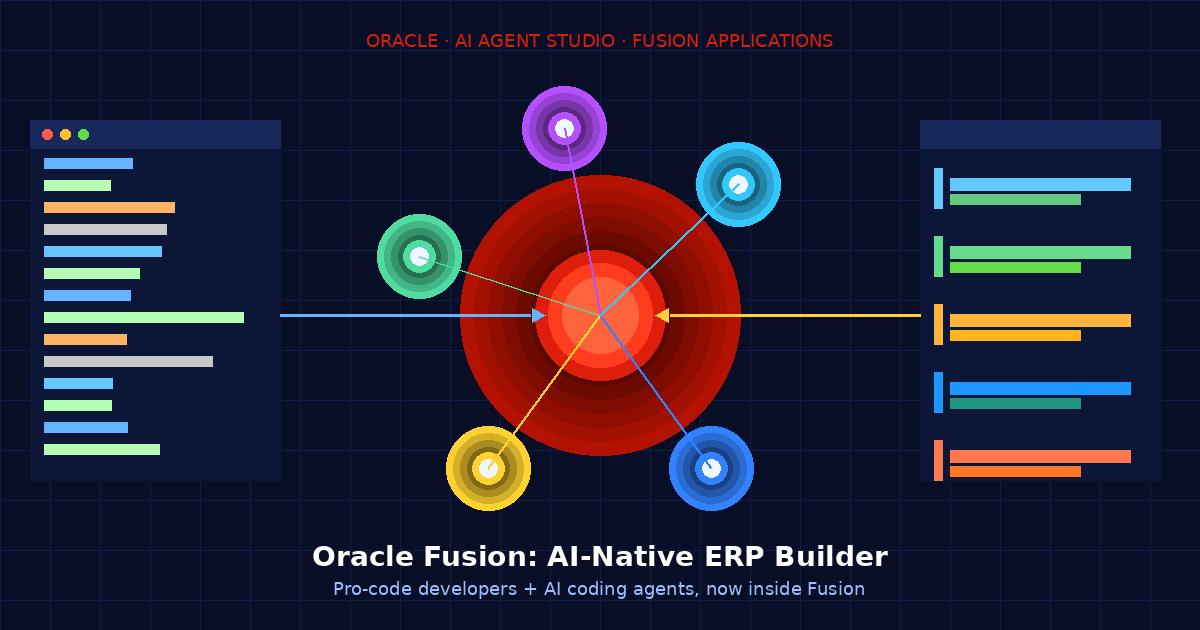
The result is a unified development framework that spans three tiers: no-code business users who describe an outcome and let the Agentic Applications Builder assemble the agents; low-code developers who configure agent behavior through visual tools and structured workflows; and pro-code professional developers using Visual Studio Code, Git-based workflows, and command-line interfaces — who can now bring AI coding agents like Claude Code, OpenAI Codex, and Google Gemini into the process.
What makes this architecturally interesting is the “builder-agnostic” design. Oracle publishes a Fusion AI Studio skill — essentially a structured context package — that any compatible coding agent can load. The developer describes the intended business outcome, loads the skill, and the coding agent generates, validates, and tests the required Fusion artifacts before the developer deploys the resulting application.
Why This Matters for Enterprise Development
For years, building applications on top of ERP systems meant dealing with proprietary tooling, arcane configuration layers, and brittle integrations. Oracle is proposing something different: a model where standard developer tooling connects directly to the ERP’s agentic runtime, where agents operate on transactional data that lives inside Fusion — not against a detached, potentially stale copy.
Rachelson framed it this way: “They’re not really a bolt-on, like an extra layer. They operate inside Fusion.”
That distinction carries significant implications for enterprise teams. Traditional agentic automation tools frequently create synchronization problems — agents reading from one dataset while humans work in another, leading to conflicts, audit gaps, and stale decisions. By anchoring Fusion Agentic Applications to Fusion’s own business objects, workflows, roles, and approvals, Oracle’s model gives agents real-time access to operational ground truth.
The company used renewal management as a concrete example. An organization could instruct an agentic application to increase its contract renewal rate by a specified margin. The application would examine historical and current records inside Fusion, identify at-risk accounts, draft renewal contracts, and potentially send them to customers — all while reasoning against live transactional data and maintaining a full audit trail. Every decision, tool invocation, and execution step is logged and traceable.
The Governance Layer
Audit and governance have been chronic weaknesses of enterprise AI deployments. Agents that act autonomously create accountability gaps that compliance teams and regulators alike find deeply uncomfortable. Oracle has been methodical about building governance into Fusion’s agentic runtime from the start.
The October 2025 update added monitoring, evaluation, telemetry, token tracking, and visibility into agentic state changes. The July 14 announcement maintains that governance architecture as a non-negotiable constraint — Fusion Agentic Applications inherit Fusion’s security controls, identity and role management, business policies, and approval workflows. Every action is auditable.
This is a meaningful competitive differentiator at a time when enterprise buyers are increasingly scrutinizing AI deployments for compliance risk. Oracle is betting that deep integration with the ERP’s native governance layer is more valuable than flexibility or speed-to-market — a defensible position in regulated industries like financial services, healthcare, and public sector.
The Competitive Picture
Oracle’s move comes as the entire ERP market grapples with the same fundamental question: how do you add AI agency to software systems that were designed to be deterministic and controlled?
SAP has pursued a similar path with its Joule copilot and Business AI frameworks, emphasizing integration across its cloud portfolio. Microsoft Dynamics 365, backed by the full weight of Microsoft’s Copilot investments, has pushed agentic automation across CRM and ERP workflows. ServiceNow has staked out a strong position in AI-assisted workflow automation.
Oracle’s differentiation lies in the depth of Fusion integration. Unlike layered AI additions — copilots bolted atop legacy platforms — Fusion Agentic Applications are designed to run where the work already happens, against live operational data, within the same security perimeter that governs the rest of the enterprise.
The pro-code and coding-agent support announced this week broadens the potential builder community considerably. There are far more professional developers familiar with VS Code and Git than there are Oracle Fusion specialists. If Oracle can make it genuinely productive for those developers — and their AI coding assistants — to build on Fusion, it significantly expands the surface area of enterprise software that Oracle’s platform can touch.
What Enterprise Buyers Should Watch
A few questions remain unanswered for organizations evaluating this capability. On cost, Oracle has stated that Oracle AI Agent Studio for Fusion Applications is available at no additional charge and includes orchestration, testing, validation, and built-in security tooling. But the compute costs of running agentic workflows at scale — particularly multi-agent orchestration over large Fusion datasets — are not yet well-characterized.
On complexity, the no-code-to-pro-code continuum is appealing in principle. The harder question is how much of that complexity Oracle’s tooling actually absorbs versus surfaces. Agentic applications that coordinate multiple specialized agents against real-time ERP data are not simple systems.
On ecosystem maturity, Oracle’s decision to support Claude Code, Codex, and Gemini as first-class development partners signals an intent to build a broad ecosystem. But the quality and depth of those integrations — particularly how well the Fusion AI Studio skill packages Fusion’s data model and constraints for an AI coding agent — will determine whether this is genuinely productive or another integration that requires expert hand-holding.
The Bigger Picture
Oracle’s announcement is part of a broader industry shift in which enterprise software vendors are racing to make their platforms programmable by AI agents — not just usable by AI-assisted humans. The companies that succeed will be those that can make their platforms legible to AI coding tools while maintaining the governance, security, and auditability that enterprise deployments require.
By extending Fusion’s agentic runtime to pro-code developers and their coding agents, Oracle is placing a significant bet that depth-of-integration beats breadth-of-feature. For Fusion customers already running finance, HR, supply chain, and CX operations on Oracle’s stack, the calculus is compelling. For the rest of the market, it’s a sign of where the competition is heading.
Enterprise software is no longer just a system of record. It’s becoming a development platform — and the ERP vendors are building for an era where AI agents do the building.