July 11, 2026 | KickhammerNews
Eighteen months ago, Chinese AI models were a footnote in enterprise AI spending — capturing roughly 2 percent of the token volume on OpenRouter, the popular AI API routing platform used by thousands of developers and companies. Today, they command nearly half of it. That shift is forcing a reckoning in boardrooms, federal agencies, and the halls of Congress.
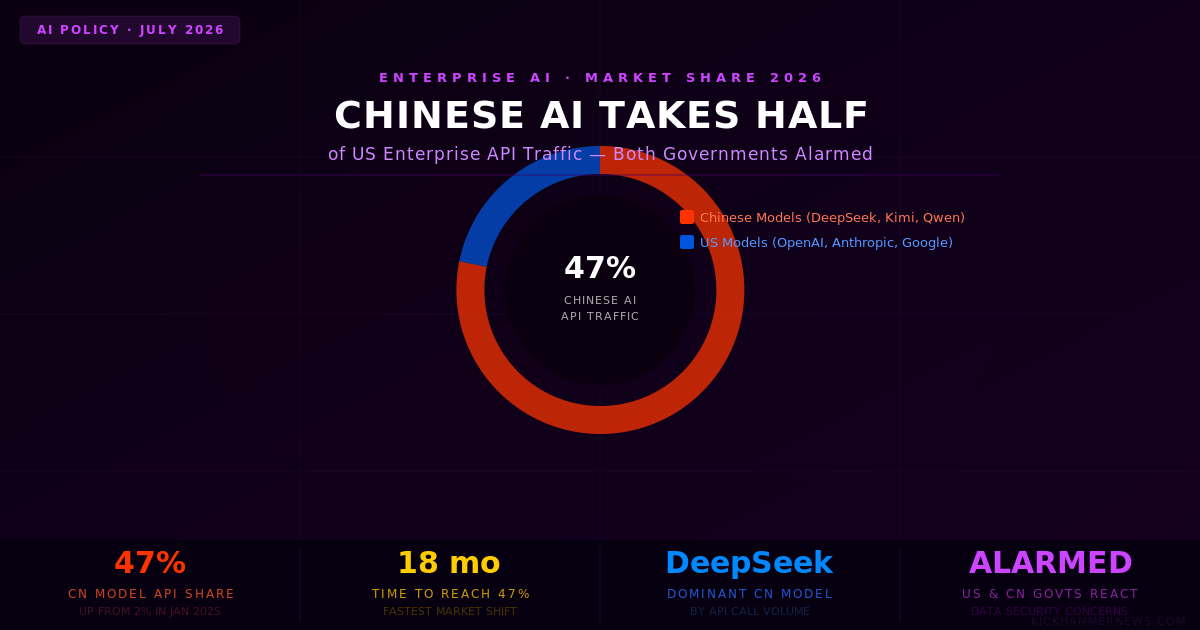
According to a CNBC investigation published July 7, Chinese-origin AI models now account for between 30 and 46 percent of enterprise API token usage flowing through US developer platforms, with the peak hitting 46.4 percent in mid-2026. The same share stood at 11 percent averaged over the prior twelve months — and just 4.5 percent in the first half of 2025. By almost any measure, this is one of the fastest platform shifts in enterprise software history.
The Numbers Behind the Seismic Shift
The tipping point arrived the week of February 9, 2026, when Chinese AI models processed 4.12 trillion tokens on OpenRouter versus 2.94 trillion for US models — the first week any Chinese system outpaced American ones on the platform. That was not a blip. For every week since February 8, Chinese-origin models have held at least 30 percent of OpenRouter’s enterprise token volume, an unbroken streak now spanning five months.
The provider breakdown is striking. DeepSeek now holds 17.6 percent of all OpenRouter routed tokens, amounting to 5.13 trillion weekly — making it the single largest vendor on the platform, ahead of every US-based provider. Alibaba’s Qwen follows at 13.9 percent, with 2.77 trillion tokens weekly. Together, Chinese-origin models hold 46.4 percent, compared to 35.7 percent for all US-origin models combined. Anthropic, the largest US provider by token share on OpenRouter, captures just 14.8 percent.
OpenRouter itself has grown dramatically over this period — from roughly 5 trillion tokens per week in April 2025 to over 20 trillion by April 2026 — so the absolute volume flowing to Chinese models is even more staggering than percentages alone suggest.
It Is Mostly a Cost Story
The primary driver behind this tectonic shift is not some sudden revelation that Chinese models are dramatically superior. It is price. And the price gap is not modest — it is extraordinary.
As of June 2026, DeepSeek V4 Flash is priced at $0.14 per million input tokens and $0.28 per million output tokens. OpenAI’s GPT-5.5 costs $5.00 per million input tokens and $30.00 per million output tokens — a roughly 100x gap on output. Alibaba’s Qwen 3.6 Max comes in at $1.20 per million output tokens. Even Z.ai’s GLM-5.2, which scores 62.1 percent on SWE-bench Pro (versus GPT-5.5’s 58.6 percent), costs $4.40 per million output tokens — less than one-sixth the cost of GPT-5.5 while outperforming it on a key coding benchmark.
For agentic workloads — where a single task might call an AI model 50 to 200 times in a loop — these differentials compound with every iteration. A workflow that costs $30 per thousand runs on GPT-5.5 costs under $0.30 on DeepSeek V4 Flash. At enterprise scale, that gap quickly becomes hundreds of thousands or millions of dollars per month. According to OpenRouter’s Justin Summerville, open-source Chinese models are consistently 60 to 90 percent cheaper than the leading offerings from Anthropic and OpenAI.
DeepSeek’s momentum has extended beyond API platforms into corporate procurement. The company recently became the number one trending software vendor on the Ramp index — a measure of corporate card spending — signaling that these models have moved from experimental sandbox use into formal enterprise expense reports.
The Regulatory Squeeze From Both Sides
What makes this moment particularly fraught is that both the US and Chinese governments are now moving to control which AI models flow across national boundaries — and the directions are not obviously compatible with the market’s trajectory.
On the American side, the House Select Committee on China and the House Committee on Homeland Security launched a joint investigation this spring into US companies using Chinese-developed AI. Airbnb, which uses Alibaba’s Qwen for certain internal workloads, and Cursor’s parent company Anysphere, which integrates Moonshot AI’s Kimi model, are both under scrutiny. The stated concerns center on data security and the risk that AI models trained under China’s regulatory regime may embed ideological biases or create data exfiltration pathways. The practical problem: banning model weights that are already freely distributed on the internet is legally and technically difficult.
The US government has already demonstrated willingness to use model access as a policy lever. On June 12, the Department of Commerce required Anthropic to suspend access to Fable 5 and Mythos 5 under export-control directives — the first known case of a government mandating a global model takedown. Those models were restored on July 1 after the restrictions were lifted, but the incident established a precedent: AI model access can be severed by regulatory action, and enterprises that have built dependencies on any single provider — domestic or foreign — are exposed.
On the Chinese side, Reuters reported July 7 that Beijing is considering restricting overseas access to its most advanced AI models, including some not yet released. The proposed framework is tiered: basic open-source models would require a regulatory filing, advanced models would go through security review, and frontier models could be restricted to domestic use only. No decision has been finalized, but the policy direction is clear. The same models that US enterprises are increasingly depending on could become inaccessible — or at minimum, more complicated to use legally — under future Chinese export controls.
What Enterprises Are Actually Doing
The most sophisticated enterprise buyers are not treating this as an all-or-nothing choice. They are routing by workload.
Airbnb’s stated position — using Chinese models “only through approved US-based service providers” for non-sensitive workloads — represents the emerging consensus. Concretely, this means deploying Chinese models for high-volume, low-stakes agentic loops (internal tooling, data processing, classification tasks) while routing customer-facing outputs and anything touching regulated data to US providers.
The risk calculus differs by deployment method. Enterprises using hosted Chinese API endpoints directly — deepseek.com, Qwen’s direct API — face real data sovereignty exposure. Prompts containing proprietary code or customer data processed through those endpoints fall under China’s National Intelligence Law. For EU operations, routing through non-EU infrastructure may also violate GDPR Article 46. These are not hypothetical compliance risks.
Companies routing through US or EU cloud providers that serve Chinese model weights face lower direct data exposure, but still carry model behavior risk — decisions made in training by Beijing-based researchers can surface in subtle ways in production. Self-hosting open model weights on US infrastructure largely eliminates the data sovereignty problem, but breaks even economically only at around 2 million tokens per day versus API pricing.
The Structural Contradiction No One Has Solved
The deeper problem this episode reveals is a structural contradiction in US AI policy. The government has created a tiered access system for frontier domestic models — GPT-5.6 Sol’s most sensitive capabilities are permanently gated behind federal clearance for approximately 20 vetted organizations. By making the most capable American models effectively inaccessible to commercial buyers, regulators have inadvertently accelerated the shift toward cheaper, widely available Chinese alternatives.
The market responded exactly as markets do: it found the path of least resistance. When the most advanced domestic option requires a federal security clearance and the foreign alternative costs a hundred times less with comparable performance on most commercial benchmarks, the outcome is predictable.
The question now being asked in Washington and in enterprise procurement departments is the same question: how do you resolve a market structure where the incentives for cost efficiency and the incentives for strategic autonomy point in exactly opposite directions? The week of February 9, 2026 may be remembered as the moment the answer became unavoidable.


