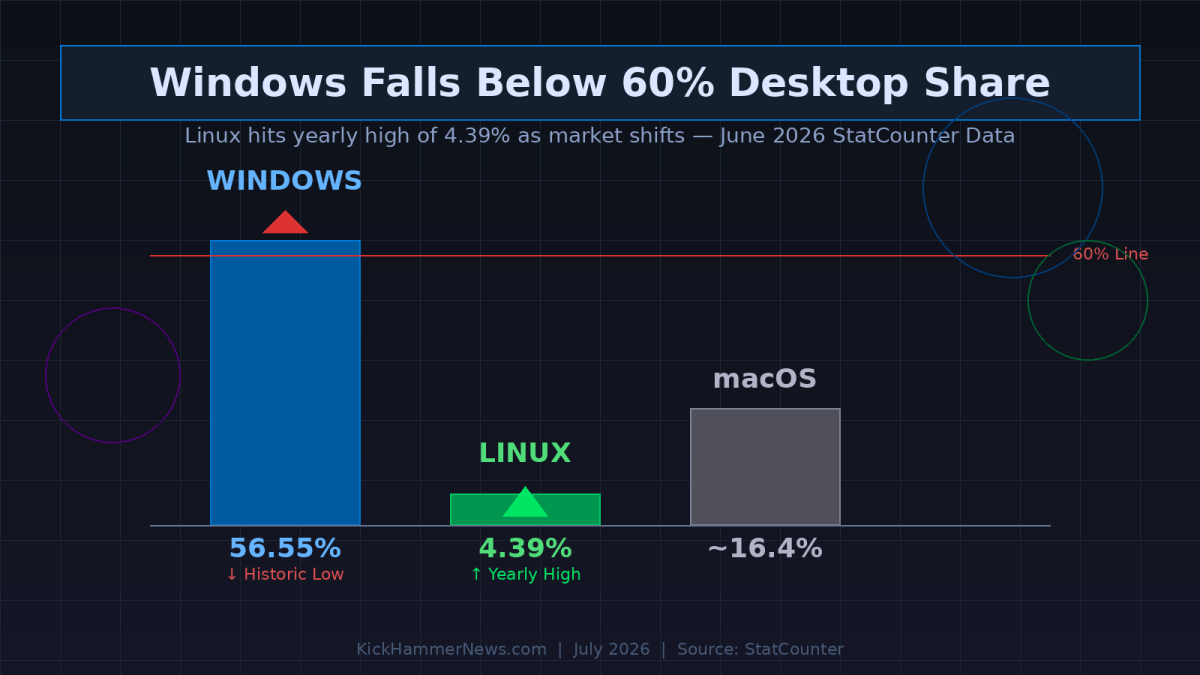
July 11, 2026 — It finally happened. For the first time in the recorded history of StatCounter’s desktop operating system data, Windows has dropped below the 60% threshold for global desktop usage share. According to StatCounter’s June 2026 report, Windows registered just 56.55% of worldwide desktop OS activity — a remarkable departure for a platform that once seemed unassailable, and a signal that the computing landscape is shifting beneath our feet.
At the same moment Windows hit its new low, Linux closed June 2026 at 4.39% globally — one of its strongest showings ever in StatCounter’s dataset, and its highest figure in more than a year. Those two numbers, taken together, tell a story that the open-source community has been telling itself for years and that the broader technology industry is finally being forced to acknowledge.
The Numbers That Shook the Internet
StatCounter’s Global Stats are compiled from billions of page views across over a million websites, using signals like browser user-agent strings to identify what OS each visitor is running. The June 2026 desktop breakdown looked like this:
The reaction online was immediate. On Reddit’s r/linux, the thread hit the front page within hours, and the comment section was equal parts celebration and skepticism — a dynamic that, if anything, speaks to how mature the Linux community has become.
A 60% Floor, Gone
To understand why the 60% mark matters, you have to appreciate how stable Windows dominance has been. Through the 2010s and into the early 2020s, Windows sat so consistently above 70% — and often above 75% — that analysts barely bothered to frame it as something that could change. Then came the end of Windows 7 support, the messy rollout of Windows 10, and eventually the controversial requirements of Windows 11.
The pace of change accelerated in the past year. Microsoft’s decision to end support for Windows 10 on October 14, 2025, left hundreds of millions of PCs stranded. Those devices — many of which lack the TPM 2.0 chip required for Windows 11 — didn’t evaporate. Their owners faced a stark choice: buy new hardware, continue running unsupported software, or migrate to something else. More users than anyone anticipated chose door number three.
The “Unknown” Problem — and Why It Actually Helps Linux
Skeptics were quick to point to that 21.45% “Unknown” bucket — a number nearly five times the size of Linux’s entire share. And they have a point worth examining.
StatCounter’s “Unknown” category swells whenever traffic cannot be reliably attributed to a known operating system. Privacy-focused browsers that suppress user-agent strings, bots and AI scrapers that don’t identify themselves as desktop browsers, corporate or government machines with identifying headers stripped — all of these land in “Unknown.” Several astute commenters noticed that Windows and Unknown have been moving in nearly perfect inverse correlation for the past several months, which strongly implies that a significant portion of that “Unknown” traffic was previously being counted as Windows.
But here’s the nuance: some of that reclassified traffic may well be Linux. Privacy-conscious users running hardened Firefox or Mullvad Browser on Arch Linux are exactly the kind of people who disable user-agent reporting. If anything, the “Unknown” bucket may be understating Linux’s real-world footprint, not overstating Windows’ decline.
Cloudflare’s own traffic data, independently measured, currently places Linux closer to 7% of worldwide desktop traffic. A U.S. government analytics dashboard puts desktop Linux above 10% of American desktop sessions once mobile is excluded. The direction of travel is consistent across every methodology — only the exact figures vary.
Gaming Finally Stopped Being Windows’ Ace Card
For years, the standard rebuttal to any “year of the Linux desktop” claim was simple: but what about gaming? That argument grew dramatically weaker over the past two years, and in 2026 it has largely collapsed.
Valve’s Steam Hardware Survey for March 2026 put Linux at an all-time high of 5.33% of the Steam player base — a figure that would have seemed laughable in 2020. Proton, Valve’s compatibility layer, now runs the overwhelming majority of Steam’s catalog without any native Linux port required. The Steam Deck, which ships with a custom Arch-based Linux OS, has placed Linux gaming hardware in the hands of millions of players who had never considered Linux before.
The ripple effects on mainstream desktop adoption are real. People who spend hundreds of hours gaming on Linux via their Steam Deck begin to wonder why their desktop needs to be different. Distros like Bazzite, built specifically to replicate the Steam Deck desktop experience on general hardware, have seen explosive install growth through 2026.
Hardware Makers Are Finally Listening
A shift this large doesn’t happen without hardware support, and hardware makers have been paying attention. Framework laptops now default to offering Ubuntu and Fedora alongside Windows. Dell’s XPS and Precision lines carry Canonical certification for Ubuntu. Lenovo ThinkPads ship with Red Hat Enterprise Linux as a first-class option for enterprise buyers.
For ordinary consumers, the calculus is changing. Distributions like Ubuntu 26.04 LTS, Linux Mint 22.1, and Fedora 42 offer polished, modern desktop experiences that require less technical overhead than ever before. Installation is often a matter of 20 minutes and a USB drive. For someone who primarily uses a browser, email, and a video conferencing app, the transition is nearly invisible.
Even enterprise is moving. France’s Direction Interministérielle du Numérique and several German federal agencies have announced multi-year migrations away from Windows toward Linux desktops. Every high-profile government migration lowers the political and logistical barrier for the next one.
What Microsoft Needs to Do — and What It Has Done Wrong
It would be unfair to pin all of Windows’ troubles on Linux’s quality. Microsoft has handed the opposition a remarkable amount of ammunition over the past few years.
Windows 11’s hardware requirements remain a source of genuine friction. The forced account requirements for consumer editions, the increasingly aggressive advertising of Microsoft 365 and Copilot inside the OS, and a string of high-profile bugs — including one confirmed this week in which a Windows 11 system file called CapabilityAccessManager.db-wal silently consumed up to 500GB of user storage — have eroded goodwill at exactly the wrong time.
The company’s response to privacy concerns has been seen by many users as too little, too late. And its AI push, while ambitious, has introduced complexity and performance overhead onto machines that users simply wanted to use for work.
The Realistic Take
Let’s be clear about what June 2026’s data does and does not mean. Windows is not dying. It still accounts for more than half of all measurable desktop web activity, a dominant share by any reasonable standard. Enterprise Windows lock-in — through Active Directory, Group Policy, Microsoft 365, and thousands of line-of-business applications with no Linux equivalent — is not dissolving this year.
What the data does mean is that Windows’ cultural and psychological stranglehold on the desktop has broken. The idea that desktop computing equals Windows is no longer a given. A measurable, growing minority of users has decided that the equation doesn’t work for them anymore, and the platforms waiting on the other side — Linux in particular — are better prepared to receive them than at any point in history.
For Linux advocates, this month’s StatCounter report isn’t a victory declaration. It’s a signpost. The road got longer; the destination got more plausible.
Sources: StatCounter Global Stats, Linuxiac, Linux Stans, PCWorld on 500GB Windows bug