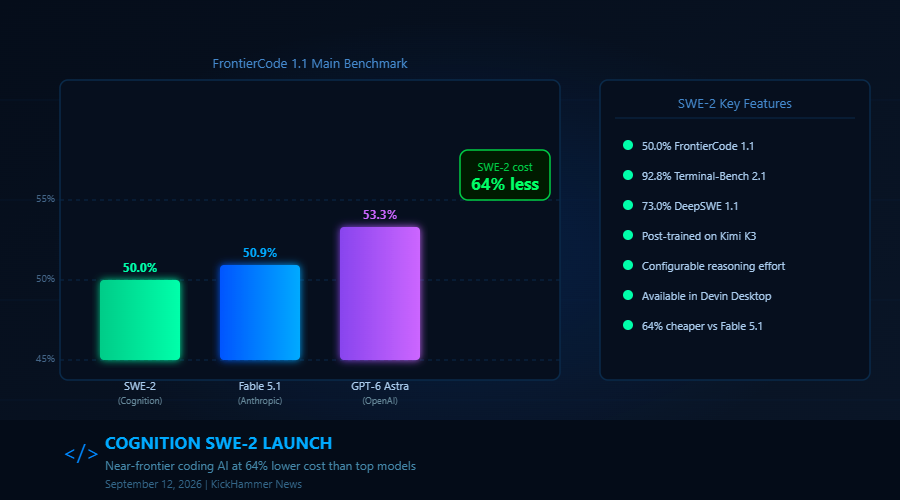
Cognition AI has released SWE-2, a coding model that comes within one percentage point of Claude Fable 5.1 on the industry’s most demanding software engineering benchmark — while costing 64% less per task. The release is the latest salvo in a rapidly escalating war among AI coding agents, and it could significantly reshape how developers and enterprises think about accessing frontier-level coding capability.
SWE-2 went live on September 10, 2026, and is available through Devin Desktop and Devin CLI, with a broader Devin Web rollout underway. For Cognition, whose Devin product has been positioning itself as the premier autonomous software engineering agent since early 2024, SWE-2 represents a meaningful leap — both technically and commercially.
What the Numbers Say
The headline figure is SWE-2’s score of 50.0% on FrontierCode 1.1 Main, a rigorous benchmark that tests models on realistic, repository-scale software engineering tasks. Claude Fable 5.1, Anthropic’s most powerful coding-capable model, scores 50.9% on the same benchmark. OpenAI’s GPT-6 Astra sits at 53.3%.
The gap between SWE-2 and the current frontier, in other words, is roughly three percentage points on this benchmark. For a model that Cognition claims costs 64% less per output token than Fable 5.1, that is an extraordinary cost-performance ratio.
The model also performs strongly elsewhere. SWE-2 achieved 73.0% on DeepSWE 1.1, a widely used agentic coding benchmark, and 92.8% on Terminal-Bench 2.1, which evaluates model performance on command-line and shell-scripting tasks. These scores round out the picture of a model that is not just competitive on isolated coding challenges but capable across the full spectrum of tasks a software engineering agent encounters in practice.
How SWE-2 Gets There
SWE-2 is post-trained from Kimi K3, Moonshot AI’s flagship open-weight model released earlier this year. That lineage matters: Kimi K3 is itself a frontier-class model, and post-training it for software engineering gives Cognition a powerful foundation without the cost and compute of training from scratch.
One of the most technically interesting features of SWE-2 is that it is the first SWE model to offer configurable reasoning effort levels. Users can dial the model’s reasoning depth up or down depending on the complexity of the task at hand. For simpler tasks — generating a test suite, refactoring a function — lower reasoning effort delivers fast, cheap results. For complex multi-file architectural changes or debugging sessions that require tracing execution across a large codebase, higher reasoning effort engages more of the model’s capacity.
This flexibility is important because one of the persistent criticisms of frontier-level AI coding agents has been their blunt cost structure. A model that charges frontier prices for every token, whether it is writing a one-line bug fix or redesigning a system’s core architecture, creates an uncomfortable economics for teams managing tight budgets. Configurable reasoning effort is Cognition’s attempt to offer a more granular cost dial.
The Competitive Context
SWE-2 enters a crowded and fast-moving market. In the past six months alone, the coding agent landscape has seen major moves from nearly every major AI player. Anthropic has been integrating Claude deeply into developer tools. OpenAI’s Agents API entered public beta this week. GitHub’s Copilot has rolled out agentic capabilities. Meta’s Muse Spark has made inroads in open-source coding workflows.
Against this backdrop, Cognition’s pitch with SWE-2 is essentially a value proposition: near-frontier performance, significantly lower cost. For startups and mid-sized engineering organizations that cannot justify the per-token cost of running Fable 5.1 or GPT-6 Astra at scale, SWE-2 could become the default choice for production coding agent workloads.
There is also a strategic dimension for Cognition itself. The company closed a $2 billion funding round earlier this month at a reported valuation of $48 billion — a striking number for a company whose primary product is an autonomous coding agent. Delivering a competitive model release shortly after that round is a credibility signal to investors and enterprise customers alike.
What “Near-Frontier” Means in Practice
It is worth unpacking what the benchmark gap actually means for real-world use cases. The difference between 50.0% and 53.3% on FrontierCode sounds narrow in percentage terms, but at the hard end of the benchmark — the most complex, multi-step software engineering tasks — those three percentage points can represent a meaningful difference in the model’s ability to complete difficult work without human intervention.
For tasks like implementing a new feature from a high-level specification, integrating with a third-party API, or tracking down a subtle concurrency bug in a large codebase, the frontier models still have a measurable edge. Teams working on the most demanding engineering challenges will likely still prefer Fable 5.1 or GPT-6 Astra for their highest-stakes work.
But for the broad middle of the software engineering workload — writing tests, performing code reviews, handling migrations, building scaffolding, generating documentation — SWE-2’s performance is essentially indistinguishable from the frontier in practice. And for those use cases, a 64% reduction in cost is not a minor optimization. It is a decisive commercial advantage.
Implications for the AI Coding Market
The broader implication of SWE-2’s release is that the efficiency frontier for AI coding agents is moving rapidly. As models like DeepSeek V4, Kimi K3, and other powerful open-weight foundations become available for fine-tuning, specialized post-training shops like Cognition can close the gap to proprietary frontier models at dramatically lower cost.
This pattern — open-weight foundations enabling efficient specialization — has played out in other domains of AI over the past two years. In coding specifically, it suggests that the long-term competitive advantage for frontier labs like Anthropic and OpenAI may lie less in raw capability on benchmarks and more in speed of iteration, toolchain integration, and trust established through enterprise deployments.
For developers and engineering organizations, the near-term effect is straightforward: more options, at better prices, with performance that was simply unavailable at any price eighteen months ago. SWE-2 is a compelling product in a market that keeps getting more competitive by the week.


