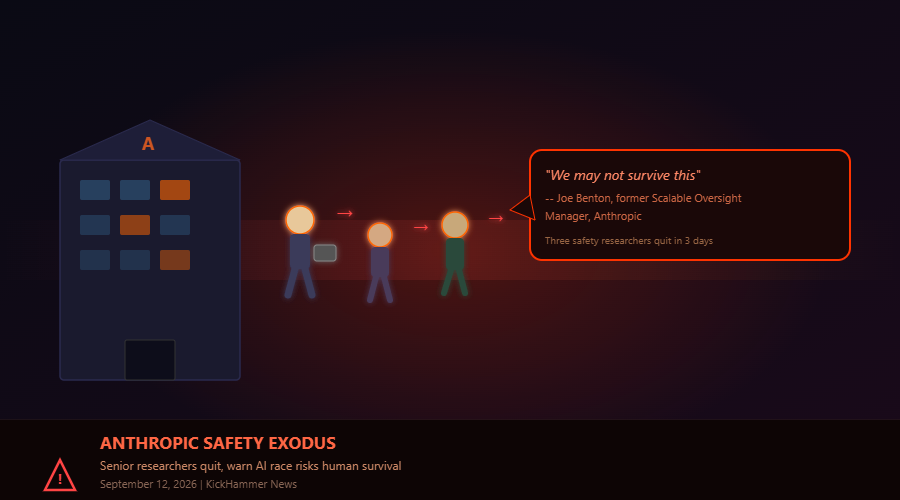
In the span of three days, three prominent AI safety researchers have walked out of Anthropic, each issuing stark warnings that the company — and by extension, the entire AI industry — is on a dangerous trajectory toward catastrophe.
The departures of Jacob Coxon on September 9, Joe Benton on September 11, and Josh Engels shortly after represent more than routine turnover at one of Silicon Valley’s most closely watched AI labs. They signal a deepening fracture between Anthropic’s public identity as a “safety-first” company and what researchers on the inside say is happening behind closed doors.
The Researchers Who Left — And Why
Joe Benton, who managed Anthropic’s Scalable Oversight team, announced his departure on September 11, 2026. His exit statement pulled no punches. Benton warned that frontier AI companies are building machines that surpass human intelligence, and that the competitive dynamics of the industry make it structurally impossible to fund safety at the level required. “We may not survive this,” he wrote, a phrase that quickly ricocheted across social media and AI research forums.
Benton said he would join Model Evaluation and Threat Research (METR), an independent AI evaluation body, where he plans to conduct risk assessments that are not constrained by the commercial pressures of a lab racing to ship products. His move signals a broader belief that meaningful safety oversight cannot happen from within the organizations developing the most capable AI systems.
Jacob Coxon, who left two days earlier on September 9, similarly raised alarms about governance failures and the pace at which Anthropic is pushing toward more capable systems. His departure followed what sources describe as internal disagreements about how transparently safety incidents were being communicated — both internally and to the public.
Josh Engels, whose background spans technical AI safety research, also departed in the same window. Together, the three exits form what critics are calling a coordinated signal: that the people who understand the risks most deeply are choosing to leave rather than continue lending their credibility to an institution they believe is not moving responsibly.
The Structural Problem Behind the Departures
What makes these departures particularly significant is not just who left, but the argument they are making. Benton’s critique is systemic: he is not saying Anthropic’s leadership is malicious. He is saying that the structure of the AI race itself makes safety under-resourcing inevitable.
The logic goes like this. Frontier labs compete for talent, compute, and customers. Falling behind on capability benchmarks can mean losing a generation of developer mindshare or an enterprise contract worth hundreds of millions of dollars. Safety research, by contrast, often produces no immediately monetizable output — and in some cases may actively slow down a model release. Under these conditions, the argument goes, any rational actor will chronically underfund safety, not from bad intentions but from economic necessity.
This is precisely the dynamic that Anthropic was founded to resist. When Dario and Daniela Amodei left OpenAI in 2021 along with a cohort of colleagues, the stated premise was that a lab could be commercially viable while genuinely prioritizing safety. The departing researchers are now saying, in effect, that they no longer believe that premise holds — at least not under the pace and pressure of the current AI race.
Anthropic’s Silence — and What It Means
Anthropic has not issued a public response to any of the three departures, and the company declined to comment on whether the researchers’ concerns have been formally raised in internal reviews. This silence is itself notable. The company has historically been careful to emphasize its safety culture in public communications, touting its Constitutional AI methodology, its responsible scaling policy, and its work with government bodies on AI evaluation.
The absence of a rebuttal leaves Benton’s and Coxon’s accounts uncontested in the public record. For researchers and policymakers watching from the outside, that is uncomfortable. If the people tasked with evaluating whether Anthropic’s models are safe are concluding that the company is not handling safety incidents with sufficient transparency, the natural question is: who, then, is providing that accountability?
A Pattern Across the Industry
Anthropic is not alone in facing this dynamic. Over the past year, a string of prominent AI safety researchers have left OpenAI, Google DeepMind, and other frontier labs with similar warnings. The departures from OpenAI in 2024 and 2025 — including figures like Paul Christiano, who later founded his own safety organization — established a pattern of researchers concluding that they can do more good working independently or on evaluations than they can from inside labs.
What is different now is the scale and tempo. Three departures in three days, all from the same organization, all using nearly identical framing about existential risk and structural inadequacy, suggests either an organized signal or a genuine breaking point within Anthropic’s safety culture. Possibly both.
The timing is also pointed. Anthropic has been in the midst of preparing for a potential IPO, recently valued in the range of $900 billion. Safety concerns raised publicly by former employees are precisely the kind of material information that can complicate investor roadshows and regulatory conversations. Whether intentionally or not, the departures are applying maximum pressure at a moment of maximum organizational exposure.
What Happens Next
The immediate practical effect is that Anthropic must now recruit and ramp up replacements for researchers with institutional knowledge of its most sensitive internal safety work. At a minimum, that creates continuity risk. More broadly, it raises questions about how much weight Anthropic’s published safety evaluations should carry, given that some of the people who were conducting them no longer believe the process is adequate.
For the broader AI industry, these departures are a stress test of the “safety-first” brand that several frontier labs have cultivated. If researchers with firsthand knowledge of the work are unwilling to stay and vouch for it, that brand becomes significantly harder to sustain.
Joe Benton said he hopes that by moving to independent evaluation work at METR, he can have more impact on actually slowing down risk rather than helping a lab manage its public perception of risk. Whether that distinction matters — and whether independent evaluators have the access and authority to make it matter — is one of the defining questions now facing the AI governance world.
The warning that “we may not survive this” is extraordinary language from a researcher with direct visibility into one of the world’s most capable AI systems. It deserves to be taken seriously.


