Today marks the final deadline for developers still using DeepSeek’s legacy API endpoints. As of July 24, 2026, `deepseek-chat` and `deepseek-reasoner` are being switched off — replaced by the General Availability release of DeepSeek V4, a model that launched five days ago and has already reshaped the conversation about what frontier-tier AI should cost.
The GA rollout began on July 19. It didn’t take long for benchmarks and early test results to circulate across developer communities, and the reaction has been a mix of genuine excitement and a fair amount of disbelief. When a fully open-weight model delivers results within a few points of the best closed-source systems in the world — at one fifty-seventh the price — that’s not a product launch. It’s an argument.
From Preview to Production: A Three-Month Journey
DeepSeek first shipped V4 as a preview build on April 24, releasing the weights under an MIT license alongside API access. The preview introduced two model variants — V4-Pro, a 1.6 trillion parameter Mixture-of-Experts system with 49 billion active parameters per token, and V4-Flash, a smaller 284 billion parameter model with 13 billion active. Both supported a 1-million-token context window by default, a context length that was considered a frontier capability just months ago.
The preview generated immediate interest, but developers were cautious. Preview builds come with caveats. The real question was always what the stable release would look like.
On June 29, DeepSeek announced a mid-July GA target. Grayscale testing began July 14, with select users receiving early access. By July 19, the full rollout began — and the results lived up to the wait.
Benchmark Performance: Close Enough to Matter
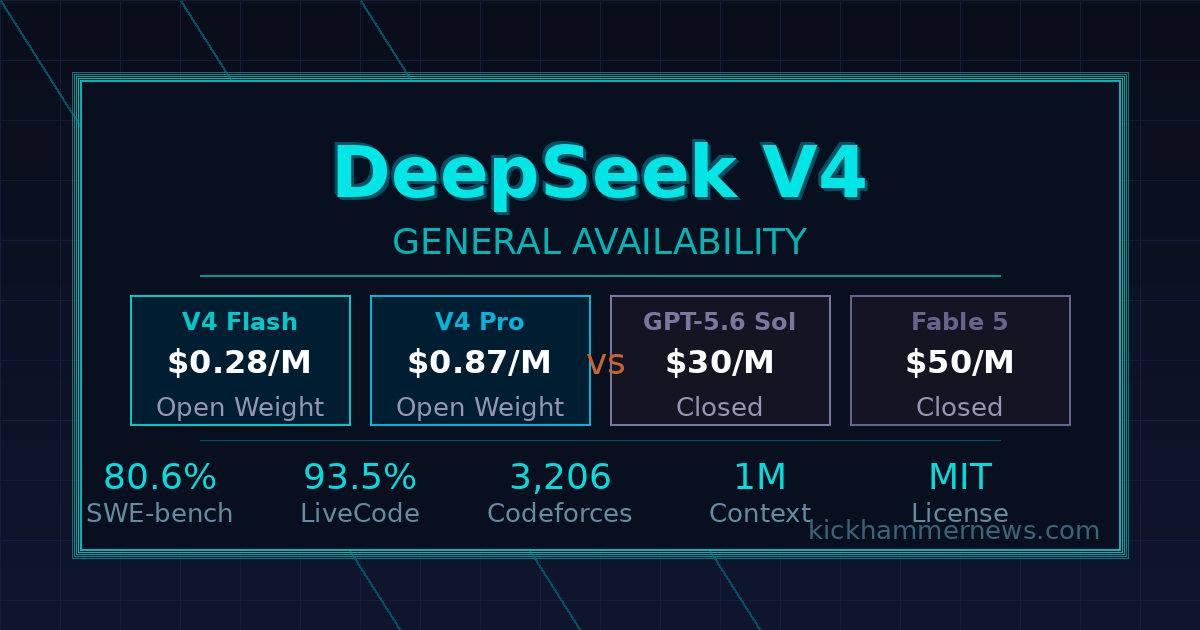
On SWE-bench Verified — one of the industry’s most respected coding benchmarks — V4-Pro GA scores 80.6%. That places it just behind Anthropic’s Claude Opus 4.6 at 80.8%, and makes it the strongest open-weight coding model available by a clear margin.
The numbers extend across the board. LiveCodeBench, a competitive programming benchmark, shows V4-Pro at 93.5%. On Codeforces, the model’s Elo rating sits at 3,206. GPQA Diamond — a doctoral-level science reasoning benchmark designed to be unsolvable by non-experts — comes in at 90.1%. Humanity’s Last Exam, one of the most brutally difficult knowledge tests available, reaches 48.2%.
For math, V4 GA hits 95.2% on HMMT 2026 February problems, outperforming K2.6 and Gemini-3.1-Pro on that dataset.
On MMLU-Pro, the model scores 87.5% — competitive with the upper tier of closed-source systems.
These aren’t just impressive numbers in isolation. The context that makes them remarkable is what they cost.
The Price That Changes Everything
DeepSeek V4 GA introduces peak-valley billing — the first time-of-day pricing the AI model API space has seen. Peak hours run from 9 a.m. to noon and 2 p.m. to 6 p.m. Beijing time, at which point API costs double compared to off-peak rates.
Even at peak pricing, the numbers are striking. V4-Pro’s output costs $1.74 per million tokens at peak, $0.87 at off-peak. V4-Flash runs $0.56 at peak, $0.28 at off-peak. For context: Anthropic’s Claude Fable 5 costs $50 per million output tokens. GPT-5.6 Sol comes in at $30. Kimi K3, which launched earlier this month to considerable fanfare, runs $15.
That means V4-Pro off-peak is approximately 1/57th the cost of Fable 5 for comparable coding tasks. Developers who schedule batch inference jobs outside Beijing peak hours can run frontier-adjacent AI workloads at a price point that was, until recently, associated with much smaller, lower-capability models.
The MIT license amplifies this further. Organizations willing to invest in self-hosted infrastructure can run V4 on their own hardware and eliminate API costs entirely. V4-Pro’s weights are available on Hugging Face at 865GB; V4-Flash, a more tractable 160GB, is already running on high-end consumer hardware setups in the research community.
Architecture: Why It Can Be This Cheap
The efficiency behind V4’s pricing isn’t magic — it comes from deliberate architectural choices. The model uses a Hybrid Attention architecture combining Compressed Sparse Attention and Heavily Compressed Attention. According to DeepSeek’s technical documentation, this means V4-Pro handling a 1-million-token context requires only 27% of the inference FLOPs and 10% of the KV cache memory compared to its predecessor, V3.2.
Additional efficiency comes from mixed-precision training — expert parameters run at FP4, most others at FP8 — and aggressive prefix caching, where repeated inputs cost just $0.0036 per million tokens to process on cache hits. The net result is a model that is genuinely massive in parameter count but engineered, at every level, to minimize what each token actually costs to generate.
The Distillation Controversy
The launch hasn’t been without friction. As grayscale testing expanded in mid-July, independent researcher @synthwavedd published an investigation on X claiming that under specific test conditions — complex coding tasks combined with knowledge queries — V4 GA returns outputs that appear “virtually identical” to Claude Fable 5. The claim is that certain queries may be routing through Fable 5 on the backend, with V4 serving as a pass-through for high-complexity requests.
DeepSeek has not publicly responded. Multiple community testers have noted that V4 GA’s chain-of-thought reasoning style closely resembles Claude’s, and that the model’s behavior has shifted during the rollout period in ways that suggest routing adjustments.
Distillation claims are not new in AI. Similar allegations followed every major open release over the past year, and the evidence in most cases has remained ambiguous. What is objectively verifiable — and harder to dismiss — are the benchmark scores. SWE-bench 80.6% and Codeforces 3,206 are numbers that can be independently reproduced, and they’re real.
For developers building production systems, the practical question isn’t whether DeepSeek trained on or routed through proprietary models — it’s whether the outputs are reliable enough for the task. On that measure, early results suggest they are, with the important caveat that V4 has a notably high refusal rate on sensitive code generation prompts, roughly 45% in testing, which makes it unsuitable as a standalone solution for certain workloads without fallback options.
Where V4 Fits in July 2026’s Model Landscape
This month has been remarkably dense with model releases. Kimi K3’s 2.5 trillion parameter open-weight launch arrived earlier in July. GPT-5.6 Sol launched mid-month. Google announced Gemini 4. Against that backdrop, V4 GA’s differentiation is clear: it is the only model in this tier combining open-weight access, MIT licensing, a 1-million-token context window by default, and API pricing that sits an order of magnitude below closed-source competitors.
The tradeoffs are real. Long-context retrieval still trails Opus 4.8 in side-by-side testing. Specialized software engineering tasks still show Fable 5 ahead at the very hardest level. And complex agent tasks require more iteration rounds. But for the broad middle of what production AI workloads actually look like — code completion, document processing, classification, agentic workflows, mathematical reasoning — V4 Pro delivers results that most enterprise teams will find difficult to justify paying 57 times more to avoid.
What Happens Next
Three things will shape V4’s trajectory in coming weeks. First, independent benchmark platforms like Chatbot Arena and Artificial Analysis will publish their own evaluations. Those results will either confirm or complicate the performance claims from early testers and DeepSeek’s own benchmarks.
Second, the community ecosystem is just getting started. The MIT license means fine-tuning, quantization, and optimized deployment variants are already in progress. Community-built versions of V4 Flash running efficiently on consumer hardware could dramatically expand the user base beyond those with access to data center infrastructure.
Third, the rumored Anthropic Opus 5 release — if it materializes by end of July as some internal sources suggest — will reset the ceiling that “near-Opus 4.8” references. A new top-end benchmark will require V4’s positioning to update accordingly.
For now, though, the headline is simple: as of today, the legacy DeepSeek endpoints are gone, V4 GA is the new standard, and the question of whether open-weight models can compete with closed-source flagships has a more concrete answer than it did a week ago. The gap in capability is a sliver. The gap in price is enormous. That combination tends to move markets.
Sources: DeepSeek API Documentation, Wan 2.7 Blog, DataCamp, Codersera, iGeekPhone, TechNode


