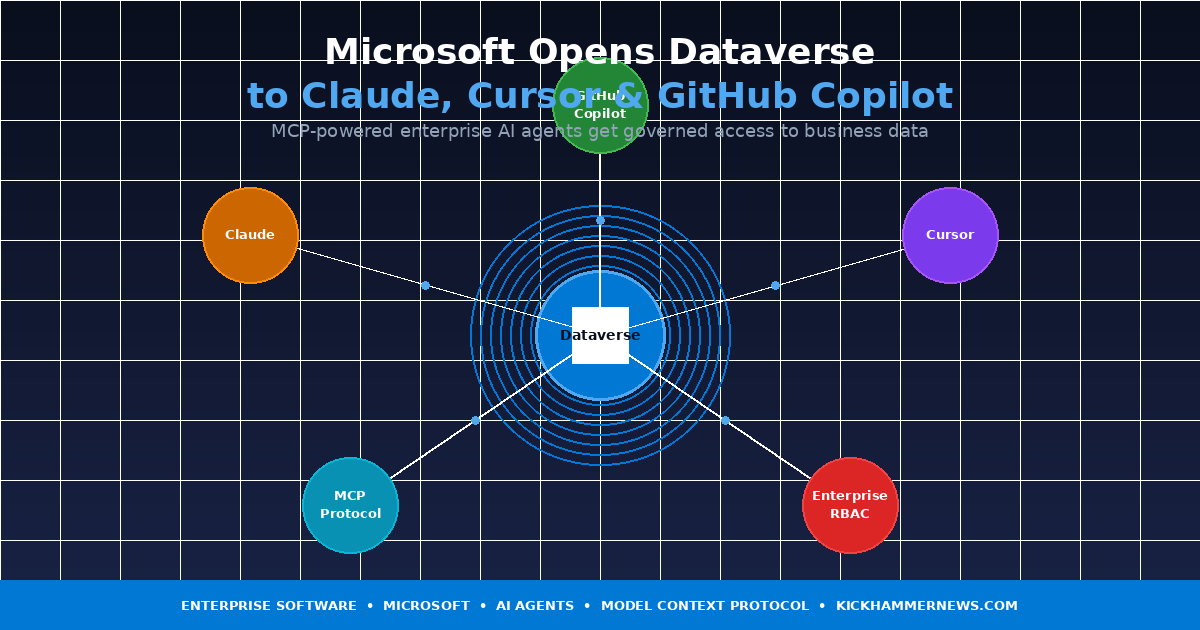
Microsoft made a quiet but strategically significant move earlier this month: the company expanded its Dataverse coding-agent plugin beyond its own tooling ecosystem, making it available directly inside Claude, Cursor, and GitHub Copilot. The announcement, published July 6 by Dataverse product leader Julie Koesmarno on the Microsoft Power Platform Blog, is a departure from the enclosure strategy one might expect from a company with Microsoft’s market position. Rather than insisting that enterprise AI agents live exclusively inside Copilot surfaces, Microsoft is meeting developers where they already work — and that choice says something important about where the enterprise software industry is heading.
What Dataverse Actually Is (and Why It Matters)
To understand why this move matters, it helps to understand what Dataverse is. Dataverse is Microsoft’s business data platform, the underlying fabric beneath Dynamics 365, Power Apps, Copilot Studio, and a growing constellation of enterprise applications. Think of it as a governed, enterprise-grade data layer — not a consumer database or a developer sandbox, but the kind of structured, permission-enforced, auditable data environment that large organizations run business-critical processes on.
Until recently, accessing Dataverse from a developer’s workflow meant bouncing between environment URLs, admin portals, command-line tools, authentication flows, and SDK documentation. It was powerful but friction-heavy. The Dataverse coding-agent plugin changes that by routing natural-language developer requests through whichever underlying tool is most appropriate: the Dataverse MCP server, the Python SDK, PAC CLI, or the Dataverse CLI. The developer stays in their coding environment; the plugin handles the orchestration.
That is a genuinely useful capability. What makes July’s announcement news is where that plugin is now available.
Choosing Reach Over Enclosure
The decision to bring Dataverse support to Claude, Cursor’s marketplace, and GitHub Copilot reflects something Microsoft has been learning from the last two years of the AI coding boom: developers are not monogamous about their AI tools.
Cursor has become a serious AI-native editor for many software teams. Claude has built a loyal following among developers who value its reasoning quality and long-context behavior. GitHub Copilot is embedded deeply in enterprise development workflows. Treating these as threats to manage rather than distribution channels to leverage would be a mistake — and Microsoft, to its credit, seems to recognize that.
The move is also an implicit acknowledgment that the competition for enterprise AI development is not primarily about which assistant produces the best autocomplete. It is about which data platform becomes the default substrate beneath enterprise agents. If Dataverse is accessible from inside Claude or Cursor, Microsoft wins something more durable than a session: it becomes infrastructure.
MCP as the New Connector Protocol
Underlying the plugin expansion is the Model Context Protocol, or MCP — the standard originally developed by Anthropic that has rapidly become a candidate for the universal connection layer between AI models and enterprise systems. Microsoft has built its MCP catalog to over 60 ready MCP servers, spanning productivity tools, developer platforms, business applications, and partner systems.
The pitch is straightforward: one connection standard that works across Microsoft 365 Copilot, Copilot Studio, Azure AI Foundry, GitHub Copilot, and any other MCP-compatible client. The Dataverse MCP server is already natively supported in Copilot Studio and Azure AI Foundry. It can now be invoked from Claude, Cursor, or whatever MCP-compatible tool an organization chooses.
For enterprise architects, MCP is starting to look a lot like what connectors were in the Power Platform era — except instead of moving data between systems, MCP servers give agents a structured menu of actions they can take. That distinction matters enormously. Reading a field from a CRM record is fundamentally different from updating a customer’s bank details or provisioning a new Dataverse table. MCP gives agents operational reach, not just informational access.
That distinction also explains why Microsoft has invested heavily in the governance layer surrounding MCP. The July announcement introduced a formal MCP certification program for ISVs and partners, allowing third-party MCP servers to go through a Partner Center certification process and become discoverable, with enterprise trust signals, across Microsoft surfaces. Certified MCPs are easier for customers to discover and evaluate. They carry implicit validation that the tool meets Microsoft’s baseline expectations for security, observability, and governance.
Bring Your Own MCP: The Enterprise Reality Check
Perhaps the most practically important part of the July announcement for large organizations is “Bring Your Own MCP” — the ability to register internal MCP servers under enterprise governance controls and make them available to agents in a governed way.
No enterprise runs entirely on catalog software. Every large organization has proprietary APIs, internal approval workflows, legacy middleware, and line-of-business systems that do not appear in any public catalog. Bring Your Own MCP gives those organizations a path to connect those internal tools to the agent ecosystem without abandoning admin visibility, approval workflows, or access controls.
This is the part of the announcement that sounds boring but is genuinely important. The demos for agentic enterprise software almost always involve generic, catalog-friendly examples. The real automation opportunity for most organizations lives in the specialized, idiosyncratic, sometimes poorly documented internal tools that developers have been maintaining for years. Giving agents access to those tools — with appropriate governance — is where productivity gains stop being theoretical.
The Governance Conversation Microsoft Needs to Have
Microsoft deserves credit for building governance language into the July announcement from the start. Terms like least-privilege security, documented authentication, existing RBAC controls, admin approval, and enterprise governance appear throughout the blog post and accompanying documentation. These are the right words.
The harder work is helping customers translate those words into practice. An agent that can describe a table is interesting. An agent that can create a table is operational. An agent that can update records in a production Dynamics 365 environment is part of a business process — and should be treated with all the change control, audit logging, and access review that implies.
Microsoft’s own documentation for Dataverse MCP preview tools includes appropriate caveats: preview capabilities may not support full functionality or scale, and preview endpoints should be enabled through Power Platform admin center with care. Those caveats are responsible. What enterprise IT teams should hear is that preview settings deserve change control review, not just casual enablement, regardless of how quickly the demo looked compelling.
What This Means for the Enterprise Software Landscape
The Dataverse-MCP-Claude combination is interesting not just for what it does today but for what it signals about where enterprise software is going. The boundaries between “Microsoft tools” and “non-Microsoft tools” are eroding at the point where AI agents do their work.
For ERP and CRM customers running Dynamics 365, this means the agents assisting their developers might be Claude-powered, Cursor-native, or GitHub Copilot-driven — and still interacting with Dataverse through a consistent, governed interface. The assistant changes; the data platform and its governance model persist.
For competitors, it means Microsoft is not defending Dynamics 365 or Power Platform by building walls around them. It is defending them by making Dataverse too useful and too well-governed to bypass. That is a subtler kind of platform lock-in, but it may prove more durable in an era where developers choose their AI tools independently of what their enterprise software vendor prefers.
The Bottom Line
Microsoft’s July 2026 Dataverse update is easy to overlook amid the louder security headlines and AI model launches of the summer. That would be a mistake. By making Dataverse accessible from inside Claude, Cursor, and GitHub Copilot through MCP, Microsoft is executing a quiet but significant bet: that the company willing to let developers work in their preferred tools will end up owning the enterprise data layer those tools touch.
Whether that bet pays off depends less on the plugin itself than on whether Microsoft can sustain the governance story as agents move from development tasks toward production business operations. The July release sets up the right primitives. The harder question — which organizations should be asking now — is whether their Dataverse environments are ready for the agents already trying to walk through the door.
Sources: Microsoft Power Platform Blog, Windows Forum, Visual Studio Magazine, Digital Applied