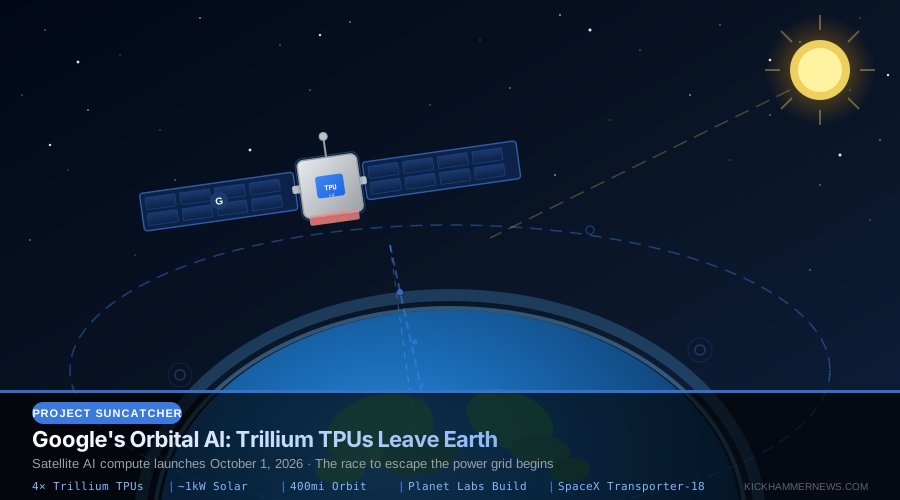
The data center has always been earthbound — a hulking complex of servers and cooling towers, tethered to power grids and real estate, constrained by the slow grind of permitting and the chronic scarcity of electricity. On October 1, 2026, Google did something that no one in the AI infrastructure industry had managed before: it launched four of its custom Trillium TPUs into orbit, tucked inside a refrigerator-sized satellite perched atop a SpaceX Falcon 9 rocket lifting off from Vandenberg Space Force Base. Project Suncatcher is now circling Earth at roughly 400 miles altitude. And the question the entire AI industry is now quietly asking is whether the future of compute is not on the ground at all.
A Satellite the Size of a Refrigerator, Running Gemini
The MVP satellite, developed in partnership with Planet Labs — the company that has photographed every inch of Earth more times than most people realize — is deliberately modest by design. It carries a single Cloud TPU v6e-4 slice: the equivalent of four Trillium chips and roughly one kilowatt of solar power. It is not going to train GPT-7. That’s not the point.
What it is doing, right now in a dawn-dusk sun-synchronous orbit, is running Gemini inference in 15-minute windows. Fifteen minutes of processing, then a thermal cooldown as the satellite swings from sunlit exposure to the shadow of Earth, temperatures swinging more than 212°F in a single pass. The chips survive. The bigger question is whether the cooling can keep pace.
“We don’t expect that we’ll have anything usefully operational in the next few years,” James Manyika, Google’s Senior Vice President for Research and Technology, told reporters at the launch. He drew a comparison to the company’s fifteen-year arc in autonomous driving research. This is a long game, and Google knows it.
The Real Problem: Earth Is Running Out of Power
To understand why a technology giant would put AI chips on a rocket, you need to understand what’s happening to terrestrial data centers right now. Grid interconnection queues — the waitlists for connecting new facilities to the electrical grid — have become the single most constrained resource in the AI buildout. Futurum Research estimates that over 33% of new data centers will be forced to operate off-grid by 2030, relying on on-site power generation because the grid simply cannot absorb them fast enough.
Space offers a seductive alternative. In a dawn-dusk orbit — where a satellite rides the terminator line between day and night, staying in perpetual sunlight — solar panels can harvest approximately eight times the annual energy of an equivalent panel at mid-latitude on Earth. No weather. No night. No transmission losses. No waiting six years for a grid interconnection permit.
If launch costs come down far enough, the economics flip. Google’s research suggests orbital compute reaches cost parity with terrestrial off-grid installations in the mid-2030s — but only if launch costs drop below $200 per kilogram. Falcon 9 currently costs around $3,600 per kilogram. Getting there would require roughly 1,800 Starship launches across ten years, hitting a sustained learning curve. It’s a significant dependency on SpaceX’s execution. Google is betting SpaceX will deliver.
The Radiation Problem Is Solved. The Heat Problem Is Not.
Before the October 1 launch, Google spent the better part of two years proving that commercial silicon could survive space radiation. Testing at UC Davis’s Crocker Nuclear Laboratory, begun in February 2025, subjected Trillium chips to 15 krad(Si) of cumulative ionizing dose — providing a 20x safety margin over the 750 rad expected across a five-year mission. The chips passed. High Bandwidth Memory was more sensitive, showing irregularities at 2 krad(Si), but still maintained a 3x safety margin over the mission requirement. One silent data corruption event was detected. One restart fixed it.
The radiation problem, it turned out, was manageable. The heat problem is thornier.
In orbit, the only way to shed heat is radiation. There’s no air to convect it away, no liquid cooling loop venting to atmosphere. Every Trillium TPU dissipates energy at a rate requiring 1.3 square meters of radiator area per chip. The MVP satellite’s heat pipes and external radiators have never been tested under real orbital thermal cycling. The 15-minute compute window is not a software limitation — it’s a physics constraint. Until Google can prove sustained cooling in actual orbit, the 15-minute ceiling stands.
The next milestone is a two-satellite mission planned for early 2027, designed to test optical inter-satellite links — achieving 1.6 terabits per second of bidirectional data transmission between spacecraft flying in formation. That demonstration is the bridge between a single test satellite and the future architecture: an 81-satellite cluster flying within one kilometer of each other at 650 km altitude, with inter-satellite spacing of 100 to 200 meters, delivering approximately 10 terabits per second per link.
Formation flight at that precision, sustained indefinitely, has never been attempted at scale. Google openly describes it as “uncharted engineering territory.”
Google’s Structural Advantage in the Orbital AI Race
Project Suncatcher is not the first orbital AI compute experiment. Starcloud, a San Francisco startup, trained an AI model in orbit using NVIDIA H100 GPUs and raised $170 million at a $1.1 billion valuation in March 2026. SpaceX is developing its own Starmind satellite system targeting 150 kilowatts of peak power using NVIDIA Vera Rubin GPUs — roughly 150 times the capacity of Google’s MVP — with deployment targets in 2027 and 2028. NVIDIA has announced a Space-1 module. Axiom Space, Blue Origin, and China’s state AI programs are all pursuing orbital compute at varying scales.
But Google’s position is structurally different from any competitor. It controls the accelerator design — the TPU is Google’s chip. It controls the AI models — Gemini runs on that chip. It controls the cloud demand that drives the economics. And now it controls a flight-qualified pathway to orbit. No other player in the AI industry holds all four cards simultaneously.
Critically, Google is qualifying commercial silicon rather than radiation-hardened custom chips. That means every new generation of Trillium TPU can inherit its capabilities within months of tape-out — compared to the multi-year development cycles that space-grade custom silicon traditionally requires. As TPUs improve on Earth, they improve in orbit automatically. The competitive gap between Google’s orbital compute and competitors using commodity NVIDIA hardware compounds with each chip generation.
Futurum estimates the orbital compute market could represent approximately $1 trillion of AI infrastructure investment by 2030, contingent on launch cost trajectories. If that estimate is even partially correct, what lifted off from Vandenberg on October 1 was not just a refrigerator-sized satellite. It was a claim staked on the future of where AI lives.
What Happens Next
The MVP satellite will operate for one year. Google will study HBM degradation over that period — the critical unknown that ground testing couldn’t fully answer. If the memory holds up, the 2027 two-satellite optical link demonstration follows. If that succeeds, the economics of 81-satellite clusters become discussable in engineering terms rather than theoretical ones.
Jonathan McDowell, an astrophysicist at the Harvard-Smithsonian Center for Astrophysics, is skeptical of the timeline, warning that space debris risk and atmospheric reentry impacts from large constellations present hurdles that Google’s projections underweight. The mid-2030s cost parity target, he suggests, assumes everything goes right.
Everything rarely does. But for an industry that has spent the last two years watching data center power queues stretch to 2032 and beyond, a company that puts its AI chips on a rocket and declares the grid optional is making a statement worth taking seriously.
Google’s AI has escaped the building. Whether it can escape the planet — at scale, at cost, at the pace the industry needs — is the experiment that just began.


