It started with a problem no one could solve: how do you build a robot that works everywhere?
Not a robot optimized for one factory floor, or a drone calibrated for one warehouse, or a humanoid trained on one task. A robot that can navigate a construction site, a data center, a disaster zone—each one chaotic, unpredictable, and completely different—without being reprogrammed from scratch each time.
That was the question Ali Agha kept asking during his years at NASA’s Jet Propulsion Laboratory, where he supervised aerial mobility and led teams in the DARPA Subterranean Challenge: competitions where autonomous robots had to navigate unmapped underground environments without GPS, without communication, without any guarantees about what they’d find. He watched brilliant systems fail the moment reality didn’t match their training data. He watched physics get ignored until it bit back.
In 2023, he founded FieldAI to fix that. On Thursday, the company announced it had raised $700 million in a late-stage funding round, reaching a $10 billion valuation—a five-fold increase from just over a year ago.
From Mars to the Factory Floor
Before FieldAI, Agha’s career was a tour through the hardest robotics problems on the planet—and a few beyond it. After a PhD in computer science at the University of Texas and postdoctoral work at MIT studying multi-agent coordination, he joined Qualcomm to develop autonomy for resource-constrained processors. That work caught NASA’s attention, and he was pulled into the Mars helicopter project—the Ingenuity mission that first proved powered flight was possible in another atmosphere.
At JPL, Agha led teams deploying legged robots into Mars-analog caves to search for signs of microbial life. He studied why autonomous systems broke down in the field: not because of bad sensors or insufficient compute, but because of the gap between what AI models assumed and what the physical world actually looked like.
“The mission is to build a single robot brain that can generalize across different robot types and a diverse set of environments,” Agha has said. The key word is generalize—the same word that transformed text AI from brittle tools into the flexible assistants that now populate every enterprise.
FieldAI’s bet is that physical AI is about to undergo the same transformation.
The Universal Brain
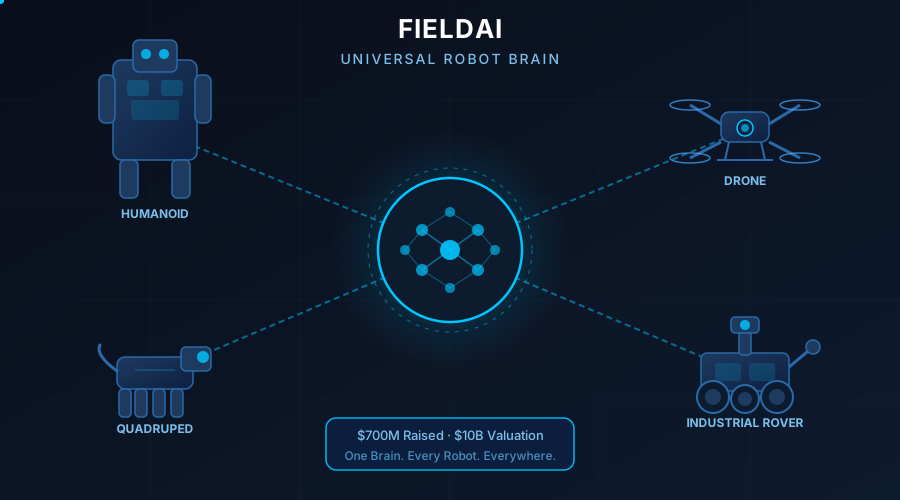
FieldAI’s core product is what the company calls its “Field Foundation Models”—a software platform that functions as a universal controller for any autonomous machine. Feed it a humanoid robot, a quadruped, a drone, or an industrial rover, and it learns to pilot all of them through a single AI system, rather than building separate software stacks for each.
What makes this different from every prior attempt isn’t just the ambition. It’s the architecture.
Most large AI models were designed from the ground up for text or images—discrete tokens, pattern matching, probabilistic outputs. Agha’s team took a different approach, embedding physics, uncertainty modeling, and risk awareness into the model at a fundamental level. The result is a system that doesn’t just predict what to do next; it models what could go wrong, how confident it is, and what the cost of being wrong would be.
That matters enormously in the physical world. A language model that hallucinates outputs a wrong answer. A robot that hallucinates drives into a wall. FieldAI’s physics-first architecture is designed to prevent that failure mode—letting machines operate safely in environments they’ve never seen before, without GPS, without pre-mapped coordinates, without a guarantee that anything will look like the training data.
The system learns continuously through real-world deployment, creating what engineers call a data flywheel: the more robots run the platform in the field, the better the model gets at handling novel conditions.
$135 Million in Revenue, 30 Customers, and Growing
Three years ago, FieldAI was a concept. Today it has more than $135 million in cumulative revenue from more than 30 customers—adding over $35 million in new contracts since June alone.
Those customers aren’t running pilot programs. They’re in construction, data center operations, and defense—the industries Agha describes as “dirty, dull, and dangerous”: work that humans want machines to do, in environments where those machines currently fail.
Construction sites are dynamic and unpredictable. Data centers require constant inspection and maintenance across environments that can be hazardous. Defense applications demand reliability in conditions where GPS jamming, communication blackouts, and rapidly changing terrain are not hypotheticals but operational realities.
That combination of customers—commercial, infrastructure, and government—explains why investors from across the spectrum have converged on the company. The current round drew backing from NVentures (Nvidia’s venture arm), Intel Capital, Gates Frontier, Samsung, Khosla Ventures, Temasek, Prysm Capital, and Canaan Partners. Prior backers include Bezos Expeditions and Laurene Powell Jobs’ Emerson Collective.
The team reflects FieldAI’s recruiting strategy: specialists drawn from Google DeepMind, Tesla, Nvidia, and Boston Dynamics—organizations that have each been trying to crack physical AI from different angles.
The $50 Trillion Market, and the Race to Own It
Nvidia CEO Jensen Huang has estimated the humanoid robotics and physical AI market at a “$50 trillion total addressable market.” Whether or not that figure materializes—it’s both enormous and speculative—the direction is broadly accepted: autonomous machines will be a major category of AI deployment, and whoever builds the software layer that runs them will occupy a position analogous to what operating systems became for personal computers or what cloud platforms became for enterprise software.
FieldAI’s closest competitors are Physical Intelligence, which recently closed at an $11 billion valuation, and Skild AI, which has reached $14 billion. Both pursue similar “general-purpose” approaches to robot software. The difference is emphasis: Physical Intelligence leans heavily into dexterous manipulation—robots that can handle objects and perform household tasks—while Skild focuses on accelerated learning frameworks. FieldAI’s niche has been the field: unstructured, outdoor, and industrial environments where the unpredictability is highest.
The geographic context matters too. While American physical AI companies race toward billion-dollar valuations, Europe’s largest robotics investments have gone primarily to hardware makers—NEURA, Humanoid, Agile Robots—rather than software. Europe’s closest software-layer equivalent, Genesis AI, sits at roughly a third of FieldAI’s current valuation. For international robot manufacturers looking for a universal software partner, the options are narrowing toward a small handful of US-based companies.
Why This Round Is Different
FieldAI has now raised more than $1.1 billion in total, including its $405 million prior round. But the $700 million raise at a $10 billion valuation represents something qualitatively different from the earlier rounds: it’s no longer startup validation. It’s a bet that the category is real and that this company is positioned to lead it.
The $10 billion valuation makes FieldAI one of the most valuable private AI companies in the world, full stop. It’s a mark that took ChatGPT years to approach, and that most of the hardware-first robotics companies still haven’t reached. It also arrives at a moment when the broader AI market is asking hard questions about which companies have real revenue, real customers, and real defensibility—questions FieldAI can now answer with $135 million in contracts.
Agha has compared his company’s approach to human evolution: developing general-purpose capability across diverse environments, rather than optimizing for any single task. The analogy holds in another direction too. Humans weren’t the fastest animal or the strongest, but we became the most adaptable. In a physical world full of machines built by different manufacturers, running different hardware, deployed in different conditions—the most adaptable software layer wins.
That is the game FieldAI is playing. And with $700 million more to play with, the game is very much on.
FieldAI is headquartered in Irvine and the Bay Area, California. The $700 million round has not yet formally closed.


