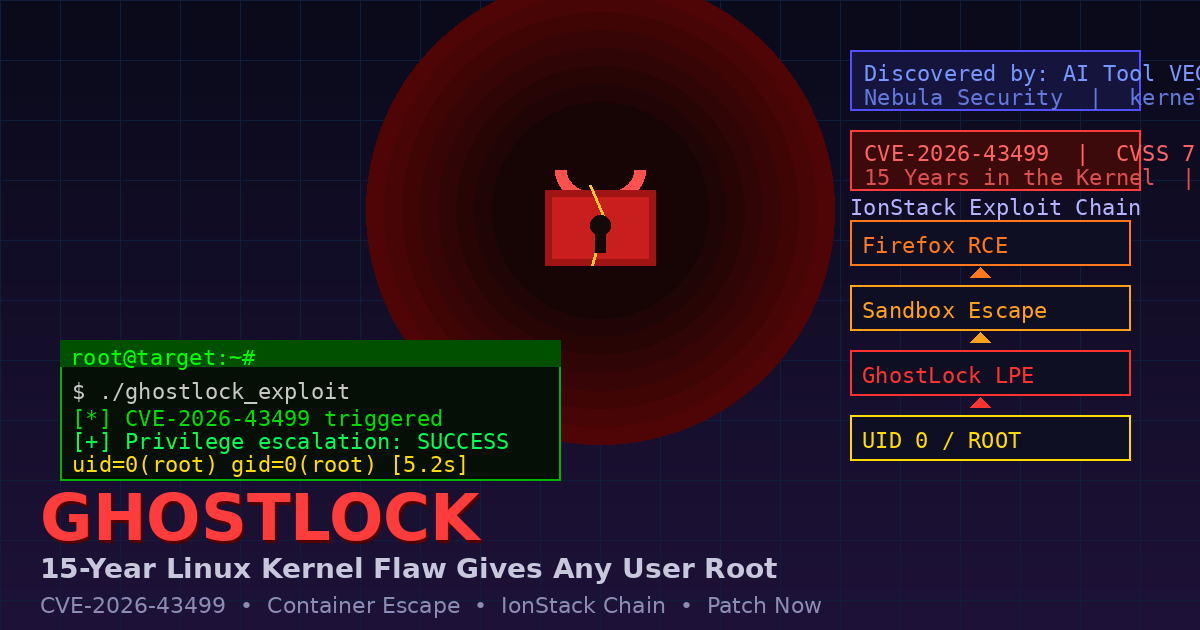
A security flaw that has been silently embedded in the Linux kernel since 2011 is now in the hands of anyone willing to run a public proof-of-concept. GhostLock — tracked as CVE-2026-43499 — lets any ordinary logged-in user become root on virtually every mainstream Linux system built over the last fifteen years, and it can escape containers too. The exploit works in about five seconds. Patches exist, but distribution coverage is still uneven weeks after disclosure, leaving millions of servers, cloud instances, and CI runners exposed.
What makes GhostLock unusual — besides its age and reach — is how it was found. It was not spotted by a human auditor combing through source code. An AI-driven automated analysis tool called VEGA, built by Nebula Security, surfaced the bug during a systematic sweep of the kernel’s concurrency primitives.
What the Bug Is
GhostLock lives in the kernel’s futex priority-inheritance code, a subsystem responsible for a very specific problem: preventing a low-priority thread from blocking a high-priority one indefinitely. The mechanism is old and heavily used — it dates to Linux 2.6.39 in May 2011 — and the CONFIG_FUTEX_PI option that enables it is turned on in essentially every distribution kernel shipped since then.
The flaw itself is a classic use-after-free. When a lock operation hits a dead end and has to back out, a cleanup routine runs at the wrong moment and wipes the wrong task’s record. That leaves the kernel holding a pointer to memory it has already freed and reallocated. Later, when the kernel follows that stale pointer and trusts what it finds there, an attacker in control of how that memory gets reused can steer the kernel toward running arbitrary code.
No special privilege is required. No unusual kernel configuration. No network access. The threading system calls that trigger the flaw are the same ones any local process makes in the normal course of operation. Nebula’s exploit chain turns that small mistake into full root in about five seconds, with a 97% reliability rate in testing. The team also demonstrated a working container escape, which is why cloud operators, CI runners, and multi-tenant environments need to treat this as high priority regardless of their containerization model.
How VEGA Found What Humans Missed for Fifteen Years
Nebula reported GhostLock to the kernel security team and subsequently collected a $92,337 bug bounty from Google’s kernelCTF program. But the backstory of the discovery may matter as much as the vulnerability itself.
VEGA, Nebula’s AI-powered bug-hunting tool, found GhostLock by systematically analyzing the kernel’s locking primitives — exactly the kind of dense, highly stateful code that is brutally hard to audit manually. The futex priority-inheritance path had been reviewed by humans over the years; no one caught this interaction. VEGA did.
The same story is repeating across the kernel ecosystem in 2026. Bad Epoll (CVE-2026-46242), disclosed days after GhostLock, is a close cousin in the same neighborhood of kernel code that also escalates an unprivileged user to root and additionally works on Android. Anthropic’s Mythos model was credited with identifying a related flaw in the same futex code path. Copy Fail (CVE-2026-31431), discovered earlier this year, is already on CISA’s Known Exploited Vulnerabilities list after appearing in real-world attacks.
The pattern is difficult to ignore. Old kernel subsystems — ones that have existed for over a decade with light human review — are now being systematically combed by AI tools, and they are yielding high-severity bugs at a pace that has caught the industry off guard. The question is no longer whether AI can find kernel bugs. It is whether defenders can patch them as fast as researchers, friendly or otherwise, can discover them.
The IonStack Chain: From Browser Click to Root
Taken alone, GhostLock requires a local foothold. That sounds limiting — an attacker needs to already be logged in. But Nebula’s disclosure included a sobering demonstration of why “local only” kernel exploits still matter enormously.
GhostLock is the second half of a full exploit chain the team calls IonStack. The first half is CVE-2026-10702, a vulnerability in Firefox that executes attacker-controlled code inside the browser process and escapes its sandbox. Chain the two together — browser flaw feeds the local kernel flaw — and the result is complete root access from a single click on a malicious link.
Nebula has demonstrated the full IonStack chain running against Firefox on Android, taking a victim from a tap on a malicious link to full device compromise. A detailed write-up of the Android side is still forthcoming, but the proof-of-concept for the kernel half is already public on GitHub, which means any actor with the Firefox component can build the complete chain.
The Patching Landscape
The kernel fix is commit 3bfdc63936dd, merged into Linux 7.1 after a disclosure period. However, the patching story is complicated by a follow-on: the original fix introduced a separate crash bug (CVE-2026-53166), and the repair for that was still settling in upstream development in early July. Early distribution builds based on the first fix may not include the final correction.
Ubuntu illustrates the gap. As of disclosure, the newest Ubuntu release and some cloud-optimized kernels were patched, but Ubuntu 24.04, 22.04, and 20.04 LTS — versions that cover a large share of production servers — were still listed as vulnerable or under remediation. Red Hat and AlmaLinux issued advisories around the same time, but administrators should verify against their distribution’s specific advisory rather than assuming the latest kernel package contains the complete fix.
There is no satisfying workaround. The operations that trigger GhostLock are fundamental; they cannot be restricted without breaking normal application behavior. Two build-time mitigations — RANDOMIZE_KSTACK_OFFSET and STATIC_USERMODE_HELPER — raise the bar for exploitation but do not close the hole. Patching is the only answer.
What Administrators Should Do Right Now
The priority order is straightforward. Shared and multi-tenant systems come first: cloud instances, VMs with multiple users, CI runners where code from external sources executes, and container hosts where workloads share a kernel. An attacker who can run any code on these machines has a reliable, five-second path to root.
Single-user developer workstations are a lower priority by exposure, but they are not immune — the IonStack chain means a compromised browser session on an unpatched machine is enough to trigger the escalation.
Specific guidance: do not just install the first patched kernel package your distribution offered. Check the version number against your distribution’s updated advisory, because the secondary CVE-2026-53166 fix may require a newer build. For Ubuntu, Debian, and other distributions still working through their stable branches, the advisory pages will carry the definitive patched version numbers. For enterprise distributions under extended support, contact your vendor for the explicit build that contains both fixes.
A Broader Signal for Enterprise Security
The string of 2026 Linux privilege-escalation bugs — GhostLock, Bad Epoll, DirtyClone, Copy Fail, and the Mythos-credited futex flaw — represents a meaningful shift in the vulnerability landscape. AI analysis tools are now fast enough and capable enough to revisit code that human researchers considered settled. Subsystems that had not seen a critical bug in years are producing multiple high-severity findings in a single quarter.
For enterprise security teams, the implication is a change in cadence. Kernel updates that once felt routine are now, in a period of intensive AI-assisted research, more likely to contain serious privilege-escalation fixes. Treating Linux kernel updates with the same urgency as web-facing patch cycles is no longer overcautious — it reflects the actual threat surface.
GhostLock is patched. The exploit is public. The window between those two facts is the one that matters.
Sources: Nebula Security IonStack research, The Hacker News, CloudLinux advisory, AlmaLinux advisory, CVE-2026-43499 (NVD)


