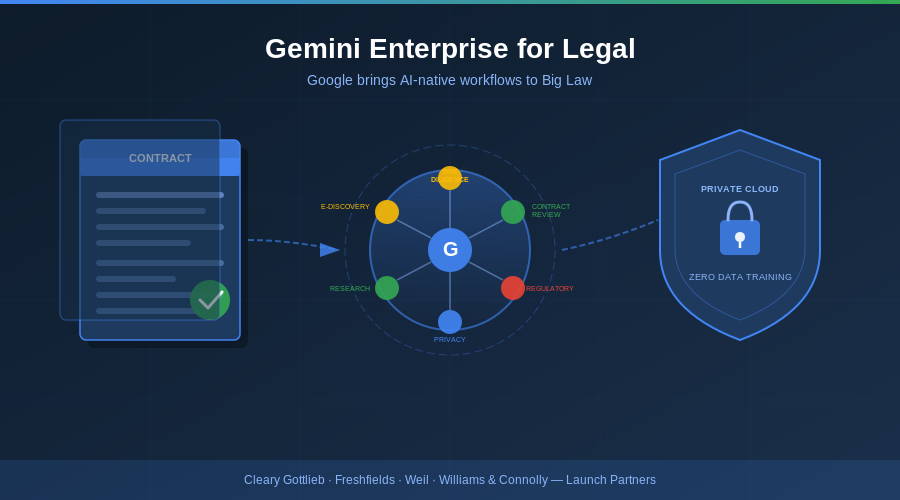
The legal industry’s cautious dance with artificial intelligence reached a turning point this week as Google Cloud officially launched Gemini Enterprise for Legal, a purpose-built AI platform designed specifically for law firms and corporate legal departments. Announced on August 25, 2026, with Cleary Gottlieb, Freshfields, Weil, and Williams & Connolly named as launch partners, the product represents Google’s most ambitious vertical-specific AI push yet — and a signal that the era of generic AI tools being retrofitted for legal work is coming to an end.
What Gemini Enterprise for Legal Actually Does
The platform is not a chatbot layered on top of existing software. Google has built Gemini Enterprise for Legal as a fully integrated AI layer that drops into the systems law firms already run — document management platforms, e-discovery tools, legal research databases, and billing systems. Pre-built agents handle complete end-to-end workflows, not just answer questions.
Contract review is the headline capability: the platform can analyze and redline commercial agreements, flagging non-standard clauses, missing provisions, and risk factors against a firm’s own playbooks. Due diligence workflows for M&A transactions can be partially or fully automated, with agents that surface relevant documents, summarize key terms, and generate preliminary issue lists. Regulatory monitoring agents track changes to rules and statutes across jurisdictions, alerting lawyers when shifts affect matters they are working on. Privacy request processing — a growing burden under GDPR, CCPA, and a proliferating stack of state privacy laws — can be routed through automated workflows that reduce the need for paralegal time.
Perhaps most notably, Google has built deep integrations with the legal tech ecosystem. Connectors exist for platforms like iManage, NetDocuments, Relativity, Kira, and Westlaw, meaning firms don’t have to migrate their data or abandon workflows they’ve spent years developing. The AI meets lawyers where they already work.
Security as the Selling Point
Law firms have historically been slow to adopt cloud AI tools for an obvious reason: client confidentiality. Attorney-client privilege, bar ethics rules, and simple professional paranoia all create friction. Google is addressing this directly.
Under Gemini Enterprise for Legal, client data, prompts, and outputs are processed entirely within the organization’s private cloud perimeter. Base models are never trained on customer data. Existing document-level permissions carry over automatically through the connectors, meaning an associate who shouldn’t see a partner-track memo won’t accidentally surface it through an AI query. Audit logs track every interaction.
This architecture is meaningfully different from firms simply subscribing to a general-purpose AI service and hoping the terms of service adequately protect privileged communications. Google is offering a contractual, architectural guarantee — which is what large law firms need before they can justify deployment to their partnership committees and risk managers.
The Ecosystem Play
Google isn’t trying to sell this as a Google-only platform. The launch includes a partner network of legal tech specialists and major consulting firms: Accenture, Deloitte, Eudia, Factor Law, KPMG, Tribe AI, Valtech, and others. This matters because legal AI adoption is not primarily a technology problem — it’s a change management and workflow integration challenge. Firms that have tried to roll out AI without professional services support have largely struggled. Google is building the scaffolding to make enterprise-wide adoption realistic rather than aspirational.
The financial services edition of Gemini Enterprise launched alongside the legal version, with healthcare and life sciences described as coming soon. The pattern suggests Google is executing a systematic, sector-by-sector AI packaging strategy, wrapping the same underlying Gemini models in industry-specific compliance frameworks, pre-built agents, and partner ecosystems.
Why This Moment, Why Now
Legal AI has been talked about for years, but actual penetration in large law firms has remained shallow. Tools like Harvey, CoCounsel, and earlier versions of Lexis+ AI attracted attention but struggled to move beyond point solutions used by individual practitioners. The workflows remained fragmented.
Several things have changed. Frontier AI models are now substantially better at complex legal reasoning, document interpretation, and nuanced drafting than they were even eighteen months ago. Client pressure on billing efficiency has intensified. Associates and junior partners who grew up using AI tools are increasingly in positions to champion technology adoption internally. And the economic math has shifted: firms that demonstrate AI-driven efficiency gains are winning pitches and lateral partner moves that would have gone elsewhere two years ago.
The regulatory environment has also clarified enough for general counsel and managing partners to feel more comfortable. The EU AI Act’s requirements around high-risk AI systems have been incorporated into compliance frameworks. The American Bar Association has issued updated guidance on competence obligations in the context of AI use. The fog of legal uncertainty has not fully lifted, but it has thinned considerably.
What the Launch Firms Are Saying
Cleary Gottlieb, one of the most prestigious international practices in the world and not historically an early adopter of untested technology, participating as a launch firm is itself a signal. Freshfields — a similarly conservative Magic Circle firm — joining alongside them suggests the legal industry’s hesitance is breaking down at exactly the level of institutional credibility that matters.
Public quotes from the launch have been carefully managed, as one might expect from law firms. Spokespeople emphasized productivity and client service rather than cost reduction — the latter being a message that tends to unsettle associates who are already anxious about AI-driven headcount effects. But the underlying economics are hard to ignore: legal work that once required a team of associates to spend weeks on can now be completed in hours.
The Road Ahead
Gemini Enterprise for Legal is launching in preview, not general availability — Google is clearly managing the rollout carefully and gathering feedback from the launch firms before broader release. The platform faces real competition: Harvey has secured significant venture backing and blue-chip firm relationships; Thomson Reuters has been integrating AI deeply into Westlaw and Practical Law; Microsoft has built Copilot for Legal as part of the Microsoft 365 stack.
But Google’s advantage is the depth of the Gemini model itself, the breadth of the infrastructure ecosystem it can connect to, and the scale of its partner network. If the launch firms validate the product over the coming months, the rollout to the broader Am Law 200 and Magic Circle could happen faster than most observers expect.
Legal AI has long been described as the next frontier. With Google’s entry at this scale and level of institutional credibility, the frontier just got a lot closer.


