August 4, 2026
Something fundamental shifted in how consumers interact with AI this week, and it happened not with a dramatic model release or a benchmark announcement, but with a phone ringing at a hardware store. On the other end of the line: not a person, but Google.
The search giant has quietly rolled out a suite of agentic features that mark one of the clearest transitions yet from AI as a tool you prompt to AI as an agent that independently acts in the world on your behalf. For the first time, a mainstream consumer AI can pick up the phone, call a local business, and handle an errand — with no human hand-holding required.
What Google Is Actually Doing
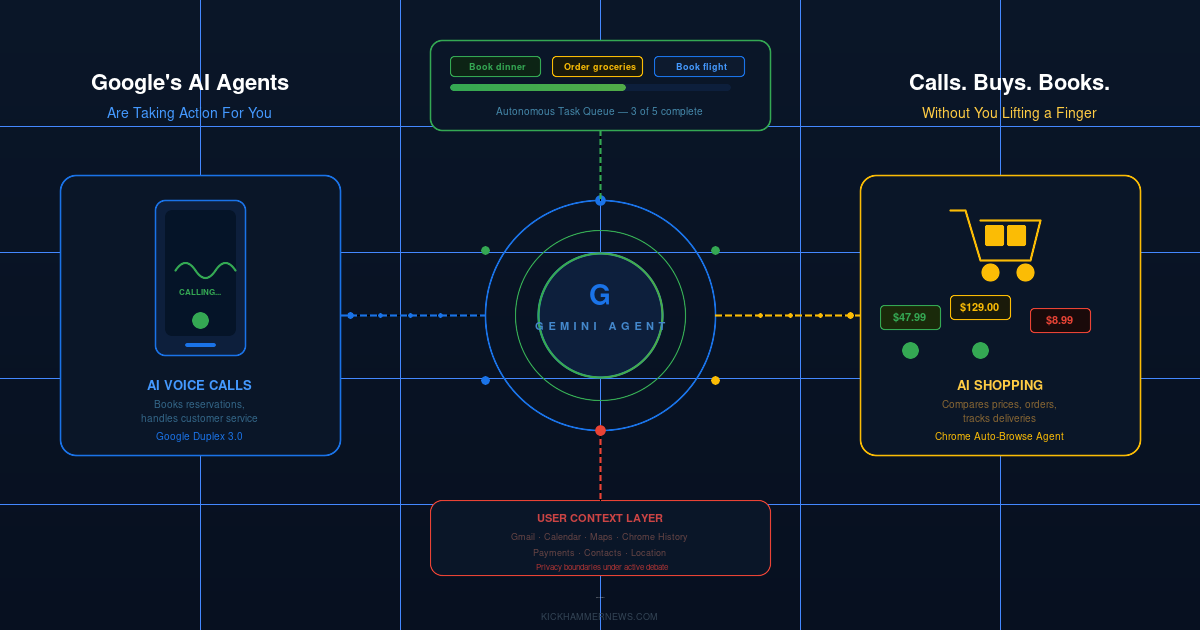
Google’s new consumer agent capabilities center on two interconnected features. The first is “agentic checkout,” which allows an AI agent to monitor a product you’ve marked for price tracking and automatically purchase it when the price drops to your target. The system uses Google Pay to complete the transaction and requires an explicit user confirmation before charging anything, but the execution — finding the price drop, navigating the checkout flow, and completing the purchase — happens without you lifting a finger.
Agentic checkout is already live across major retailers including Wayfair, Chewy, Quince, and a growing number of Shopify merchants. The underlying infrastructure is Google’s Shopping Graph, a database that processes more than 50 billion product listings with 2 billion updates per hour. That scale gives Google a real edge: the agent isn’t just responding to your request, it’s continuously watching prices across an enormous real-time dataset.
The second feature is even more striking. When you search for a product near you, Google now offers a “Let Google Call” button. Click it, and Google’s AI — powered by an upgraded version of its Duplex technology running on Gemini models — actually calls nearby stores to ask whether the item is in stock, what it costs, and whether any promotions are running. The AI identifies itself as an automated caller. Stores can opt out. You receive a summary via text or email.
To put it plainly: Google is now making phone calls to real humans at real businesses, on behalf of real consumers, to accomplish real errands. That’s a genuinely new thing in the world.
Why This Matters More Than the Headlines Suggest
The technical pieces of what Google launched — price tracking, automated checkout, AI phone calls — aren’t individually new. Amazon has been testing conversational commerce through Alexa for years with mixed results. Duplex debuted all the way back in 2018. But the combination, delivered through a consumer product used by billions, crosses a threshold that analysts and observers in the AI agent space have been tracking for months.
The core shift is captured in the word “agentic.” For most of AI’s recent history, even the most capable models have been reactive: you ask a question, the AI answers. You provide a task, the AI helps. The user always initiates, always confirms, always stays in the loop. What Google is rolling out moves the boundary. The price-tracking agent monitors, decides, and acts — on a timeline and trigger you defined in advance, but without further input from you. The calling agent dials, listens, adapts to whatever the store employee says, and reports back.
This is categorically different from a chatbot that helps you draft an email. The agent is operating in the world — spending your money, occupying a store employee’s time, and producing a real-world outcome — not just producing text.
Vidhya Srinivasan, Google’s VP and GM of Ads and Commerce, described the shift in stark terms: AI is moving from tools that assist users into agents that independently carry a task across a workflow. The framing isn’t just marketing. It reflects a genuine architectural change in how Google is building and deploying AI, with Gemini Spark — a personal agent that runs continuously on cloud virtual machines rather than shutting down when you close your laptop — part of the same roadmap.
The Broader Market Shift
Google isn’t alone in this direction. Apple used WWDC 2026 to debut a rebuilt Siri with onscreen awareness, genuine back-and-forth conversation, and enough personal context to take actions across apps. Apple hasn’t deployed consumer phone-calling in the same way Google has, but the trajectory is identical: from a question-answering interface to something that takes actions.
Meanwhile, funding for voice AI and agent startups is hitting records. Voice AI startup Rime raised a $24 million Series A. Healthcare-focused Assort Health closed a $120 million Series C at a $1.2 billion valuation. Harvey AI led the broader agent funding wave with a $200 million Series C. The money is following the conviction that agentic AI — systems that complete tasks rather than just describe them — is the next major product category.
Gartner projected earlier this year that 40 percent of enterprise applications will ship with task-specific AI agents by end of 2026, up from under 5 percent a year ago. Google’s consumer rollout is the mass-market version of that same trend. The enterprise already knows how to deploy agents that answer phones on behalf of businesses. Now those same businesses may be fielding calls from agents acting on behalf of consumers.
That creates a strange and fascinating situation: in some transactions, it could be AI talking to AI on both ends of the line.
The Honest Limits
What Google has shipped is real, but it’s also genuinely narrow. Calling four local hardware stores to check if a specific plumbing fitting is in stock is a useful errand, and having an agent do it for you is a meaningful time savings. It is not the same as rescheduling a dentist appointment, disputing a charge with a billing department, or navigating the kind of 40-minute hold queue that makes people dread phone calls in the first place.
The hardest part of any automated call isn’t dialing. It’s what comes after: the IVR menu asking you to say “billing” and then press 3, the sudden question the agent wasn’t briefed to handle, the voicemail system that needs a callback number. Most demos of AI calling agents quietly skip these scenarios. Google’s current implementation sidesteps them by staying within a tightly bounded domain — shopping inventory — where the calls are short, the questions are predictable, and opt-out options protect stores that don’t want to participate.
There are also open questions about accountability and trust. If an agentic checkout makes a purchase you didn’t intend — a wrong size, a quantity you didn’t mean — who’s responsible? What happens when a calling agent misunderstands a store employee and reports wrong information? These aren’t hypotheticals; they’re the practical questions that will determine whether consumers adopt these features at scale or pull back.
What Comes Next
The industry is watching carefully to see whether Google expands the calling feature beyond shopping. If the agent can check hardware store inventory today, why not schedule a hair appointment tomorrow? Why not call the pharmacy about a prescription, or dispute a parking ticket? The infrastructure is the same; it’s the scope and risk tolerance that differ.
The transition to completion-based AI — agents that are judged not by how naturally they sound, but by whether the task actually finished — is the major trajectory of the AI agent market in 2026. Google’s consumer rollout accelerates that transition in the most visible way possible: by giving hundreds of millions of smartphone users an agent that can make a phone call.
That’s not AGI. It’s not even close. But it’s the first time the average consumer has access to an AI that can accomplish a real-world errand, pick up the phone, talk to a human, and report back with results. That’s a change worth tracking — because once the pattern is established for shopping, the case for expanding it to other errands becomes very difficult to resist.
The phone is ringing at businesses across the country. More and more often, the caller isn’t human. August 2026 is when that stopped being an enterprise technology and started becoming an everyday consumer experience.


