Every few months, a story goes viral claiming that Linux is finally having its moment. Windows is crumbling. The Linux desktop revolution is here. This time, the headline numbers seemed undeniable — StatCounter’s July 2026 data for North America showed Linux at an astonishing 10.65%, with U.S.-specific figures pushing as high as 11.87%. Reddit’s Linux community erupted. Hacker News lit up with upvotes. Decade-long Linux advocates declared victory.
There’s just one problem: the numbers aren’t real.
The Headline That Launched a Thousand Posts
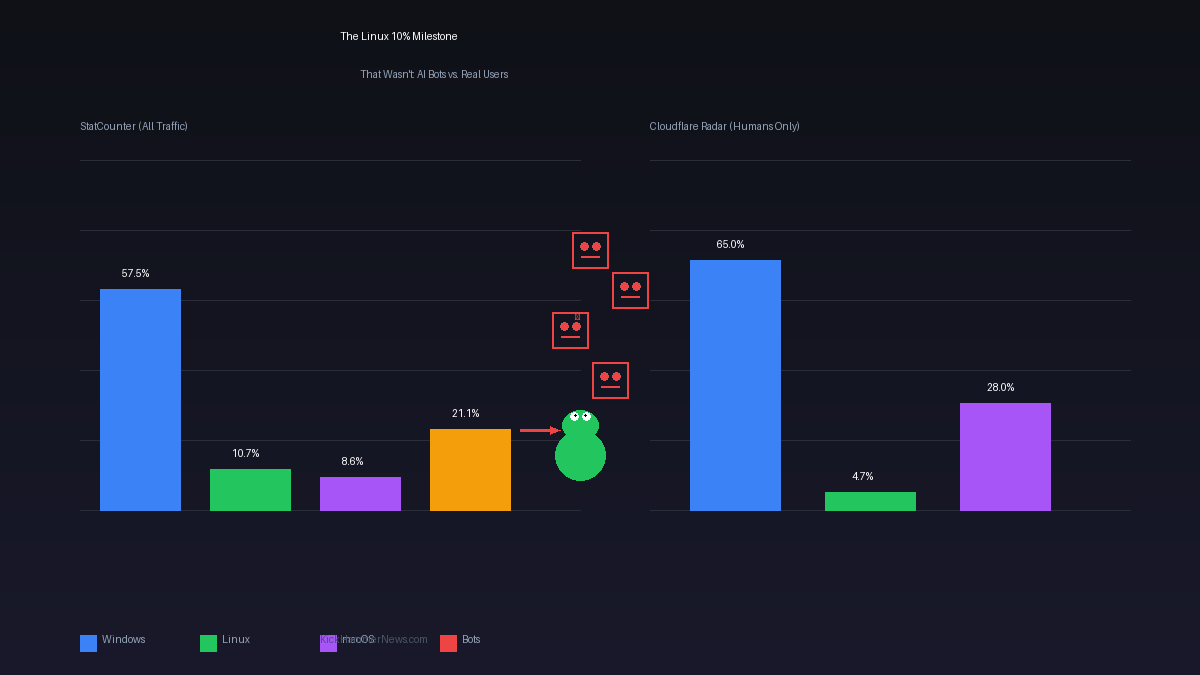
When StatCounter released its July 2026 desktop OS market share report, the data showed Windows at 57.54%, Linux at 10.65%, macOS at 8.6%, and — here’s where it gets strange — something called “OS X” at 21.14%. For anyone paying attention, that last figure should have triggered immediate skepticism.
OS X, Apple’s desktop operating system, was rebranded as macOS back in 2016. The idea that a discontinued OS label accounts for 21% of North American desktop traffic in 2026, while the current macOS sits at just 8.6%, is not just implausible — it’s a data artifact. Something is generating enormous volumes of web traffic that claims to be running a decade-old Apple OS. That something almost certainly isn’t humans sitting at vintage MacBook Airs.
Yet the Linux number went viral anyway, spawning headlines about 2026 being the “year of the Linux desktop” — a phrase that has been deployed optimistically in the Linux community every year since roughly 1998.
What StatCounter Actually Measures
The confusion stems partly from how StatCounter works, and how it’s consistently misrepresented. StatCounter is an analytics platform that webmasters install on their sites instead of, or alongside, Google Analytics. It publishes global “market share” data based on page views collected from more than a million member websites.
That’s an important distinction. StatCounter counts page views, not individual people, not physical devices, and not actual installed operating systems. Its own FAQ spells this out plainly: “We base our stats on page views (and not unique visitors) — we feel that this gives the fairest approximation of internet usage.”
The consequence is significant. If automated systems — bots, web scrapers, AI crawlers, or any agent that identifies itself as running Linux — suddenly begin generating large volumes of page views to StatCounter-tracked sites, Linux’s reported “market share” rises. Windows and macOS shares drop proportionally, because the whole system adds up to 100%. None of this means a single person uninstalled Windows.
StatCounter has produced similar anomalies before. In 2025, it briefly suggested Windows 7 was gaining users while Windows 11 was in decline — a result that prompted a wave of “Windows 11 is failing” articles before the data was corrected. Earlier reports showed Windows 8.1 spiking mysteriously in certain regions. Last year, StatCounter data seemed to indicate Google had lost roughly ten percentage points of search market share to ChatGPT — what turned out to be a reporting error during a quarter when Google had one of its strongest performances.
The pattern is consistent: a dramatic anomaly appears, the tech press amplifies it, and a quieter correction follows weeks later.
The Cloudflare Test
Investigators looking for independent verification turned to Cloudflare Radar, which draws on traffic data from one of the internet’s largest DNS and security infrastructure providers. Cloudflare also showed a Linux spike in the same timeframe — which initially seemed to confirm the StatCounter numbers.
But Cloudflare has a feature StatCounter lacks: the ability to separate human visitors from automated traffic.
When Windows Latest analyst Mayank Parmar applied the human-only filter to Cloudflare’s North American desktop data, the Linux surge collapsed. With bots included, Linux accounted for 16% of traffic on average, spiking as high as 26% on individual days. Filter to human traffic only, and Linux falls to approximately 4.7% — consistent with its gradual, organic growth trajectory over recent years. Windows holds roughly 65% of human desktop traffic. macOS sits around 28%.
The bot/human divide tells its own story. In the automated traffic breakdown, Linux and Windows move as near-perfect mirror images of each other, correlating at approximately -0.91. When bot-attributed Linux traffic goes up, Windows traffic drops by almost the same amount. macOS barely moves. This is precisely the pattern you’d expect if AI agents, scrapers, or crawlers are sending traffic under Linux user-agent strings — not a genuine desktop OS adoption event.
What’s Actually Happening
The most accurate interpretation of these numbers isn’t that 2026 is the year of the Linux desktop. It may be the year that bot traffic overtook human traffic on significant portions of the web.
AI crawlers, automated testing pipelines, large language model training scrapers, and a proliferating ecosystem of agentic software are generating an increasingly large share of internet page views. Many of these systems run on Linux servers or Linux-based environments, and their HTTP requests include Linux user-agent strings. When those requests hit StatCounter-tracked websites, they register as Linux “users.”
The implications extend well beyond operating system market share debates. If bot traffic is now substantial enough to move StatCounter’s global statistics by multiple percentage points, it raises serious questions about the reliability of web analytics as a whole. Advertising click-through rates, content engagement metrics, A/B test results — all of these depend on some reasonable assumption that web traffic reflects human behavior.
Cloudflare’s data on total versus human-only traffic suggests that a meaningful portion of what the internet measures as activity is actually automated. This isn’t a Linux problem or a Windows problem. It’s an internet infrastructure problem.
Linux Is Growing — Just Not That Fast
None of this means Linux desktop adoption is stagnant. The platform has made genuine gains, driven by converging factors: Windows 10’s end-of-life deadline pushing users to reconsider their options, Steam’s continued investment in Proton compatibility for gaming, improvements in hardware support, and growing privacy concerns about AI features being embedded into Windows 11.
Cloudflare’s human-filtered data puts Linux at roughly 4.7% of North American desktop traffic — still a meaningful number for an operating system that spent most of its desktop history in the 1-2% range. Organic growth is real. It’s just not the explosive viral moment the StatCounter numbers suggested.
The distinction matters for realistic expectations on both sides of the debate. Linux advocates deserve accurate credit for genuine progress, not a statistic inflated by AI bots that will be quietly corrected in next month’s report. Windows users deserve equally accurate reassurance that their platform hasn’t suddenly shed tens of millions of users overnight.
The Bigger Picture
The episode is a reminder that data, even publicly available data from well-known sources, requires context and skepticism. StatCounter serves a legitimate purpose as a web analytics platform. It was never designed to be a definitive census of desktop operating systems, and its own documentation says as much.
The challenge is that easily digestible statistics travel fast. A number that seems to confirm an existing narrative — in this case, that Windows is declining and Linux is rising — will be amplified before anyone checks the methodology. By the time the correction appears, the original claim has already completed its viral lap.
As AI-generated traffic continues to grow, distinguishing signal from noise in internet statistics is going to get harder, not easier. The Linux market share spike of July 2026 may be remembered less as a milestone and more as an early, visible example of the problem. The internet’s data about the internet is increasingly being shaped by systems that aren’t human — and our analytics infrastructure is only beginning to catch up.
Sources: Windows Latest (August 3, 2026), PCWorld (August 3, 2026), HotHardware, StatCounter Global Stats, Cloudflare Radar